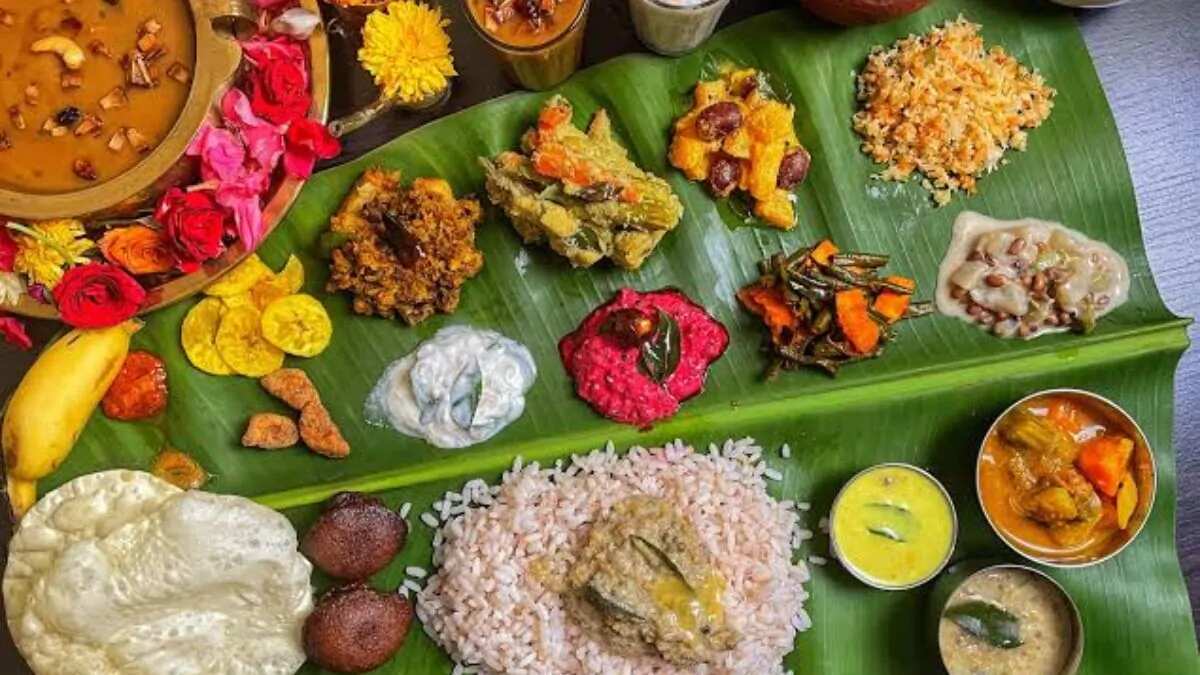
This piece is, above all, written in honour of the greatest chef I know — who also happens to be my wife, Ramya.
She is the person who brought the real Onam Sadya into my life. The Sadya may be an elaborate ritual of memory, food and belonging, with its own precise grammar of dishes and courses, but for me it became something much simpler and more intimate: a family tradition that entered our home after our marriage.
Ramya is half Nair, half Iyer, and entirely brain and culinary artist — which probably explains why her Sadya respects tradition without ever becoming imprisoned by it.
Every Onam, she takes over the kitchen for the better part of two days and, almost single-handedly, produces more than thirty dishes for the family. The operation begins well before the cooking. Banana leaves, chips and some of the other essentials are sourced from the old Nair shops around Santacruz Market. But once the ingredients enter our home, the Sadya becomes unmistakably hers.
Her parippu is to die for — and considering that parippu and ghee traditionally open the meal, that is a fairly consequential compliment. And because she married a man with an unreasonable affection for potatoes, that great American immigrant to Indian cuisine invariably manages to insinuate itself somewhere onto our otherwise Malayali banana leaf. Tradition, after all, survives partly because every family quietly makes it its own.
And then there is Ramya's other culinary heresy — or genius, depending on one's point of view.
She has mastered the art of creating a meat-and-seafood Sadya: taking the architecture, abundance and theatre of the traditional feast and reimagining it through fish, prawns and meat. I was the extremely fortunate recipient of one such magnificent spread on my last birthday.
But that deserves an essay of its own.
For now, this one belongs to the woman who taught me that the Onam Sadya is not merely something one eats. It is something a family inherits, adapts and eventually calls its own.
The history belongs to Kerala. The Sadya in our home belongs to Ramya.
“If the king cannot be visited, the feast is brought to him."
Image credit: Pexels
I. A Meal That Remembers A King
There are feasts that celebrate a harvest, and there are feasts that celebrate a homecoming. The Onam Sadya of Kerala is unusual in that it insists on being both at once — a table laid not merely for the turning of the agricultural year but for the annual return of a king who, by every account handed down to us, no longer has a kingdom to return to. That a civilisation should build its most elaborate act of hospitality around receiving a ruler it lost more than two millennia ago, in myth if not in measurable history, tells us something about how Kerala has always understood the relationship between memory, food and belonging. The Sadya is not consumed so much as it is performed — a ritual reading of a story that the state tells itself every Chingam, the Malayalam month that falls across August and September, using coconut, jaggery, banana leaf and a grammar of courses so precise that it functions almost as liturgy.
To understand why a vegetarian banquet of twenty to almost sixty dishes, served without plates, eaten with the right hand while seated on the floor, has become the single most legible expression of Malayali identity — at home and across a diaspora that stretches from Kochi to the Gulf, from London to Bengaluru — one has to go back past the recipes to the myth that authorises them, and then forward again through the temples, the palaces, the feudal households and the modern nation-state that each, in turn, took custody of the story and reshaped the meal in their own image.
II. The Myth: A Demon King Kerala Refuses To Forget
The central narrative of Onam is, on its surface, a story about the humbling of a king. Mahabali — grandson of the devoted Prahlada, and by lineage an asura, a being conventionally cast as an adversary of the gods in the wider Puranic universe — ruled a Kerala remembered in folk memory as a land without hierarchy, want or dishonesty. The couplet that every Malayali child learns, roughly rendered, imagines a golden age under Maveli's rule where all people were considered equal and none went hungry. Threatened by Mahabali's growing power and popularity, the deva Indra is said to have appealed for intervention, and Vishnu descended in his fifth incarnation as Vamana, a diminutive Brahmin ascetic, to visit the king during a great sacrifice. Vamana asked for only as much land as he could cover in three strides. Mahabali, true to a sovereign's duty of generosity toward a mendicant, granted the wish — whereupon Vamana grew to cosmic scale, covering the earth with one stride and the heavens with the second. With no space left for the third, Mahabali offered his own head, and was pressed down into the netherworld, Patala. Moved by this final act of surrender, Vishnu granted him one boon: permission to visit the people he had once ruled, once every year, on the star of Thiruvonam.
What makes this story culturally distinctive is not its structure — the myth of Vamana's three strides recurs across Puranic literature well beyond Kerala — but the emotional weight Malayalis have chosen to place on it. Elsewhere in the subcontinent this episode is typically read as a triumph of dharma over an overreaching demon. In Kerala, the sympathy of the story is inverted: Mahabali is not vanquished so much as martyred, remembered as Onathappan, a beloved and just ruler whose loss is mourned even as his subjects assure him, gathered on the family sadya leaf each year, that they remain prosperous, honest and well-fed in his honour. Onam, at its mythic core, is Kerala performing contentment for a king it still misses.
Image credit: Pexels
III. Before the Myth: What the Historical Record Actually Shows
Strip away the theology and the documentary trail suggests Onam's roots reach back at least to the early centuries of the Common Era, and possibly further. Scholars of Sangam-era Tamil literature point to Maturaikkanci, a poem associated with that classical corpus, as containing what is regarded as the earliest surviving reference to an Onam-like celebration — one that, intriguingly, situates the festivities not in present-day Kerala but around Madurai, in the bright fortnight of the month later corresponding to Chingam. Kerala historians have separately argued that inscriptional and literary evidence places related festivities in Madurai and Tirupati centuries before Kerala, as a distinct political geography, fully existed in its modern form. The likeliest reading is that Onam began life as a harvest and temple festival broadly shared across the old Tamil-speaking macro-region, and was gradually absorbed into and reoriented around the specifically Malayali Mahabali narrative as Kerala's own political and temple culture consolidated in the medieval period.
The most concrete anchor for this consolidation is epigraphical: temple records at Thrikkakara, near present-day Kochi, are cited as containing one of the earliest firm references to Onam as an organised festival, dated to the ninth century CE. From that point on, the historical and the mythic trails converge at a single site — a modest temple that would go on to define how the festival was governed, patronised and eventually distributed to every household in Kerala.
Image credit: Pexels
IV. Temple Patronage: Thrikkakara And The Politics Of A Festival
The Thrikkakara Vamanamoorthy temple, dedicated exclusively to Vishnu in his Vamana form and counted among the 108 Divya Desams sacred to Vaishnavites, occupies the ground tradition holds to be the very spot where Mahabali was pressed into the netherworld — the place-name itself is said to derive from Trikalkkara, "the sacred place of the foot." For centuries this was not merely a shrine but the administrative heart of Onam. Chronicles associated with the Chera dynasty describe the emperor Cheraman Perumal convening a month-long gathering at the temple each year, running from the Thiruvonam asterism in the preceding month of Karkidakam through to Thiruvonam in Chingam, with the culminating ten days recognisable as the Onam most
Malayalis celebrate today. Fifty-six local kings, sixty-four village chieftains and assorted nobility were expected to attend without fail. The arrangement was as much statecraft as devotion: a sovereign using a religious calendar to compel an annual muster of every feudatory power in the land. When distance or circumstance made it impossible for a chieftain to present himself at Thrikkakara, the emperor is said to have decreed that Onam be observed instead in every household under that chieftain's charge, with an image of the Thrikkakara deity installed in the home — the origin, many trace, of the clay Onathappan figures still placed at the centre of the pookalam today. A festival of centralised royal assembly was thus, by administrative necessity, distributed into a festival of domestic worship, and it is that second, domesticated form that survived into the present.
Royal involvement did not end with the Cheras. After the region passed from the Kingdom of Kochi following the interventions of Marthanda Varma of Travancore and the East India Company, the Onam festivities at Thrikkakara continued to be jointly organised by sixty-one local Naduvazhis under the leadership of the Travancore Maharaja, an arrangement that persisted until Indian independence. The temple's most visible surviving royal ritual is the Athachamayam procession at Tripunithura, once the ceremonial departure of the Cochin royal family — accompanied by caparisoned elephants, martial troupes and the classical and folk performance traditions of the region — marching, at least symbolically, toward Thrikkakara to mark the start of the ten-day cycle. The temple today falls under the administration of the Travancore Devaswom Board, and its own Onam Sadya, while less extravagant than a typical household feast, is considered by many the closest surviving link to the festival's ritual origins, still built around staples like sambar, kaalan and yam.
A second major site of temple patronage is Aranmula, on the banks of the Pamba river, where the famous Vallamkali snake-boat race on the Uthrittathi asterism is paired with the Aranmula Vallasadya, an elaborate feast offered at the Parthasarathy temple — one of the few contexts in which the sadya's hospitality is extended not merely to family but to the boatmen and pilgrims who converge on the river for the race. Across Kerala's temple economy more broadly, the sadya sits inside a much older ethic of annadanam, the meritorious feeding of the community, which temples of every denomination in India have practised for centuries; Onam simply gave that ethic its most theatrically generous annual expression.
Image credit: Pexels
V. From Feudal Tribute To Domestic Equaliser
Beneath the temple ritual lay a harder economic reality that the mythology has, over time, gently absorbed and softened. In the agrarian order that persisted in Kerala well into the colonial period, Onam coincided with Onam kazhcha — a customary tribute of grain, produce, cloth and coin rendered by tenants and lower functionaries to landlords, temple authorities and the crown, timed precisely to the festival calendar. The lavishness of the Onam feast in a landlord's household, in other words, was underwritten in real terms by an extraction of surplus from those who worked the land, and access to a full sadya, historically, correlated closely with caste and landholding status; the elaborate, multi-course feast was for centuries more attainable in an upper-caste or landed household than in the huts of agricultural labourers, many of them Dalit and Ezhava communities, whose own Onam observance was often far more modest.
This is worth stating plainly because the twentieth-century civic narrative of Onam — the festival as a great social leveller, a day when caste and class dissolve at the table — is a genuinely important ideal, but one substantially built atop, and in some tension with, an older and more stratified reality. What changed it was a combination of land reform in post-independence Kerala, the erosion of the old jenmi landlord system, the state's deliberate promotion of Onam as an official, secular harvest festival from 1961 onward, and a Malayali diaspora economy — first to the Gulf, later worldwide — that gave ordinary households the disposable income to reproduce a feast once associated chiefly with palace and temple kitchens. The sadya most Malayali families sit down to today, generous and unhierarchical in spirit, is in that sense a genuinely modern achievement layered over an old ceremonial form — not a survival of egalitarian antiquity so much as a hard-won, twentieth-century democratisation of what had long been an aristocratic and priestly table.
Image credit: Pexels
VI. The Architecture Of The Leaf
A sadya is served on a fresh banana leaf, its narrower, tapering end pointed to the diner's left — a convention rooted in ideas of auspiciousness, hygiene and biodegradability that long predate the modern vocabulary of sustainability now used to explain it. Each dish has an assigned coordinate on the leaf, refined over generations into something close to a fixed grammar: salt and pickles near the top left, chips and banana at the top right, the array of vegetable preparations arranged across the upper half, with rice and its accompanying curries — dal, sambar, rasam, buttermilk-based pulissery — occupying the lower, larger portion of the leaf where the meal's real business is conducted. The sequence of service is itself ritualised. Parippu curry, a simple lentil preparation finished with ghee, opens the meal; sambar follows with the first serving of rice; the tart, buttermilk-based pulissery or moru curry typically closes the savoury courses before payasam is brought out. A sadya is not so much assembled as conducted, one course displacing the last in a fixed order that every Malayali diner carries in memory without needing to be told.
VII. The Dishes And Their Origins
Rice, usually the parboiled, russet-hulled Kerala matta or rosematta variety, is the sadya's material centre — the harvest itself, offered back as food, and the reason Onam is inseparably a harvest festival regardless of its mythic overlay. Parippu curry, a mild preparation of cooked moong dal finished with ghee and a tempering of cumin, is thought to be among the oldest and simplest elements of the meal, its restraint deliberately setting up the richer courses to follow. Sambar, the tamarind-based lentil and vegetable stew, occupies a curious place in food history: culinary historians widely trace its popularisation to the Maratha court of Thanjavur under Shahuji, whose kitchens are credited with adapting a Marathi dal preparation to local Tamil ingredients in the seventeenth century — after which it travelled south and west along trade and migration routes into Kerala's own cuisine, where it was fully naturalised long before living memory. Rasam, a thinner, peppery tamarind broth, shares sambar's broadly Tamil-country lineage and appears in a sadya far less consistently than sambar does — many traditional Malayali households omit it altogether, regarding it as a later, optional addition rather than a core dish. Avial, arguably the sadya's signature preparation — a medley of vegetables in a thick, minimally spiced coconut and curd gravy — carries its own foundational legend: popular Kerala folklore credits its invention to Bhima, the Mahabharata's second Pandava, who during the brothers' exile is said to have improvised the dish from whatever vegetable scraps were at hand while working incognito as a palace cook. Culinary historians treat this as charming rather than literal, and note avial's documented rise instead through the Tamil Brahmin, particularly Palakkad Iyer, culinary tradition that has long straddled the Kerala-Tamil Nadu border, from where it was absorbed fully into Malayali festive cooking.
Thoran, a dry stir-fry of finely chopped vegetables — cabbage, beans, yam or raw plantain — with grated coconut, represents the sadya's most everyday register: a preparation eaten in Malayali homes on any ordinary day, elevated for Onam mainly by the number of vegetable varieties offered together rather than by any special festive technique. Olan, a pale, gently sweet stew of ash gourd or white pumpkin and red cowpeas simmered in coconut milk, is prized precisely for its lack of assertive spicing, functioning almost as a palate rest between the more piquant courses around it. Kaalan, a thick, yoghurt-based curry of yam or raw plantain, is regarded in the northern parts of Kerala as the true anchor of the meal — tradition holds that a properly thickened kaalan, poured into the cupped palm, should not run between the fingers, and diners are expected to finish the meal with a final serving of kaalan and rice. Erissery, pumpkin or yam cooked with black-eyed peas and a coarse, roasted coconut paste, and often finished with a tempering of coconut oil and curry leaves, sits in a similar register to olan but with a nuttier, earthier profile from the roasted coconut. Kootu curry, combining yam, ash gourd or raw plantain with Bengal gram and roasted coconut, is considered one of the more labour-intensive preparations, traditionally reserved for festive occasions rather than daily cooking.
Pulissery and moru curry, buttermilk-based preparations sometimes studded with ash gourd, pineapple or ripe plantain, close the savoury arc of the meal; the plain, well-spiced buttermilk that follows is a digestive as much as a dish, cutting through the coconut and ghee that dominate the courses before it. Kichadi and pachadi — the former a savoury, curd-based preparation typically built around bitter gourd or cucumber, the latter its sweeter cousin made with pineapple, mango or beetroot in a coconut-curd base — provide the meal's principal notes of tang and sweetness, and their side-by-side presence on the leaf is often cited as sadya's own internal argument for balance. Inji curry and puli inji, ginger cooked down with tamarind, jaggery and chilli into a thick, condiment-like relish, function as the meal's palate cleanser and are traditionally credited with settling the stomach against the sheer richness of everything else on the leaf. Pickles — of mango, lime or ginger — and pappadam, the thin, fried lentil wafer, are late but now indispensable additions, their crunch offering textural relief against a meal otherwise dominated by soft, coconut-thickened curries. Banana chips (upperi) and sharkara varatti, plantain fried in coconut oil and, in the latter case, coated in a jaggery caramel, draw on Kerala's centuries-old commercial relationship with the Nendran banana and the coconut palm, two crops whose cultivation history in the region long predates any written record of the Onam festival itself. Payasam, the sweet, milk- or coconut-milk-based dessert that closes the meal, is offered in several forms — palada payasam, made with milk and rice flakes; ada pradhaman, jaggery-sweetened and built on rice-flour ada and coconut milk; and semiya or vermicelli payasam among others — and a full sadya traditionally serves at least two varieties side by side. Several of Kerala's most celebrated payasam traditions are themselves temple products: the Guruvayur temple's ada pradhaman and the Aranmula Vallasadya's own payasam are both cited by food historians as having shaped the versions now made in ordinary homes, another instance of temple kitchens quietly setting the standard for domestic festive cooking.
Image credit: Adobe Stock
VIII. Culture, Community And The Question Of Whose Festival This Is
Though its mythology is unmistakably Hindu, Onam in practice has functioned for generations as one of the few genuinely cross-community festivals in India — observed with real enthusiasm by Kerala's substantial Christian and Muslim populations, who join in the pookalam, the sadya and the associated cultural events without the festival requiring any theological buy-in to the Mahabali story. Some accounts even trace elements of Pulikali, the tiger-dance procession now most associated with Thrissur, to a Muslim community's parading tradition that was gradually folded into the wider Onam calendar over the past two centuries. That absorptive, low-friction quality — a Puranic myth wearing the loose costume of a civic harvest holiday — is arguably why the Kerala government was able to formally adopt Onam as the state's official festival in 1961 without controversy, positioning it as a marker of Malayali identity first and a religious observance second.
The diaspora has, if anything, intensified the sadya's symbolic weight. For Malayalis working in the Gulf, in North America, in Bengaluru's technology corridors or in cities like London, the Onam Sadya has become the single most reliable annual occasion for reconstructing home in miniature — associations and restaurants from Dubai to Chicago now compete each August to offer the most complete leaf, sometimes running to thirty dishes, precisely because the meal functions less as nutrition than as memory made edible. To lay out a sadya in a rented banquet hall eight thousand kilometres from Thrikkakara is to re-perform, however unconsciously, the same gesture that a Malayali household five hundred years ago made when it could not send its chieftain to the temple: if the king cannot be visited, the feast is brought to him.
IX. Coda
What endures across the myth, the epigraphy, the royal ledgers and the modern diaspora hall is a single, oddly moving proposition: that the best way to honour a lost golden age is not to mourn it but to cook it, once a year, in extravagant detail, and to sit down together, on the floor, on a leaf, and eat it as though the king might, this year, actually be watching.
Compiled as a historical and cultural essay on the Onam Sadya — sources include temple records, Sangam-era literary references, Kerala tourism and food-history documentation, and standard accounts of the Mahabali–Vamana legend.