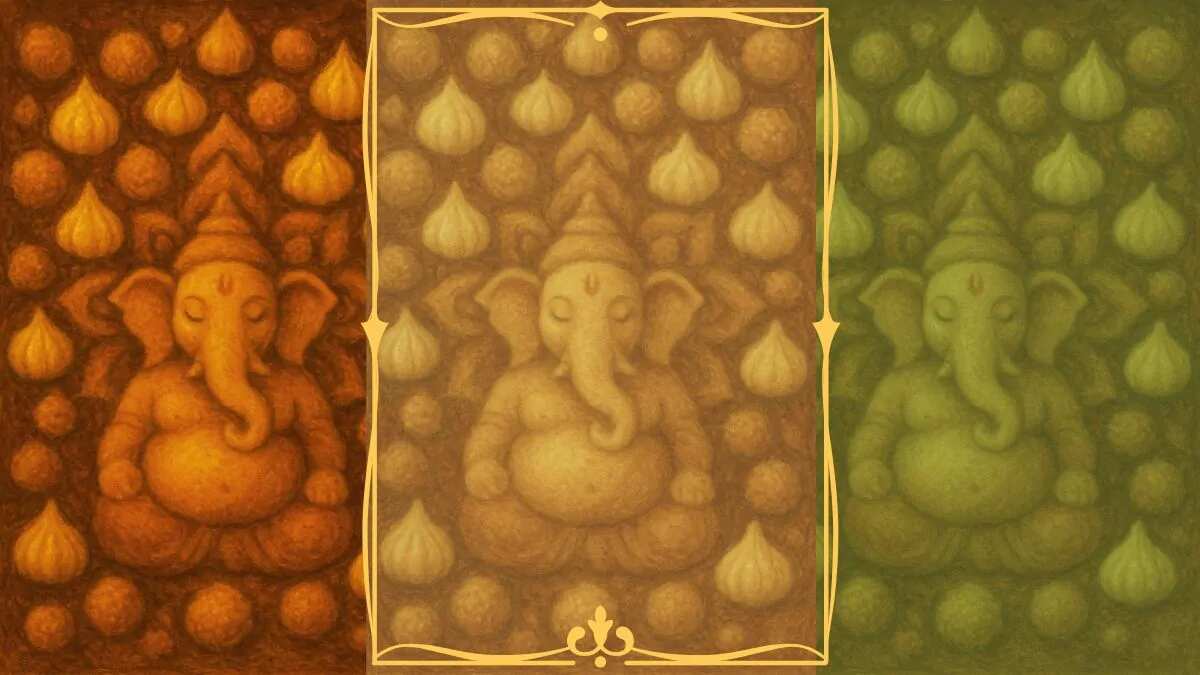
AT THE START OF GANESH CHATURTHI, the air fills with the fragrance of sweets made for the elephant-headed god. Most beloved among them is the modak, a dumpling with a molten heart of jaggery and ghee, long considered his favourite. In Maharashtrian homes, the fragrance of steaming rice flour, jaggery, and coconut is a mark of Ganpati’s arrival. These dumplings — ukadiche modak — arrive in batches of twenty-one, placed reverently before Ganesha. The sweet, with its molten heart of jaggery and ghee, is believed to be his favourite. But Ganesha’s reputation as a lover of food stretches far beyond the kitchen. In story after story, hymn after hymn, the god of wisdom and beginnings reveals himself as an unabashed gourmand.
A Belly That Holds the World
Hindu texts rarely describe Ganesha without invoking his round belly. In the Mudgala Purana, it is called a vessel for the universe — capacious enough to hold joy, sorrow, creation, and dissolution. Food, then, becomes the natural metaphor for that plenitude. His fondness for sweets and rice flour dumplings is not a weakness but an allegory: the divine appetite that consumes contradictions and holds them together.
The Ganapati Atharvasirsha, a Sanskrit hymn, makes this explicit. It calls him 'modaka-priya,' lover of sweets, and describes him as the one who ensures prosperity through abundance. To feed Ganesha is to acknowledge both the god’s cosmic hunger and his deeply human cravings.
The Night the Moon Laughed
Perhaps the most vivid tale of his appetite is the one about the moon. After a lavish feast on his birthday, Ganesha mounted his mouse to return home. Overstuffed, his belly split open, spilling food on the path. Calmly, he gathered it back, cinching his stomach with a snake as a makeshift belt. Watching from the sky, Chandra the moon god burst into laughter. Offended, Ganesha cursed him: anyone who looked at the moon that night would face false accusations.
To this day, on Ganesh Chaturthi, many avoid looking at the moon. Yet beneath the cosmic curse lies an image almost comic: a god who, in his eagerness to eat, forgets restraint — a reminder that divinity can be both majestic and endearingly flawed.
When Wealth Wasn’t Enough
Another tale tells of Kubera, the god of riches. Keen to flaunt his opulence, Kubera invited Ganesha to a banquet. But the boy-god devoured everything in sight: rice, sweets, vegetables, grains. When the kitchens lay bare, he demanded more. Kubera panicked — what if Ganesha turned his hunger toward him? In desperation, he sought Shiva’s counsel. Shiva offered a simple solution: a bowl of parched rice, given with humility. Ganesha ate it contentedly, his hunger finally stilled.
The parable has travelled centuries not only as a lesson in modesty but also as a meditation on appetite: that what satisfies is not excess but sincerity.
The Modak as Cosmic Sweet
Every regional kitchen has made this myth its own. In Tamil Nadu and Karnataka, kozhukattai takes the form of crescent dumplings offered to the god. In Odisha, rice cakes called pitha are shaped for him. In Bengal, where Ganesha is part of Durga’s household, nadus of coconut and jaggery echo his sweet tooth.
Each of these is not just an offering but a reenactment of myth. When devotees steam rice flour, fill it with molten jaggery, and fold the edges carefully, they are recalling the Atharvasirsha’s image of Ganesha as “modaka-priya.” The food is theology in edible form.
Appetite as Allegory
If we gather these stories together, a pattern emerges. Ganesha’s hunger is not frivolous. It signals his cosmic role: a deity who does not renounce the pleasures of the senses but sanctifies them. His belly represents the universe; his sweets, the sweetness of wisdom; his feasts, the fullness of life itself. In making food central to his mythology, Hindu tradition proposes that the sacred is not separate from appetite — it is expressed through it.
The Sweet That Endures
In kitchens today, this mythology continues. Families still gather to shape dumplings for him, telling children the tale of the laughing moon or the humbled Kubera. The sweets are eaten after being offered, their taste lingering long after the ritual. Through them, the myths survive: stories folded into dough, cooked in steam, offered to a god who, unlike most, could never resist a second helping.