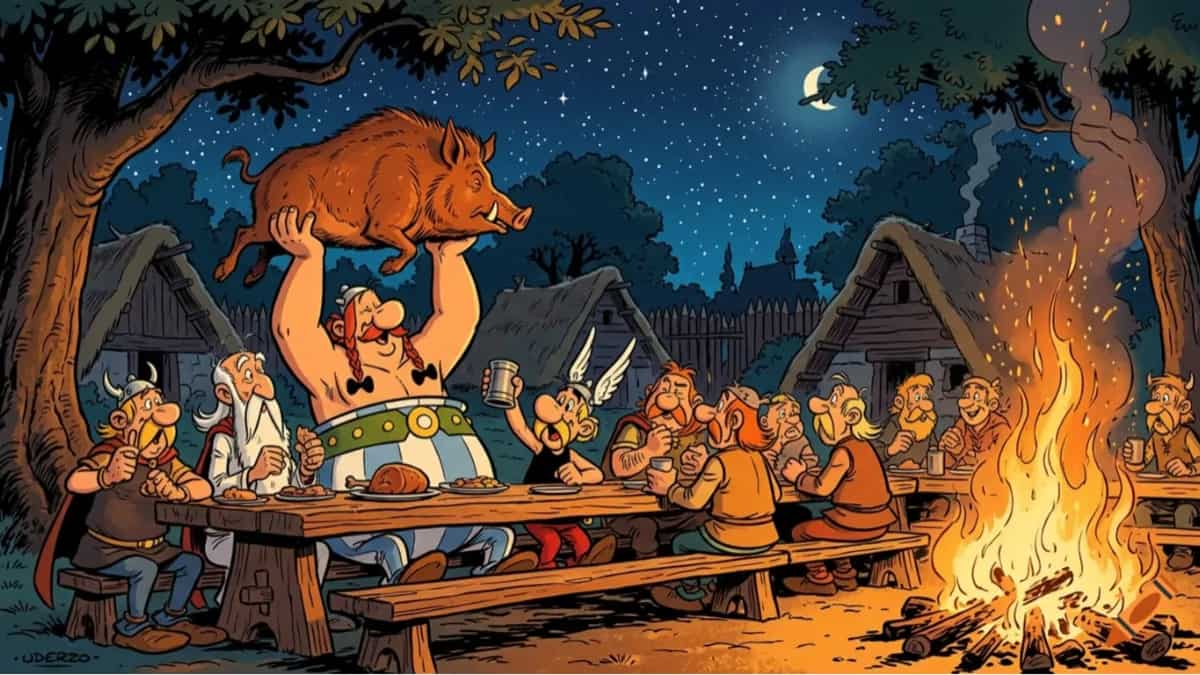
Editor’s note: 2026 is a big year in the Gaulish village. René Goscinny, the writer of Asterix, would have turned 100 in August; The Twelve Tasks of Asterix turned 50 in October; and a new animated film, Asterix – The Kingdom of Nubia, reaches French cinemas on 2 December. To mark the year, Slurrp is serialising The Great Asterix Feast, a six-part essay on what, how and why everyone eats in Asterix. This is part one.
I SHOULD BEGIN with a confession that will sound absurd to anyone raised in Europe and perfectly ordinary to anyone raised where I was: I had never tasted pork before Asterix.
Not a rasher. Not a sausage. Not the ghost of a chop. In the South Bangalore of my childhood, pork simply did not appear on the table, and the question of whether it should was not one anybody thought to raise. It belonged, if it belonged anywhere, to other people’s kitchens. Which is why the single most exotic object in the Asterix books — more exotic than Roman galleys, Egyptian pyramids, Norman longships or the fakir’s flying carpet — was the animal slung over Obelix’s shoulder on almost every other page.
The wild boar. Le sanglier. Drawn by Albert Uderzo as a bristling, grinning, slightly indignant creature in life, and as a glistening bronze mountain of meat in death, laid out on a wooden trestle with its trotters in the air and a haze of steam rising off it like incense. I had no idea what it tasted like. I had never seen one. I was not entirely sure, at eight, that they were real. But I knew, with the certainty children reserve for things that matter, that it must be the most delicious thing on earth, because Obelix — who had access to the whole of the known world and who was not a man of delicate judgement — wanted nothing else.
That is how a comic strip about a village in Armorica in 50 BC ended up, some years later, with me ordering pork in a restaurant with a nervousness usually reserved for proposals of marriage. It was fine. It was, honestly, a bit dry. Nothing in my life has ever tasted the way that drawing looked. I am not sure anything could.
There is a second confession. For a period of my adult life I bore a reasonably convincing physical resemblance to Obelix, and I would like to say that circumstances have since altered beyond recognition. I would like to say that. What I can say is that I have always felt the affection of a fellow traveller for a man whose response to the phrase “you’re fat” is genuine, wounded bewilderment, and whose answer to almost every problem the ancient world can throw at him is a second helping.
This essay is my attempt to repay the debt. Because the more I have re-read these books as an adult — and I have re-read them, in two languages, more times than is respectable — the more convinced I have become of something that sounds like a joke and isn’t: no comic strip in history has made eating as important to its universe as Asterix. Not as decoration. As architecture.
WHY 2026 IS A REMARKABLE YEAR TO REVISIT ASTERIX
• René Goscinny at 100. The writer of Asterix was born in Paris on 14 August 1926. His centenary is the occasion for this essay: not merely the man who wrote Asterix, but one of the great comic writers of the twentieth century.
• The Twelve Tasks of Asterix turns 50. Released in October 1976, it was not an adaptation of an existing album but an original story written for the screen by Goscinny and Uderzo through their own Studios Idéfix — the second and last animated film the two creators directed themselves. Éditions Albert René has marked the anniversary with a special illustrated edition of the story.
• Asterix in Britain at 60. First published in 1966 — the album that turns the most on food, and the one that would give Anthea Bell her strangest translation problem.
• Obelix and Co. at 50 (1976), and Asterix the Gaul at 65 (1961) — the first album, where the first food joke in the canon is about strawberries.
• Anthea Bell at 90. The English translator of Asterix was born on 10 May 1936; she died in October 2018. Ninety years on, her jokes are still the ones British children read.
• Asterix and the Vikings at 20 (2006), and a new animated feature, Asterix – The Kingdom of Nubia, due in French cinemas on 2 December 2026.
• A living series. The 41st album, Asterix in Lusitania (Fabcaro and Didier Conrad, October 2025), has sold more than 1.6 million copies, by its publisher’s count. The village is still eating.
WHAT FOOD ACTUALLY DOES IN ASTERIX
Every Asterix album is shaped like a stomach. Something is ingested — a Roman plot, a foreign errand, a threat to the village — it is digested, at length and with violence, and then everything returns to the long table under the stars. The banquet is the full stop. A reader who has never opened an Asterix book knows that it ends with a feast, in the way a reader who has never opened a fairy tale knows it ends with a wedding.
But food does far more than close the book. Consider how much work it is doing at any given moment.
• Food establishes character. Obelix eats differently from Asterix: without pause, without embarrassment, and without the slightest interest in what the food is called. Asterix eats like a man who would rather be planning. Getafix eats like a man who has to be reminded.
• Food establishes geography. You know you have arrived in a new country because of what the locals are drinking. Warm beer means Britain. Cheese with holes means Switzerland. Cream on everything means the Normans. A dish is the passport stamp.
• Food establishes the stereotype — usually affectionately, occasionally mercilessly. Goscinny’s foreigners are defined by their tables before they are defined by anything else, and the joke is almost always that they are proud of exactly the thing the Gauls find inedible.
• Food drives plots. A tour of Gaul collecting regional specialities. A poisoned cake in Alexandria. A boar stall in Condatum that crashes the market because its owners have no idea what a boar is worth. A magic potion that cannot be brewed because an ingredient has run out.
• Food signals order and disorder. When the village fights, it fights over fish. When the village is at peace, it eats boar. The state of the table is the state of the polity.
• Food is hospitality, and hospitality is the plot. Nearly every foreign adventure turns on someone offering the Gauls a meal — and the Gauls’ faces as they eat it.
Above all, food creates the ritual of Asterix. The adventures are centrifugal: they fling the heroes outward across the Roman world. The banquets are centripetal: they pull everyone back to the fire. Rome may hold all of Gaul but one small village. Rome does not hold dinner.
THE WILD BOAR: COMIC MYTHOLOGY AND THE ARCHAEOLOGY OF APPETITE
Let us start where Obelix starts. The wild boar is not merely the favourite food of the Asterix universe; it is its currency, its unit of measure and its emotional weather. Boars are carried home in pairs like shopping. They are roasted whole, gnawed to the bone, thrown at Romans, hunted by Dogmatix and, in Asterix in Corsica, pronounced by the locals to be so refined that a mainland boar is scarcely worth the fire. When boar is off the menu — at the spa where Vitalstatistix takes the cure in Asterix and the Chieftain’s Shield, or in a Britain where it is boiled and served with mint sauce — the deprivation is treated as a genuine tragedy, and the comic engine roars.
So here is the historical question, and it deserves a straight answer: did the Gauls actually live on wild boar?
THE SHORT ANSWER: NO — BUT THEY LIVED ON PIG, AND THAT IS THE SAME JOKE TOLD MORE SLOWLY
The archaeozoology of Iron Age and Gallo-Roman sites is remarkably consistent on this point, and the French scholar whose name comes up most often in the literature is Patrice Méniel, whose long-running work on Gaulish animal husbandry, hunting and ritual feasting — notably his study of hunting and stock-rearing among the Gauls — established a picture that has held up: the animal bones from Gaulish settlements are overwhelmingly domestic. Pig, cattle and sheep dominate. Genuinely wild game, including boar, typically appears as a small fraction of the assemblage. Hunting was real, but it was a pastime and a prestige activity rather than a food supply. Obelix, in other words, would have been eating pork most of the time — and a village that ate as many boars as his does would have emptied the forests of Armorica in a season.
What the comic gets right, and it is a lot, is the centrality of the pig. Strabo, writing in the early first century AD, remarks on the quantities of salted pork the Gauls produced and exported, including to Rome; Gallic salted meats were a recognised trade good. Pigs suited the wooded, pannage-rich landscape of northern Gaul, and pork — fresh, salted, smoked — was the Gaulish protein. When Uderzo draws a landscape of sausages and hams, he is drawing something an archaeologist would recognise.
THE FEAST IS THE TRUEST THING IN THE BOOKS
The most striking survival, though, is not a food but a scene. The Greek philosopher Posidonius travelled in Gaul in the first century BC, and although his own writing is lost, later authors preserved his description of a Celtic feast: warriors seated in a circle on the ground, the bravest in the middle, the host beside him; meat boiled in cauldrons or roasted on spits, eaten with the hands; wine for the wealthy and beer for the rest; and — the detail every Asterix reader will recognise with a jolt — a rule that the finest cut of meat, the champion’s portion, went to the bravest man present, and that disputes over who deserved it could escalate to single combat.
A feast that ends in a fight over the meat. Goscinny and Uderzo, with no access to modern archaeology and, one suspects, no great interest in it, arrived at the same image by instinct. The Gauls of the Asterix village are not gluttons because the authors thought that was funny (though it is). They are a warrior society whose central social ritual is the shared feast, and the cartoon version is closer to Posidonius than to any Roman comedy.
DIODORUS, WINE AND THE SLAVE FOR AN AMPHORA
Diodorus Siculus, drawing on the same Greek sources, records the Gauls’ notorious enthusiasm for imported Italian wine — drunk unmixed, to the horror of Mediterranean sensibilities — and the famous, probably exaggerated claim that Italian merchants could obtain a slave in exchange for a single amphora. The archaeology bears out the appetite if not the exchange rate: Italian wine amphorae are found in enormous quantities on late Iron Age Gaulish sites, particularly along the Rhône and Atlantic trade routes. When a Roman in Asterix offers a Gaul a drink, he is doing something historically plausible. When the Gaul prefers his own beer, that too is attested: cervesia is a word the Romans borrowed from Gaul.
ASTERIX VS ARCHAEOLOGY — WILD BOAR
• Comic version: the village eats wild boar daily, whole, roasted over open fires; Obelix eats several at a sitting.
• Historical reality: domestic pig dominated the Gaulish diet; wild boar was hunted but rare on the plate and carried prestige. Whole-animal spit-roasting is attested for feasts; everyday cooking was more often the cauldron.
• Verdict: Plausible exaggeration. Right animal family, wrong wildness, and about ninety-five boars too many.
THE GREAT ASTERIX FEAST: THE SERIES
Next in this series: Part 2: The Last Panel, The Stale Fish And The Secret Potion