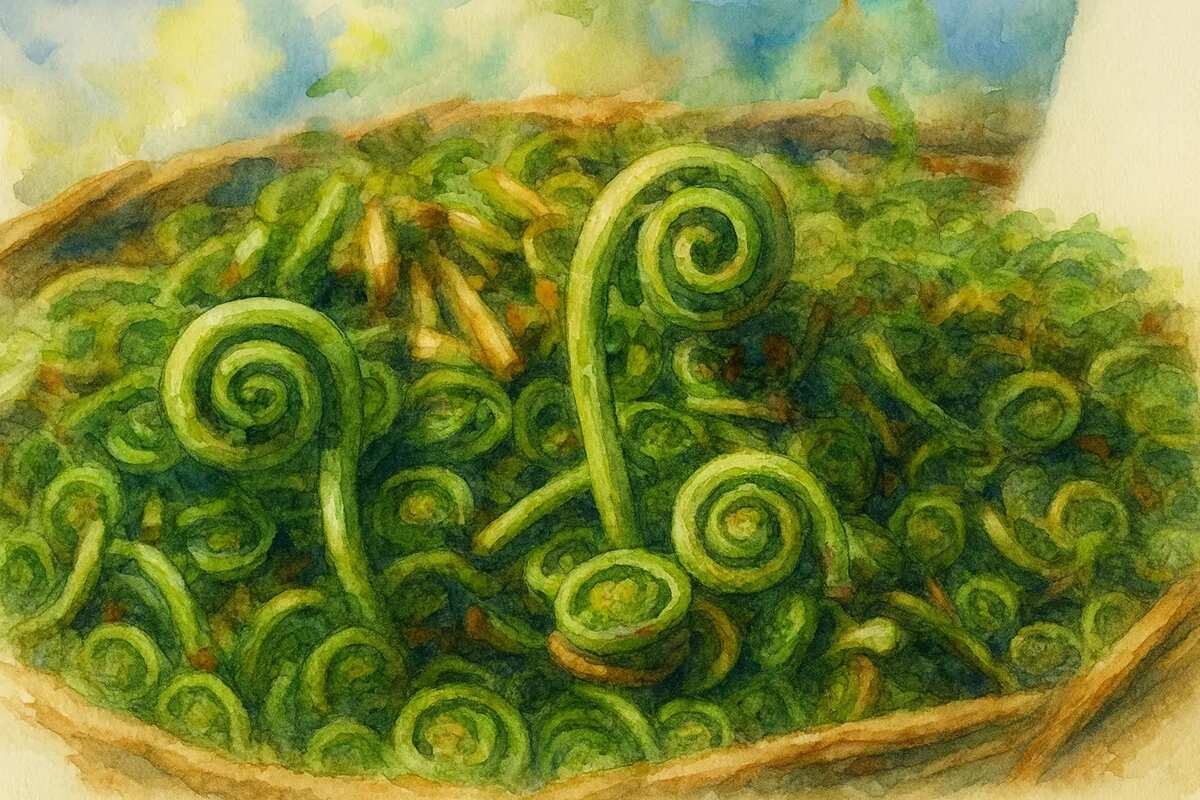
SOME INGREDIENTS announce their arrival with fanfare: mangoes perfuming the air before they are seen, or the first flush of Darjeeling tea that arrives with entire marketing campaigns attached. Others emerge quietly, almost shyly. The fiddlehead fern belongs firmly in the second category. You have to know where to look for it — curled tight like a secret, lingering in the shadowy undergrowth of Himalayan slopes or the damp fringes of forest streams, visible only to those who have learnt the soft choreography of foraging.
Yet this shy spiral is, quite literally, prehistoric royalty. Ferns have existed for nearly 400 million years, long before flowers, fruit, or human beings. When dinosaurs roamed the earth, they munched on early ferns. When early humans scavenged for greens, they reached for the plant’s tender tips. And long before food trends made ingredients “rare”, “seasonal”, or “foraged”, fiddleheads were exactly that — a fleeting marker of spring, appearing briefly and then vanishing into fully grown fronds.
Today, they can be found in farmers’ markets in Maine, in pickles in Jammu, in coconut curries in Indonesia, and in the memories of home cooks across the Himalayan belt. But in India, the fiddlehead fern — known variously as lingri, lingad, limbra, kasrod, dhekia xak, muikhonchok, niyuro, therme thoppu — has its own life story to tell.
What Exactly Is a Fiddlehead? A Fern at Its Most Tender
“Fiddlehead” isn’t a species. It is a moment — the very first chapter of a fern’s springtime life. If left undisturbed, the tightly wound coil would unfurl into a frond in the mesmerising slow-motion curl that botanists call circinate vernation. But at the precise instant when the tip is still tightly spiralled, smooth, and almost succulent, it becomes a delicacy.
Small — usually just 2–3 cm across — and bright green, each fiddlehead feels like a crisp snap waiting to happen. There’s something sculptural about the curls, something both artistic and edible, like nature doodled a Fibonacci spiral just for fun.
When cooked, they surprise you: grassy like asparagus, nutty like broccoli stems, a little woodsy, occasionally tangy depending on the species. The Himachali lingri, for instance, carries a distinctive sourness, while the prized North American Ostrich fern (Matteuccia struthiopteris) is cleaner and more delicate.
Their nutritional résumé is impressive — Vitamin C, iron, fibre, omega-3s and omega-6s, manganese, copper, potassium — making them feel less like a side dish and more like a micro-seasonal superfood.
One caveat: you must cook them. Raw fiddleheads can harbour harmful bacteria or natural toxins found in certain fern varieties. It’s one ingredient that insists on a little respect: rinse, clean, blanch or boil, and only then let it into your curry, stir-fry, or pickle jar.
A Plant Older Than Civilisation: How Humans Met the Fern
The relationship between ferns and humans is ancient, woven into foraging traditions long before agriculture narrowed the human palate. In Northern France, fiddleheads slipped into medieval diets. In Norway, they made their way into beer-making. Across Indigenous North America, tribes such as the Maliseet, Mi’kmaq, and Penobscot harvested spring fiddleheads long before the arrival of Europeans.
By the time Japanese culinary tradition developed its deep appreciation for sansai (mountain vegetables), ferns had become a spring ritual — roasted, sautéed, and even incorporated into sweets like warabimochi. Korea embraced them as gosari, a staple in bibimbap and banchan. In Indonesia, Minangkabau cooks simmered young fronds in coconut-rich gulai paku. In the Philippines, pakô became a bright, refreshing salad with tomato and salted egg. In New Zealand, Māori communities harvested pikopiko, a group of edible fern shoots.
This is an ingredient with passports, languages, and timelines. But it is in India — specifically in the hills of the North and Northeast — where the fiddlehead fern attains a deeply personal, domestic, everyday identity.
The Indian Chapter: A Wild Green With a Hundred Names
Follow the western Himalayas upward in spring and you’ll find vendors selling bunches of lingad in Himachal Pradesh, their hands dusted with the brown papery scales that must be cleaned off each shoot. In Uttarakhand, home cooks wait for limbra season. In Jammu, jars of kasrod ka achaar signal generosity and pride — a pickle so beloved that families gift it when relatives return from the hills. In Assam, where the fern is called dhekia xak, it is one of the most recognisable spring greens. In Tripura, it becomes a bhaja — crisp, savoury, quick. In Manipur, it is cooked with prawns or chicken, melding seamlessly with local protein traditions. In Coorg, therme thoppu appears in humble stir-fries eaten with rice or akki roti.
Across Darjeeling and Sikkim, niyuro is almost household vocabulary — a vegetable, not a novelty. Himalayan cooks never fetishised fiddleheads as precious; they simply recognised them as the first, freshest green after winter’s lull. A seasonal handshake from the forest.
And unlike Western cuisines where fiddleheads often appear as side dishes dressed with lemon or butter, Indian kitchens fold them into daily meals: sabzi, stir-fries, pickles, curries, and even cheese-based preparations in the hills.
Most importantly, their edibility is governed by traditional ecological knowledge — the ability to distinguish safe edible species from potentially toxic cousins. In many regions, only experienced foragers pick them, which is why this ingredient has never fully commercialised in India and still feels like a whisper from the wild.
Pickles, Stir-Fries, and Spring Curries: How India Eats Fiddleheads
If the fiddlehead fern had a wedding album, Indian cuisine would give it many looks.
The Pickle:
In the valleys of Jammu and Himachal, lingri/lingad/kasrod ka achaar is the most famous fiddlehead avatar. Cleaned and blanched shoots are mixed with chilli, mustard oil, spices, and salt, then left to mature. The result is bright, sharp, almost citrusy — a spring preserved in oil.
The Stir-Fry:
Tripuri kitchens turn it into bhaja, a quick sauté with minimal ingredients. Coorgi versions feature coconut and chillies. In Assam, dhekia xak is lightly cooked to keep the fern’s snap intact.
The Curry:
Himachal’s lungru ki sabji is perhaps the warmest expression of the fern — a simple curry made when the slopes begin to thaw, eaten with rice or roti. In parts of Sikkim and Darjeeling, fiddleheads are combined with local cheese for a mellow, milk-kissed dish.
The Protein Pairing
Manipuri cooking often pairs chekoh with eggs, prawns, or chicken, proving that this delicate fern can hold its own against punchier flavours.
In all these variations, the through-line is the same: freshness, seasonality, the thrill of the first green after winter.
Elsewhere in the World: A Shared Seasonal Obsession
If you travel far from India’s hill states, you’ll find the same springtime romance playing out. In New Brunswick, Canada, where the Ostrich fern dominates, fiddleheading is a culture of its own; Tide Head even calls itself the Fiddlehead Capital of the World. In Tokyo, the demand for bracken fiddleheads is so high that imports began arriving from Siberia as far back as the 1980s. Across Japan and Korea, April and May are marked by the gathering, preparing, and cooking of ferns — a way of tasting the mountains before the heavy heat of summer arrives.
It is rare to find an ingredient that appears in so many corners of the world yet retains such a humble, localised personality. The fern does not travel through empires or colonial trade routes. It travels through foragers, through home cooks, through traditions that remember the forest long after the forest recedes.
The Main-Character Moment: Why Fiddleheads Feel So Magical
Maybe it’s the shape: a perfect spiral, like a secret still half-told.
Maybe it’s the timing: the joy of seeing green when the world has only just shrugged off winter.
Maybe it’s the labour: the cleaning, the boiling, the wait, the fleeting season.
Maybe it’s the history: 400 million years of survival, of unspooling.
But mostly, it's this: you cannot rush a fiddlehead.
You cannot force it into season.
You cannot stockpile it endlessly.
You cannot industrialise it beyond recognition.
In a world of year-round produce, the fiddlehead fern insists on being seasonal, local, and momentary. It is the culinary equivalent of a poem that can only be heard when the snow melts, when the light is right, when you’re standing close enough to the earth.
India, with its layered, regional, deeply personal relationships with wild greens, understands this instinctively. Every jar of kasrod ka achaar, every plate of dhekia xak, every handful of niyuro speaks of the same truth: some foods are not just eaten. They are awaited.
And when they appear, tight-spiralled and shining, they feel like a promise.
A promise that spring has returned.
A promise that the earth remembers how to begin again.