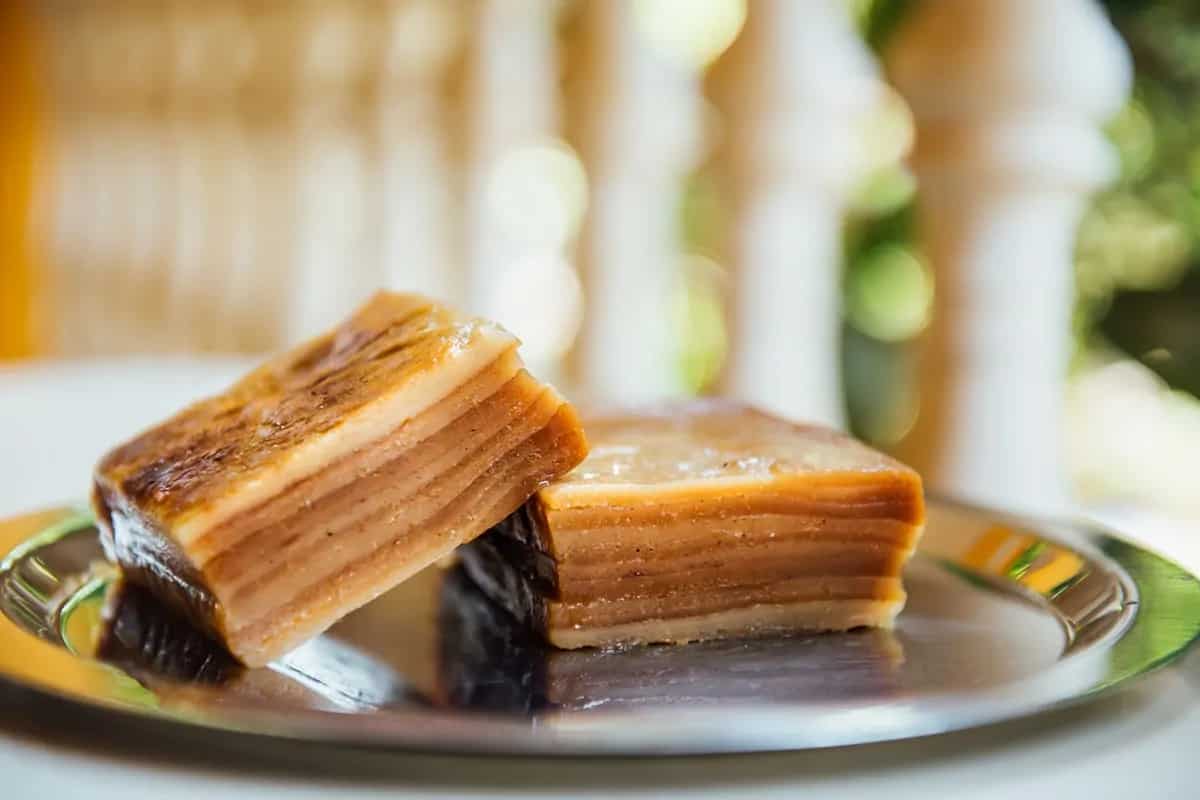
IN GOA, some desserts travel better than others. A box of bebinca can survive a flight, a suitcase, a hurried airport purchase and the faint indignity of being pressed into service as a last-minute gift. It sits obligingly on supermarket shelves, vacuum-sealed and glossy, its many layers visible through plastic, promising the recipient a slice of Goa.
But anyone who has eaten a truly good bebinca knows that portability is not the same as memory.
The great Goan layered cake — also called bibik in Konkani — has long been described, with only slight exaggeration, as the queen of Goan desserts. At its best, it is regal not because it is showy, but because it refuses to be rushed. A proper bebinca is built slowly, layer by layer, from egg yolks, coconut milk, sugar, flour, ghee and nutmeg. One layer is poured, browned, brushed with ghee, watched carefully, then followed by the next. And the next. And the next. Seven layers at least; sometimes twelve, sometimes sixteen. Each one thin enough to matter, each one carrying the memory of heat.
This is not the kind of food that lends itself naturally to modern impatience. It asks for time, attention and a willingness to repeat the same small act until repetition becomes craft.
As the story goes, bebinca began in the 17th century at the Convent of Santa Monica in Old Goa, during Portuguese rule. The convent’s nuns used egg whites to starch and bleach their habits, leaving behind a surplus of yolks. One version of the legend credits a nun named Sister Bebiana with transforming those yolks into a dessert of unusual richness and economy. Almonds, expensive and imported, gave way to the coconut milk abundant along the Goan coast. Waste became invention. A convent kitchen produced a cake that would outlive an empire.
The first version, according to the tale, had seven layers — sometimes said to represent the seven hills of Lisbon and Goa. When Sister Bebiana sent it to the priests of the Convent of St Augustine, they approved of the dessert but not its size, asking that it be made larger. Whether or not the story is entirely literal, it captures something true about bebinca: it has always been a dessert of accumulation. Of yolks saved, heat controlled, ingredients adapted, and layers patiently added until the cake becomes more than the sum of its parts.
Traditionally, bebinca was baked in a tizal, an earthenware pot heated from above with slow-burning coconut husks placed on the lid. That uneven, smoky heat is part of its old magic. It gives the top of each layer a delicate caramelisation, so that the final cake is neither simply soft nor simply dense, but something more complicated: sticky, rich, smoky, tender, faintly chewy at the edges, and melting at the centre.
The colour tells its own story. Bebinca is not one uniform shade of brown. Its beauty lies in alternation: pale gold, deeper amber, caramel, ivory. Some of the batter is darkened with caramelised sugar, giving the finished cake its striped, almost geological appearance. To cut into it is to expose time itself, stacked neatly in edible bands.
No wonder it became festive. Bebinca is closely associated with Goan Christian celebrations — Christmas, Easter, weddings, family feasts — occasions where food is not only consumed but displayed, gifted, remembered and argued over. It is a dessert that announces labour. Someone had to stand over it. Someone had to know when a layer had browned enough but not burned, when to brush the ghee, when to pour again, and when to stop.
And yet, the very qualities that made bebinca famous have also made it vulnerable.
Unlike more delicate Goan sweets, bebinca has a useful sturdiness. It keeps well. It slices well. It can be packed, sealed, labelled and carried home by tourists who want a taste of Goa in their luggage. Over time, that convenience has helped make it one of the state’s most recognisable culinary souvenirs. But the supermarket bebinca, so often thick, rubbery and aggressively sweet, can feel like a translation in which the original music has been lost.
The problem is not that food changes. It always does. The problem is when complexity is flattened into merchandise. In the commercial version, the layers may be visible, but the patience is missing. The flavour becomes blunt. The texture grows stodgy. Sugar compensates for the absence of smoke, ghee, yolk and time.
This is where the modern story of bebinca becomes more than nostalgia. Its recent Geographical Indication tag is not merely a bureaucratic badge; it is an attempt to protect a food whose identity has become blurred by popularity. The campaign by Goan bakers and confectioners was rooted in a familiar anxiety: once a regional food becomes marketable, who gets to define it? The people who inherited and practised the craft, or the businesses that learned to package its image?
In Goa, the answer often lies not in the brightest shops but in private kitchens. Ask around, and someone will know someone. A village may have its own bebinca expert, a woman whose reputation has travelled farther than her signboard ever could. These are the “bebinca aunties” locals trust — home bakers who make the dessert not as a product line, but as a practice. In some places, reputations are specific enough to become folklore: one aunty known for a round bebinca, another for a square one; one preferred for Christmas orders, another for weddings; one whose layers are thinner, one whose caramel is darker.
This informal geography of skill is as important as any official map. It tells us that bebinca is not only a recipe but a relationship — between baker and buyer, village and kitchen, festival and memory. A good bebinca is rarely anonymous. It comes with a name attached.
There is something quietly moving about the fact that efforts to preserve bebinca have returned, quite literally, to where the legend began. Workshops at the Convent of Santa Monica in Old Goa invite people to learn the dessert in the setting associated with its origin story: the cloisters where egg yolks, thrift and imagination are said to have first met. For modern visitors, the act of making bebinca is not only a culinary instruction. It is a way of entering a slower rhythm, of understanding that heritage is often preserved not by looking at it, but by doing it badly at first, then better, then with care.
Perhaps that is why bebinca endures. Not because it is the easiest Goan sweet to love, though it may be that. Not because it is the most convenient to buy, though it has certainly become that. It endures because each slice contains a contradiction. It is humble and extravagant, local and colonial, festive and everyday, fragile in method but sturdy in form. It was born, if the legend is to be believed, from leftovers — and became a dessert fit for celebration.
By late June, after Goa’s São João revelry has passed and the monsoon has settled more fully over the state, the festival tables may be cleared. But bebinca belongs to a longer calendar. It appears wherever Goan celebration requires sweetness with weight behind it: at Christmas lunches, Easter spreads, wedding feasts, family visits, airport departures and homecomings.
The packaged version may continue to travel. It will sit in boxes, cross cities, satisfy curiosity. But somewhere else, in a kitchen warm with coconut, caramel and ghee, someone will still be waiting for the surface of a layer to brown before pouring the next. That is the bebinca worth remembering: not a souvenir of Goa, but a lesson in how slowly a place can be made edible.