New Delhi didn't just host the 18th BRICS Summit on September 12–13, 2026 — it staged it, down to the last grain of rice. Schools closed, 35 roads went under traffic restrictions, and Bharat Mandapam absorbed the largest gathering of foreign leaders India has hosted in years, including Vladimir Putin and, for the first time since 2019, Xi Jinping. Amid the motorcades and the closed-door bilaterals sat a quieter, more calculated performance: a food zone at the International Media Centre, built to feed hundreds of foreign journalists three meals a day for three days straight. It is easy to mistake this for logistics. It wasn't. Every dish on that counter was a small, deliberate act of statecraft — and read correctly, the buffet says more about India's ambitions for BRICS than most of the summit's official language does.
From Acronym to Architecture: A Short History of BRICS
BRICS did not begin as a bloc. It began as a slide in a research note. In 2001, Goldman Sachs economist Jim O'Neill coined the term "BRIC" to flag Brazil, Russia, India and China as the emerging economies that would reshape global growth over the following decades — a purely financial observation, not a political one. Governments took the acronym and ran with it. Foreign ministers from the four countries held their first informal meeting on the sidelines of the UN General Assembly in 2006, and by June 2009 the leaders themselves were meeting face to face, in Yekaterinburg, Russia — the first BRIC summit, convened to discuss reforming a global financial architecture that had just been shaken by the 2008 crisis.
South Africa joined in 2010 and attended its first summit as a full member in 2011, turning BRIC into BRICS. For over a decade after that, the group's ambitions stayed modest and largely financial: it built the New Development Bank in 2014 to fund infrastructure without routing through the IMF or World Bank, floated a Contingent Reserve Arrangement, and met annually to issue statements that critics — including O'Neill himself — dismissed as long on rhetoric and short on consequence.
Then, in August 2023, at a summit in Johannesburg, the bloc did something it had spent fourteen years avoiding: it got bigger. Egypt, Ethiopia, Iran, Saudi Arabia and the UAE were invited to join, with membership formalised in January 2024 and the first nine-member summit held in Kazan, Russia, that October. Indonesia followed in 2025. What had been a five-country talking shop was now an eleven-nation coalition spanning oil producers, a nuclear-armed regional power, and the world's largest Muslim-majority democracy — together accounting for more than 40% of the world's population and close to a quarter of global GDP. That scale is precisely what makes a 2026 chairship harder than a 2012 one: a five-member club can agree on ideology; an eleven-member coalition of Gulf monarchies, Communist-Party China, and democratic India can, at best, agree on food.
The Stage: New Delhi's Fourth Turn at the Wheel
This was India's fourth chairship — after 2012, 2016 and 2021 — and its most consequential, arriving as the bloc marks two decades since that first ministerial meeting. India assumed the presidency on January 1, 2026, framing the year around the theme "Building for Resilience, Innovation, Cooperation and Sustainability," and spent the following eight months running more than 350 preparatory meetings across 25 cities — trade sessions in Jaipur, competition-policy talks in Udaipur — before funnelling everything into two days at Bharat Mandapam, preceded by a Business Forum and a Women's Business Alliance meeting on September 11. Xi Jinping's presence, his first visit to India since the 2019 Mamallapuram meeting, was the diplomatic headline. The food, less noticed, was doing its own work in the background — because feeding a summit this size, this ideologically mismatched, is itself a test of whether "resilience and cooperation" can survive contact with genuinely different palates.
The Menu, Decoded
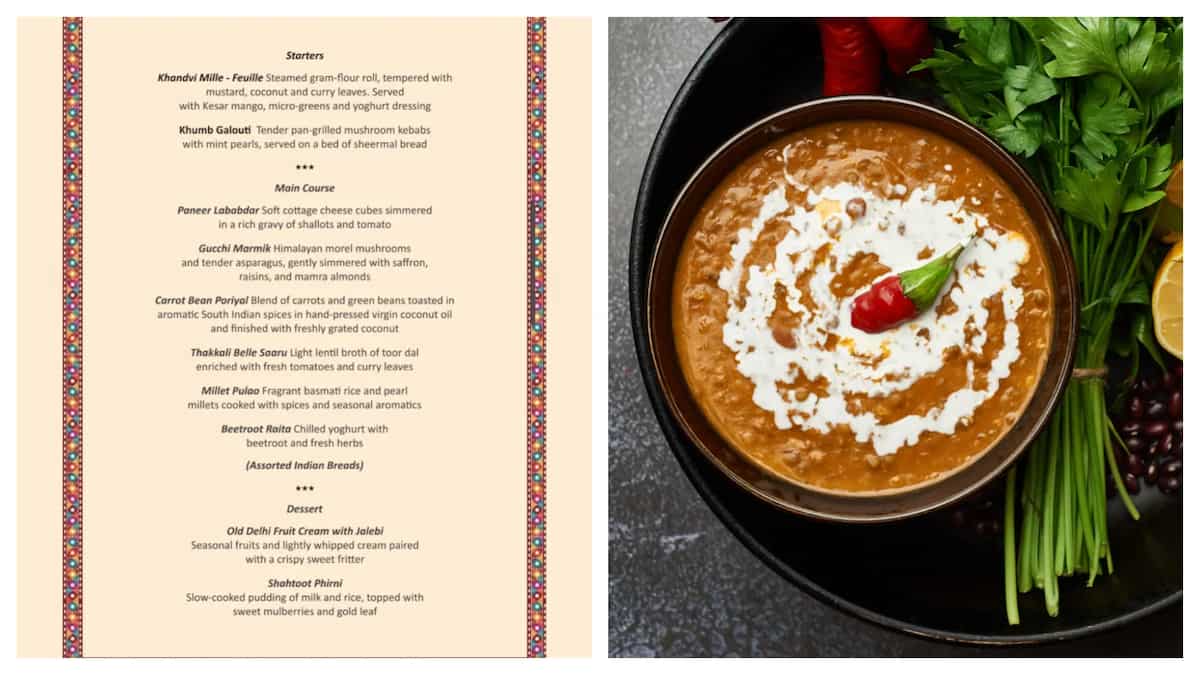
Walk the actual food zone, as India's state broadcaster did on the summit's opening day, and a clear strategy emerges — dish by dish, stall by stall.
The universal handshake. Frozen rotis, finished in ghee and served as parathas, sat beside plain rice — a pairing engineered to be instantly familiar to an Indian delegate and entirely unthreatening to anyone else at the table. Rice, in particular, is the one grain the entire BRICS map can agree on: as at home in Beijing as in Bihar, as ordinary in Jakarta as in Johannesburg.
The showpiece flex. ITC's executive chef, present on the floor, confirmed the kitchen was leaning hard on the hotel group's most decorated in-house brands — Dum Pukht, Dakshin, Kebabs & Kurries, and Bukhara, arguably the single most internationally recognised name in Indian fine dining. A slow-cooked dal makhani sat next to dal panchmel and a malai-lehsuni palak, alongside rajma rasela — a Punjabi red-kidney-bean curry — and Banarasi dum aloo: a dish named for a single Indian city, plated for a room full of the planet's most powerful diplomats.
The concession menu. Because Chinese delegations arrived in force, the kitchen ran vegetable hakka noodles and kung pao vegetable — Indo-Chinese comfort food, built specifically, as the chef put it, because "participants were coming from those countries as well." Penne alla Pods gave a nod to the Continental palate, particularly popular in Britain. Bread butter pudding, halwa, and ice cream rounded out dessert — one Raj-era holdover, one purely Indian classic, one that needs no translation anywhere.
(Credits: Freepik)
The quiet policy statement. Pearl millet sat on the counter too, and it wasn't there for flavour. It's the flagship grain of India's "Shree Anna" push — the campaign Delhi has spent three years running through the UN and G20 to get millets recognised as a climate-resilient staple crop. A summit built around the word "Sustainability" cannot serve a menu that ignores its own host's signature sustainability project. Non-vegetarian options ran alongside the vegetarian spread too, a concession to delegations for whom an all-vegetarian table would read as incomplete rather than principled.
Nothing on that table was an accident. It was a curated argument, made in food: India is positioning itself as the Global South's kitchen, and the invitation is open to everyone at the table.
Why This Matters More Than It Looks
An eleven-member coalition this large and this ideologically mismatched needs softer connective tissue than trade communiqués can provide, and food is exactly that tissue — the one language every delegation speaks fluently, with no translator required. For India specifically, hosting a fourth chairship is also an audition: New Delhi has spent this cycle explicitly steering BRICS away from being read as an anti-Western bloc and toward being read as the practical secretariat of the Global South, delivering outcomes rather than confrontation. A menu that plates Bukhara dal next to kung pao vegetable next to a British dessert is that philosophy made edible — cooperation without confrontation, difference without division, precisely at the moment the bloc's expansion has made genuine ideological unity impossible.
(Credits: ANI)
The People Behind the Counter
It's worth lingering on who actually assembles this. ITC Hotels — India's most decorated hospitality brand for Indian cuisine — supplied the culinary command, and its executive chef described the brief in terms that could have come straight from a positioning deck: showcase the house's signature Indian brands, because that's the group's global calling card; layer in enough Continental and Chinese cooking that every foreign delegate feels catered to, not merely tolerated; and do all of it inside a media centre, because the people watching you eat are also the people writing the story of what you served.
That last detail is the sharpest one. This wasn't the leaders' banquet, which happens behind closed doors, unphotographed and undiscussed. This was the media food zone — deliberately built for the cameras, deliberately generous, deliberately photogenic. In an era where a summit's global perception is set as much by the B-roll as by the joint statement, feeding the world's press well isn't hospitality. It's message discipline with a side of raita.
The Takeaway
Strip away the geopolitics and one plain fact remains: India didn't dilute its own food to make the world's most powerful leaders comfortable. It served Banarasi dum aloo, not a vague "potato curry"; Bukhara dal, not "lentils" — a confident, specific, unapologetically Indian menu that still left generous room on the plate for everyone else's comfort food. That's the real discipline on display, and it scales well beyond a buffet line. Three takeaways stand out.
India's fourth chairship bet that the fastest way to make a fractured, fast-expanding coalition feel like one table was to put its best dish on it first, and trust the rest of the room to follow.
Reporting from the BRICS International Media Centre food zone, with additional details from ITC Hotels' executive chef on the summit floor.