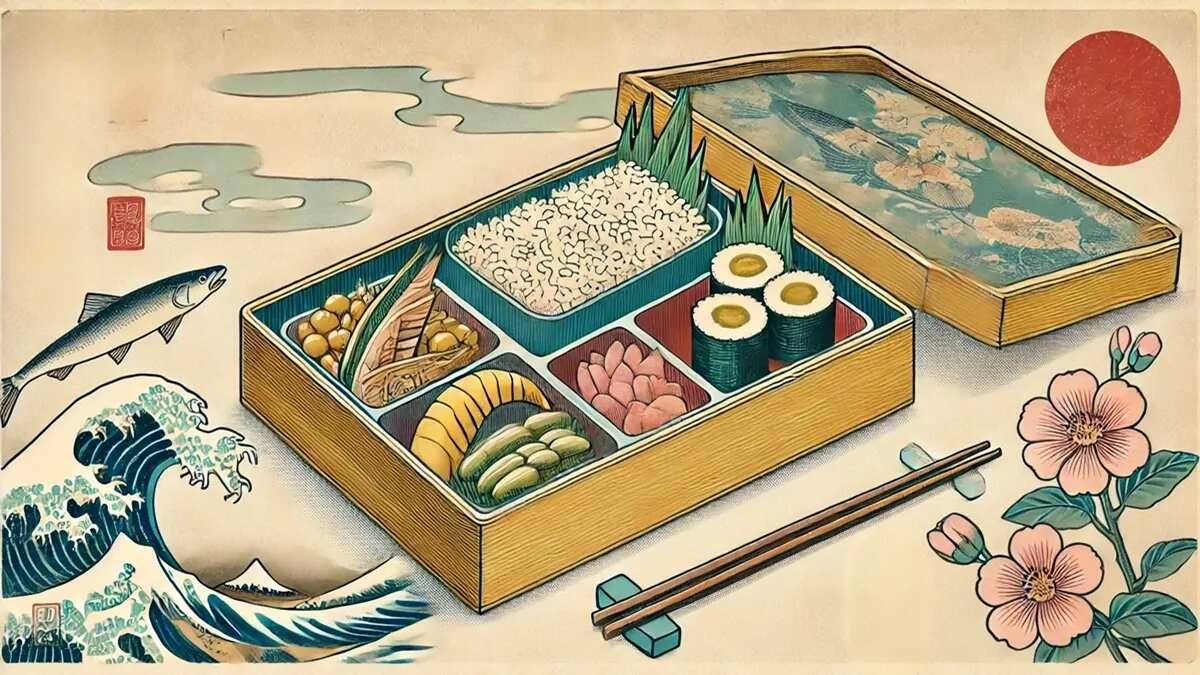
I. The Rice of Time (Origins & Early History)
Before the lacquered boxes, before the neatly packed parcels, there was simply hoshi-ii — dried rice, carried by 12th-century samurai and travellers. A meal of necessity, tucked in small pouches, it was not yet bento but held the seed of its future.
Grains dried, then stored
Carried over sea and land
A meal, a journey
As Japan entered the Edo period (1603–1868), bento became an art form, with elaborate makunouchi bento — the “between-acts” meal at kabuki theatres — offering delicate assortments of fish, pickles, and rice. Travellers and pilgrims, too, adopted the ekiben (station bento), wrapped in bamboo leaves or tucked into handcrafted wooden boxes.
II. The Side Dish of Change (Modernisation & Mass Production)
With Meiji-era industrialisation (1868–1912) came the aluminium bento box — shiny, durable, and a status symbol. The wealthier you were, the more polished your bento gleamed. But modernity had its price: as Japan moved toward wartime austerity, bento faded from schools and workplaces, seen as an emblem of class division.
Metal lunch gleams bright
Status plated in silver
Train departs, war calls
World War II dimmed the bento’s place at the table. Food shortages made it impractical, and school lunches replaced it with communal meals. But, like kintsugi repairing broken pottery with gold, the bento would not vanish — it would transform.
III. The Pickled Resilience (Post-War Revival & Reinvention)
By the 1980s, Japan’s economic boom and the rise of convenience stores (konbini) reshaped bento once more. Enter the shokado bento — a refined, lacquered-box style echoing Kyoto’s tea ceremonies — and the ubiquitous konbini bento, packaged and ready to eat, mirroring a fast-paced world.
Plastic wrap unfolds
Office workers take their lunch
Season’s taste, preserved
Meanwhile, the kyaraben (character bento) flourished, with parents sculpting rice and vegetables into cartoon figures — food transformed into art, play, and love.
IV. The Golden Seams (Contemporary Bento & Cultural Legacy)
Today, the bento holds many faces: a chef’s canvas, a child’s delight, a commuter’s convenience, a dieter’s careful measure. It has moved beyond Japan, influencing lunchbox cultures worldwide, from Korean dosirak to Western meal-prep trends. What was once a samurai’s rice pouch is now an Instagrammable, global phenomenon.
Old forms, new hands shape
Art, culture, nourishment
A box without borders
Like kintsugi, the bento does not erase its cracks — it fills them with meaning, history, and reinvention. A story told in compartments, yet always whole.
***
Bento, Box-ed:
🥢The term "bento" is believed to have originated in the 16th century, possibly attributed to military commander Oda Nobunaga, who distributed simple meals to his soldiers.
🥢In the 12th century, during the Kamakura period (1185–1333), Japanese workers began carrying dried rice called hoshi-ii as a portable meal.
🥢The Edo period (1603-1868) saw the rise of makunouchi bento, enjoyed during theater performances, and the use of lacquered wooden boxes for meals.
🥢The first ekiben (station bento) was sold in 1885 at Utsunomiya Station, consisting of rice balls and pickled radish.
🥢The 1980s economic boom and the proliferation of convenience stores (konbini) in Japan led to the widespread availability of ready-made bento boxes.
🥢Today, bento boxes are a staple in Japanese culture, available in various forms and styles, and have influenced lunch cultures worldwide.