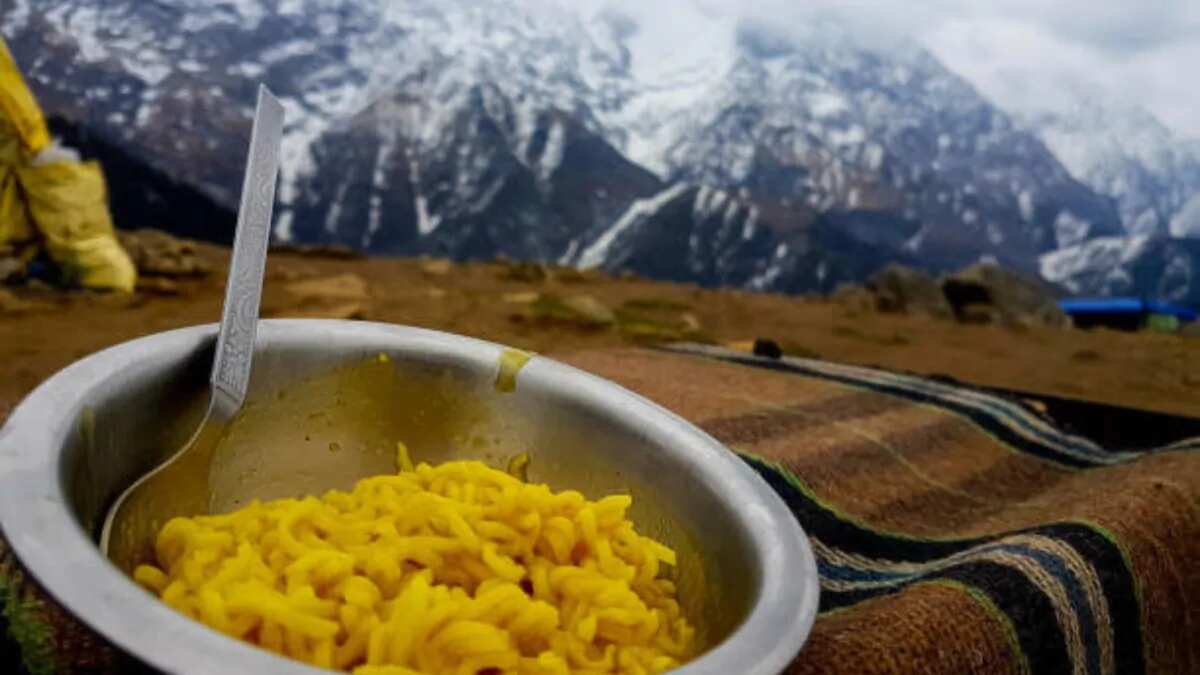
In a windswept corner of Ladakh, at an altitude where oxygen is low and spirits run high, a small shack with a tin roof proudly announces: "Hot Maggi Here!" Next to chai and the view, it's the most reliable thing in the mountains.
What began as a Swiss nutritional innovation in the 19th century has become a pan-Indian phenomenon, and perhaps nowhere is its impact as curious, emotional, and enduring as in the Himalayan belt. From Sela Pass in Arunachal Pradesh (13,700 ft) to Khardung La in Ladakh (17,582 ft), Maggi reigns supreme.
Born In Switzerland, Reborn In The Himalayas
Maggi was created in 1884 by Julius Maggi to address the dietary needs of industrial workers in Europe. It was a revolution in quick nutrition: soups, seasonings, and eventually, noodles.
In 1983, Nestlé introduced Maggi 2-Minute Noodles to India. It was positioned as a solution for busy mothers, but it found a life of its own across colleges, train stations, construction sites, and eventually, the mountains.
Fast forward to today: India consumes over 2.5 billion packets of Maggi every year, with an estimated ₹4,000+ crore market share in the instant noodle category. And a not-insignificant portion of that is slurrped high above sea level.
Why The Mountains Love Maggi
Boils in Minutes, Even When You Can’t Cook Much Else
In high-altitude areas like Spiti, Zanskar, and Tawang, cooking is not easy. Water takes longer to boil. Oxygen is thinner. Fresh vegetables are seasonal or scarce. Maggi, which just needs 2 cups of water and a gas stove, becomes a no-brainer.
Instant Warmth and Comfort
After long hikes or bike rides across mountain passes, Maggi isn’t just food, it’s fuel. The masala-laced broth and soft noodles provide quick calories (about 350 kcal per packet) and much-needed heat in freezing weather.
Perfect for Vendors and Trekkers
Maggi’s long shelf life, portability, and minimal storage needs make it ideal for small vendors who can’t afford fridges or elaborate kitchens. It’s also easy for trekkers to carry and make over a small camping stove, just ask anyone who's done the Hampta Pass or Goechala trek.
The Rise Of The “Maggi Point”
Over the last two decades, “Maggi Points” have become roadside institutions. At Sissu, Chamba, Yumthang, Pangong, or even near glacial lakes like Gurudongmar, you’ll find stalls with faded Maggi posters, aluminium pots, and gas cylinders, ready to serve.
At Rohtang Pass (13,058 ft), it’s said that on a good tourist day, over 500 bowls of Maggi are sold from a single stall.
These aren’t just food joints, they’re community spaces, where locals, soldiers, bikers, and travellers bond over bowls of soupy noodles.
Customised In The Clouds
Maggi in the mountains is never just plain. Vendors have localised it to regional palates:
Ladakh: With local greens, yak cheese, or dried meat.
Darjeeling: With eggs and chilli vinegar.
Manali: With a generous grating of Amul cheese and hot sauce.
Northeast India: With bamboo shoots, fermented soy, or smoked pork, depending on the district.
Some vendors even claim the mineral-rich mountain spring water gives the noodles a different “magic”, an unbottled terroir of the Himalayas.
The Emotional Anchoring
Maggi evokes deep pan-Indian nostalgia: hostel rooms, rainy evenings, sibling squabbles over the last bite. That emotional power gets amplified in the mountains, where travellers are far from home and closer to themselves.
In travel blogs, biker forums, Instagram posts, and even poetry, Maggi is often invoked not as a dish, but as a mountain ritual. A memory. A milestone.
Nestlé’s Strategy: Smart Silence, Deep Insight
Nestlé may never market Maggi directly as "the soul food of the mountains," but its actions speak volumes.
Marketing Campaigns like “Me and Meri Maggi” tapped into consumer stories, many set in mountain cafés and campsites.
Post-2015 Comeback: After a nationwide recall and ban, Maggi returned within months, thanks in part to intense consumer loyalty. In mountain towns, vendors hoarded old stock, refusing to believe their best-seller could be unsafe.
CSR in Hill Stations: Nestlé’s Project Hilldaari focuses on waste management in towns like Mussoorie, Dalhousie, and Nainital. Quietly acknowledging that Maggi consumption is part of the tourism ecosystem, the brand is helping clean up after its own popularity.
A Bowl That Bridges Two Worlds
Maggi straddles an unusual space: born in 19th-century Switzerland, embraced in 21st-century India, and immortalised in the rare air of the Himalayas. It’s the great equaliser, a food as likely to be eaten by a monk in Tawang as a biker in Spiti.
There are Michelin stars, Instagrammable cafés, and heirloom recipes. But few things stir the soul like Maggi at 13,000 feet, steam rising into the sky, wind howling outside, and a familiar yellow packet offering warmth in the coldest of places.
In the Indian mountains, Maggi is not a meal. It’s a memory.