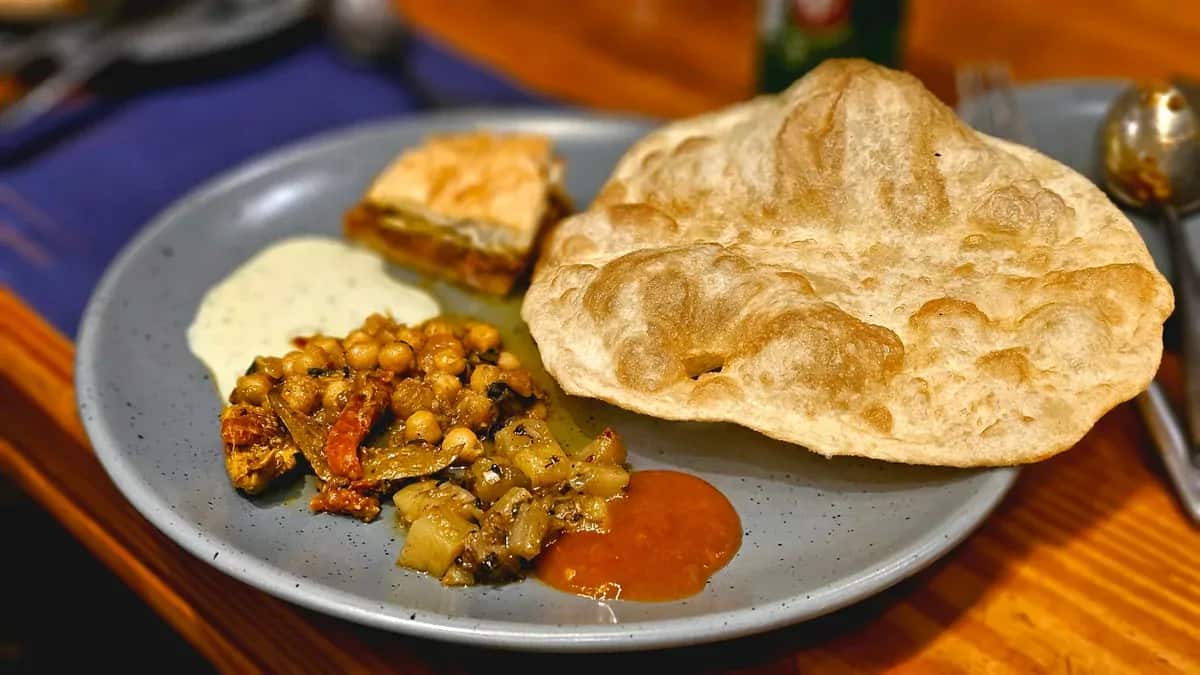
If your puris won’t puff—or they puff but feel oily—don’t switch recipes yet. Puffing is just steam inflating the puri, but only if the surface seals fast. That seal comes down to three things: dough firmness, even rolling, and properly hot oil.
Soft, Fluffy, Less-Oily Puris: The 3 Variables That Decide Everything
What you’re aiming for (observable cues):
- Soft: after cooling a minute, it bends before it cracks; bite is tender, not chewy.
- Fluffy/puffed: a full (or mostly full) balloon with an even shell—no thick centre, no paper-thin rim.
- Less-oily: after draining, the surface looks mostly matte; fingers don’t pick up a slick film.
Prioritise these (in order):
- Dough firmness/hydration (too soft = weak seal + oil soak).
- Rolling thickness & evenness (thin spots leak; thick spots stay dense).
- Oil temperature & technique (heat sets the skin; timing builds the balloon).
1-minute diagnosis (from your last batch):
- Dough tacky/sticky after kneading? → too wet.
- Discs with cracked edges or a dry, wrinkled look? → too dry, or dried out while waiting.
- Puri sank and stayed pale for a few seconds? → oil too cool.
- Oil bubbled lazily, especially mid-batch? → oil too cool or pan crowded.
Why puffing happens: steam pushes the two sides apart. Puffing fails when steam escapes through micro-cracks/thin spots, or when oil is cool enough that the surface stays porous. Cool oil also gives oil time to move in.
Dough Ratio & Texture
Baseline dough formula (with ranges)
For about 10–12 puris:
- Atta: 2 cups (about 240–260 g)
- Salt: 1/2 tsp
- Optional fat: 1–2 tsp oil or melted ghee
- Water: start with 1/2 cup (120 ml), then add 1–3 tbsp more only if needed
Method (go slow on water):
- Mix atta + salt (and optional fat).
- Add water in small additions; mix to shaggy.
- Knead until cohesive and smooth.
Feel test + pinch test (your real measuring tools)
- Just right: firm, smooth, slightly tight; not sticky. Finger press leaves a dent that slowly relaxes.
- Too soft: tacky/spongy; smears on the board; slumps fast. Pinch: edge looks damp and weak.
- Too dry: fights kneading; tiny surface cracks; ball edges split. Pinch: edge crumbles or shows fissures.
Micro-adjustments:
- Too dry: add water 1–2 tsp at a time, kneading between additions.
- Too soft: knead 1–2 minutes to tighten; if still sticky, add 1 tsp atta at a time. Don’t dump flour—dry outside + wetter core often shows up later as cracking.
Kneading cues (when to stop)
Stop when the dough is uniform and smooth and feels elastic (pulls back a little). If it keeps getting looser as you knead, it’s usually excess water.
Rest guidance (and when rest backfires)
- Rest 15–30 minutes, covered, at cool room temperature.
- Rest finishes hydration and relaxes the dough for rolling.
- In a warm kitchen, a long rest can make dough slack and sticky, which leads to sticking and heavy dusting flour (both hurt puffing).
Non-negotiable: keep dough covered. A dried skin becomes cracks, and cracks become steam leaks.
Rolling For Puffing
Thickness
Aim for 1.5–2 mm.
- Too thin: weak spots tear; steam escapes; partial bubbles and oily patches.
- Too thick: centre cooks slower; puri stays bready and dense.
Evenness method
- Portion into smooth balls; keep the rest covered.
- Roll from the centre outward, then rotate and repeat.
- Check the rim: edges should be as thick as the centre, not feathered thin.
Prevent sticking without turning the surface dusty
Pick one:
- Light oil method: thin film of oil on board and rolling pin.
- Minimal flour method: dust only when needed.
Too much dry flour burns in oil and can make puris feel greasy even when the oil temp is right.
Rolling failure symptoms and quick fixes
- Cracked edges: dough too dry/uncovered → knead in 1 tsp water; keep covered.
- Wrinkled surface: dough drying or under-kneaded → cover; knead briefly to smooth.
- Uneven rim: rotate more often; don’t press harder at the edges.
Holding time
Fry soon after rolling. If you must wait, cover rolled discs lightly so they don’t dry out.
Oil Temperature & Frying Technique
Temperature target
Aim for 180–190°C (356–374°F).
- Below 180°C: surface sets slowly → more oil absorption, less puff.
- Above 190°C: browns fast → shell can set before it inflates.
Two thermometer-free tests
- Dough-bit test: a pea-sized dough bit should rise quickly with active bubbling.
- Wooden spoon/chopstick test: dip the tip; look for a steady stream of bubbles around the wood (not sparse; not smoking).
Step-by-step frying sequence
- Heat oil in a deep, heavy pot/kadai to 180–190°C.
- Slide in one puri gently.
- In the first 5–10 seconds, bubbling should be busy and the puri should start to rise.
- When the surface looks set and it’s floating, gently press once or twice with a slotted spoon to help it balloon.
- When it balloons (or stops expanding), flip once.
- Fry the second side briefly (just to set), then lift out.
Batch size, heat recovery, and draining
- Fry one at a time unless your kadai is wide and holds temperature; crowding drops heat.
- Let oil return to temp between puris (use the dough-bit test mid-batch).
- Drain on a rack if possible. If using paper, quick blot—don’t wrap.
- Don’t stack tightly while hot; cover loosely with a cloth if holding.
Oil note: use a neutral, high-smoke-point oil; old oil browns faster and can darken puris before they puff.
Ready to put the method to work? Browse puri-friendly ideas at /discover/recipes.
The 8 Mistakes That Stop Puris From Puffing
Symptom: puris stay flat, turn firm
- Cause:too soft dough can’t seal; steam leaks; oil moves in
- Fix now: raise oil to 180–190°C; roll slightly thicker (closer to 2 mm)
- Fix next time: hold back water; aim for firm, non-sticky dough
Symptom: edges crack; puri puffs then collapses
- Cause:too dry/cracking dough creates escape routes
- Fix now: cover dough + rolled discs; switch to light oil on the board
- Fix next time: knead in water 1 tsp at a time until the ball smooths out
Symptom: rough surface; patchy blisters; uneven puff
- Cause:under-kneaded dough (uneven hydration and weak surface)
- Fix now: knead remaining dough 1–2 minutes until smoother
- Fix next time: knead until elastic and uniform before resting
Symptom: dough turns sticky during rolling; discs distort; puris feel heavy/oily
- Cause:over-rested/warm dough goes slack; encourages extra flour and weaker sealing
- Fix now: chill dough 10 minutes; keep portions covered
- Fix next time: rest 15–30 minutes in a cool spot; avoid long warm rests
Symptom: one side puffs, other stays flat; thin rim tears
- Cause:uneven rolling (thin spots leak; thick spots resist)
- Fix now: rotate more often; check edges for feathering
- Fix next time: keep 1.5–2 mm thickness with an even rim
Symptom: puri stays pale, takes long, feels oily
- Cause:oil not hot enough (slow set = more absorption)
- Fix now: pause and reheat; fry one at a time until heat stabilises
- Fix next time: preheat longer; use a thermometer or dough-bit test
Symptom: early puris puff, later ones crack and won’t balloon
- Cause:rolled discs dried out before frying (surface micro-cracks)
- Fix now: cover rolled discs; roll fewer at a time (2–3 max)
- Fix next time: roll 2–3, fry 2–3; repeat
Symptom: stays flat even in hot oil—or puffs then deflates fast
- Cause:press/flip timing off (press too early/too hard, or flip too soon)
- Fix now: wait for the puri to rise and the surface to look set; then gentle press; flip after puffing starts
- Fix next time: fry one “test puri” first to calibrate heat + timing
If you want tailored troubleshooting, post your dough and oil setup at /community—a photo of the first puri (top + side view) is usually enough to spot the issue.
Conclusion
When puris won’t puff or they turn oily, troubleshoot in this order: dough firmness first, rolling evenness second, oil heat/technique third. Steam can only inflate a puri if the surface seals quickly—cracks, thin spots, and cool oil act like vents.
For your next batch, change one lever at a time, judge success by puff + lightness (not colour alone), and keep the process tight: roll a few, fry a few. If you’re comparing “less-oily” results across batches, run a quick estimate in /nutrimeter and note what you changed.
Some parts of this article were created with AI assistance.