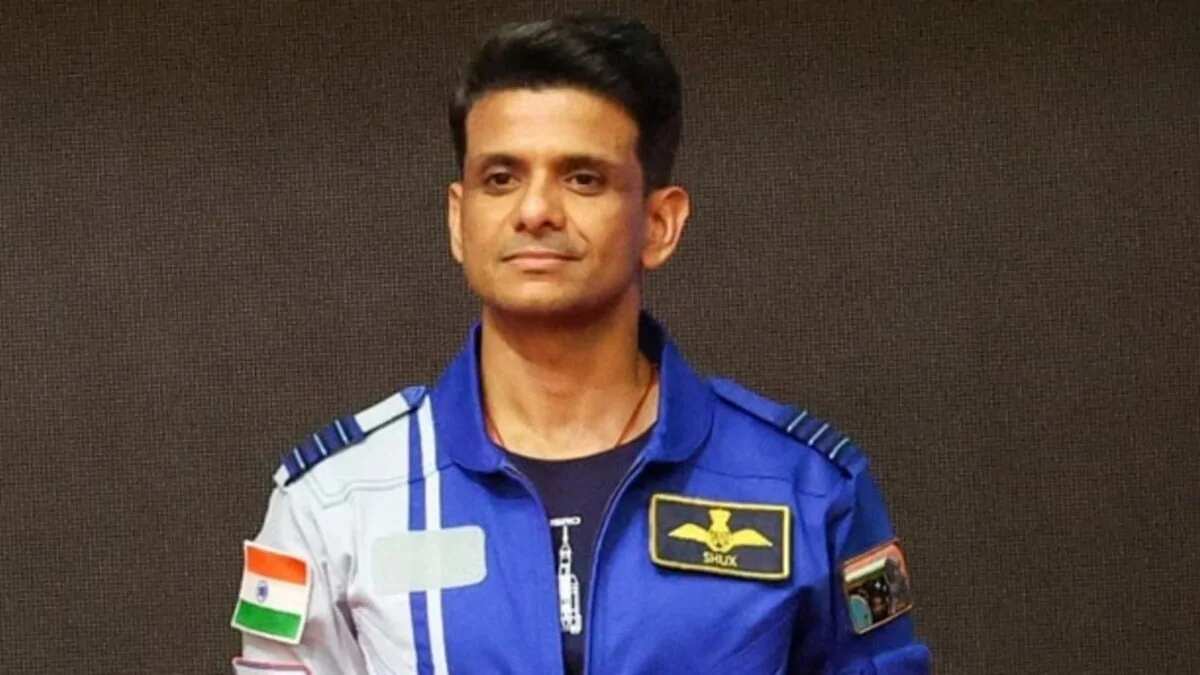
IT’S NOT EVERY DAY that gajar ka halwa defies gravity. But aboard the Axiom-4 Mission to the International Space Station, Group Captain Shubhanshu Shukla has done more than make history as India’s second astronaut and its first to step inside the ISS; he’s carried with him the flavours of home. The Indian Air Force pilot and ISRO astronaut’s journey, backed by SpaceX, marks India’s foray into private astronaut missions, and with it, a deeply personal payload: sweets, staples and snacks that anchor him to his roots even as he floats 400 kilometres above the Earth’s surface.
Shukla’s food parcel is as much about nostalgia as it is about national pride. Among the items are two favourites he hopes to share with his international crewmates: moong dal halwa and gajar ka halwa — rich indulgences rarely associated with zero gravity. Alongside them, aamras (mango nectar) offers a sweet, sun-kissed sip of the subcontinent. These dishes weren’t conjured in a home kitchen — his sister was quick to dispel that romantic notion — but have been meticulously developed by ISRO and DRDO scientists in collaboration with NASA. What began as part of India’s Gaganyaan programme has found new purpose, with vegetable biryani, rajma, khichdi, roti, basmati rice, spicy khakhra and dried mango all joining the interstellar menu. These are no ordinary rations: thermostabilised, freeze-dried, or irradiated to preserve nutrition and prevent errant crumbs or liquids from floating into flight systems. In this celestial kitchen, flavour meets physics.
If Shukla’s tiffin box speaks to India’s culinary evolution in the space age, he joins a long lineage of astronauts whose edible choices have become the stuff of legend. From freeze-dried soup inspired by a Florida lodge to a cheeky sandwich smuggled past NASA, here are three iconic morsels from space history that prove food is never just food — even in orbit.
Moon Soup, by Way of Florida
Long before fine dining had to account for vacuum seals and microgravity, one soup made the giant leap from Earth to lunar orbit. "Soup Romaine" — a velvety blend of lettuce, spinach, cream, and a daring dash of Tabasco — was served at Chalet Suzanne, a once-celebrated Florida resort that counted among its guests astronaut James Irwin of Apollo 15. So taken was Irwin with the soup that it was freeze-dried and space-certified by NASA physiologist Rita Rapp for inclusion in his mission’s menu. Its success with the crew earned it a second christening: "Moon Soup". Later missions, including Apollo 16 and Apollo-Soyuz, also ladled up this leafy luxury. Today, its legacy is preserved not just in memory, but in the archives of the Smithsonian Air and Space Museum. Read about ‘the most famous broth in space’.
The Corned-Beef Scandal
In 1965, NASA's Gemini 3 flight tasted rebellion in the form of rye crumbs. Astronaut John Young smuggled a corned-beef sandwich into his suit as a surprise for crewmate Gus Grissom, whose patience with plastic-bag rehydrated fare had worn thin. While the gesture was appreciated, the outcome was less so: the sandwich began disintegrating, scattering crumbs across the spacecraft — dangerous debris in a tightly calibrated cabin. A congressional hearing followed, but no careers were harmed. Young went on to walk on the Moon. The sandwich, however, did not survive. A replica now sits in a museum in Indiana, a quirky relic of early astronaut rebellion — and a reminder that, in space, even lunch can be a liability. Find out more about the stowaway sandwich!
Tereshkova’s Unauthorised Feast
When Valentina Tereshkova became the first woman in space in 1963, her triumph was also a test of endurance, physiology — and palate. After three days aboard the Soviet Vostok 6, she parachuted back to Earth and was greeted by local villagers who offered her traditional food: potatoes and onions, lepeshki, cheese, salt, and most notably, mare’s milk. Despite explicit instructions not to eat uncertified food (for fear of corrupting post-flight biological samples), Tereshkova tucked in, even bartering her remaining space rations in exchange. It was later speculated that she may have struggled with the onboard offerings — paste tubes of herring, caviar and roast beef among them — and perhaps hadn’t eaten much at all. "The bread was awful, too dry," she recalled. "I mainly ate the black bread and tubed onions." Her candid reflection is a testament to the grim early days of space cuisine and the human hunger that persists, even when tethered to the stars. Read about it here.