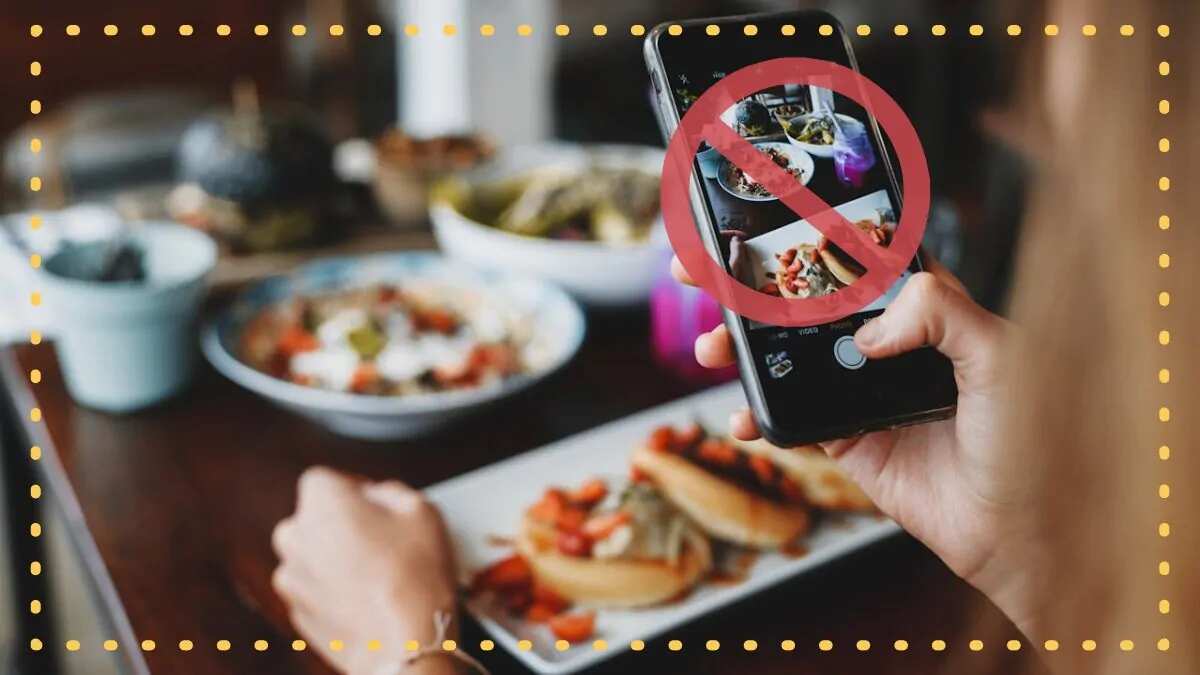
IN JANUARY 2026, Gaggan Anand announced what can only be described as a soft launch of culinary monasticism. His Bangkok restaurant — once a glittering node in the global social-media fine-dining circuit — is being reborn as a 15-seat, 180-minute experience with a strict no-phone policy.
Not a suggestion. Not a gentle “please refrain.” A hard line.
Gaggan calls the new format a “Cooksical,” a merger of food and music designed to protect surprise, intimacy, and something he believes has been eroded: romance. He’s gambling — explicitly, dramatically — that memory should exist without a camera roll to prove it.
It’s a bold pivot in an industry that once treated smartphones like the unofficial fourth utensil.
PHASE ONE: THE VIBE KILLER
In the late ’90s and early 2000s, chefs treated mobile phones like cigarette smoke: invasive, antisocial, faintly toxic. They rang loudly. They glowed harshly. They interrupted the theatre of service.
The objection was about manners. Noise. Respect. You wouldn’t light up at the table; why would you take a call? The phone was the uncouth guest no one had invited.
PHASE TWO: CAMERA EATS FIRST
Then Instagram happened.
Suddenly, that same glowing rectangle was free marketing. A diner photographing a plate wasn’t being rude; they were performing unpaid PR. Restaurants redesigned lighting, tableware, even tilework for maximum “postability.”
The anxiety shifted from “put that away” to “if it’s not posted, did it even happen?” The phone wasn’t a nuisance. It was a necessary utensil — fork, knife, iPhone.
And yet, even at peak food-porn hysteria, a quiet resistance simmered. Some chefs worried that dishes were dying on the table while diners adjusted exposure. Soufflés slumped. Ramen congealed. The pass became a waiting room for influencers.
The romance of immediacy was being replaced by choreography.
PHASE THREE: SANCTUARY DINING
Now, the pendulum has swung again.
Post-pandemic, something curious happened. Diners began craving not spectacle, but presence. A table without screens started to feel less like punishment and more like a gift. Certain establishments frame the ban as a luxury amenity: a curated digital detox.
The glow of blue light, once flattering to cocktails and chrome, has become aesthetically suspect. Socially suspect. Emotionally exhausting.
This new ethos isn’t just about etiquette. It’s about mental health, immersion, and — perhaps most tellingly — control.
WHY BAN THE PHONE AT ALL?
The rationale has evolved from “it’s rude” to something more layered.
Operationally, phones slow everything down. Diners scroll before ordering. They linger. They “camp.” A Tokyo ramen shop famously banned phones during peak hours after noticing customers took four or more minutes to start eating, bottlenecking queues.
Culinarily, chefs argue that food has a lifespan measured in seconds. Noodles swell. Steam dissipates. Crisp edges wilt under ring lights.
In Service, distracted guests fracture the hospitality loop. Staff describe the odd humiliation of trying to take an order from someone mid-scroll. The phone becomes a third wall between server and diner.
Artistically, in the age of spoilers, tasting menus are intellectual property. If the second seating already knows the punchline because TikTok posted it at 7:42 pm, what’s left to reveal?
And finally — perhaps most controversially — some restaurateurs admit to social engineering. They believe friction is required to break digital addiction. The ban isn’t accidental; it’s interventionist.
CARROTS, STICKS, & REFEREES
Enforcement ranges from gentle nudges to near-theatrical policing.
Some venues use lock pouches. Some offer discounts for voluntarily surrendering devices. Others gamify it — stack your phones; first to grab pays. One French restaurant reportedly employs a whistle and yellow-card system, escalating to ejection on repeat offence.
The subtext is clear: if you cannot separate from your phone for two hours, perhaps you’re in the wrong room.
THE RECEPTION: CONTROLLING OR CURATED?
Public reaction reveals an intriguing twist. While older diners sometimes bristle at being told what to do, younger generations — especially Gen Z — increasingly seek out these analog sanctuaries.
The phone, critics argue, is an appendage. Banning it is as absurd as banning watches. Restaurants, they insist, are service providers, not moral arbiters.
Yet many staff members privately welcome the policy. It reduces the familiar complaint: “I couldn’t get my server’s attention,” which often translates to “I was buried in my screen.”
Still, enforcement is awkward. Managers must police adults without seeming authoritarian. The hospitality industry, after all, is built on welcome, not whistle blows.
THE GREAT DINING SPLIT
What Gaggan’s move crystallises is not a fad, but a bifurcation.
On one side: Content Kitchens — designed for virality, spectacle, digital traceability. The online footprint is part of the product.
On the other: Analog Sanctuaries — intimate, immersive, sometimes expensive experiences where absence of technology signals value. Attention becomes the rarest ingredient on the menu.
In this landscape, banning phones isn’t about nostalgia. It’s about scarcity. In a hyper-connected world, uninterrupted focus is a luxury good.
Gaggan is wagering that diners are ready to pay for it.
Whether this resurrection becomes a template or a cautionary tale remains to be seen. But the fact that one of Asia’s most celebrated chefs is willing to stake his future on silence — on memory untethered from the grid — suggests something profound.
Perhaps the next evolution of dining isn’t about what’s on the plate.
It’s about where your eyes are.