Train journeys at twelve years old stretched time like warm toffee, three and a half hours between Pune and Mumbai felt like entire lifetimes. Whether we were heading to family functions or chasing whatever whim had captured my parents' fancy that weekend, these railway odysseys were woven into the fabric of my childhood. The prospect of sitting still in those sticky seats, watching the same fields blur past the window, filled me with the particular resignation that only children understand.
But salvation came in two forms. First, there was the rummage through the station bookstore, emerging with a fresh sci-fi novel or the latest Archie comics clutched triumphantly in my hands. And then, somewhere between Lonavala and Kalyan, came the second reprieve: the melodic cry of vendors threading through the compartments, their voices rising above the rhythmic clatter of wheels on tracks. "Malai, pista, mango kulfi!" they'd sing out, and suddenly those endless hours didn't seem quite so unbearable. The promise of a Parsi Dairy Farm treat could transform even the most restless ten-year-old into a patient traveller, waiting for that perfect moment when the vendor would appear at our seats, his insulated box full of creamy salvation.
This story is one that main train travellers know well on the Mumbai-Pune run, and in fact, Parsi Dairy Farm director Sarfaraz Irani shares similar fond memories of his own trips. What started as a humble dairy catering to the local crowd has grown into something of an institution, and you’d be hard-pressed to find someone in the Parsi community (in Mumbai or beyond) who doesn’t know its name.
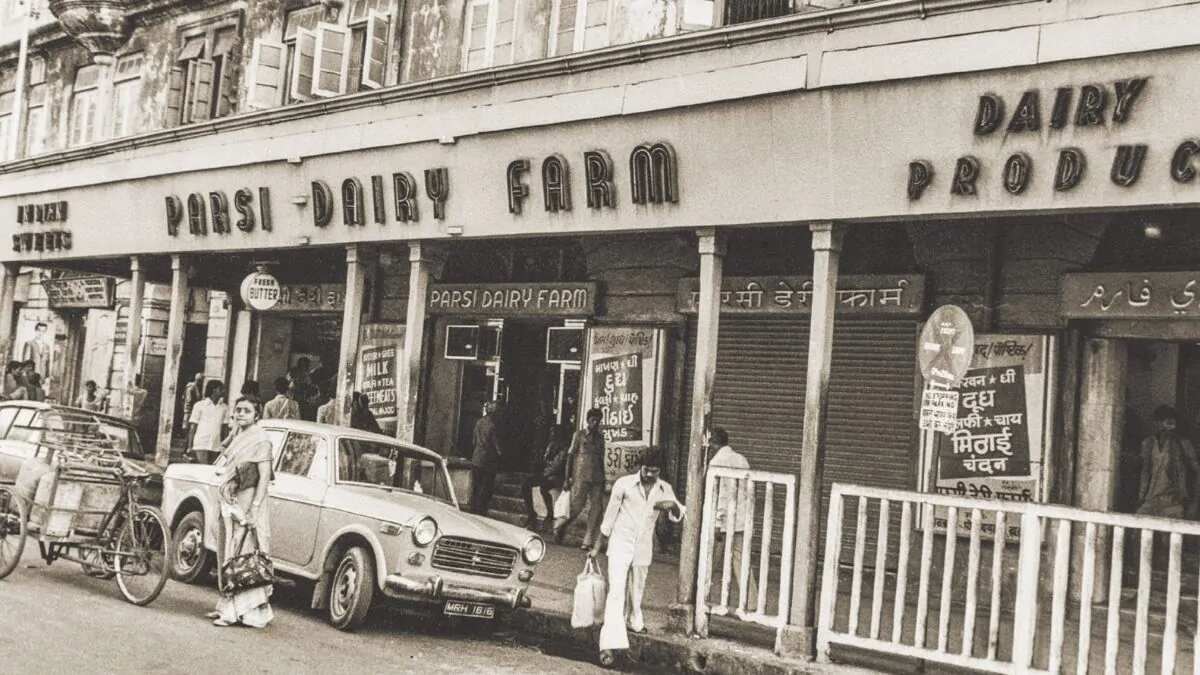
As Mumbai prepares to celebrate Parsi New Year or Navroze on 15th August 2025, the familiar queue outside Parsi Dairy Farm on Princess Street, a stone’s throw from its original location tells a story that spans 108 years. The vibrant hues of the recently renovated shop front may catch the eye of modern passers-by, but for Mumbai's Parsi community, this isn't just about aesthetics but about coming home.
The sweet aroma mingles with the cool promise of kulfi, and somewhere in that magical mix lies the essence of what makes it a Navroze special for thousands of families. Yes, it’s a festive promise of sweet treats, but it’s also a tradition that has remained unchanged whilst the world around it has transformed.
From Milk Cans To Mumbai Institution
The story begins in 1916 with a 16-year-old boy named Nariman Ardeshir, who had lost his father at the tender age of four. What started as a necessity, delivering milk cans to households in Kalbadevi, would grow into something far more significant than anyone could have imagined.
Ardeshir's principle was refreshingly simple. "Just sell the purest form of milk." That commitment to unchanging purity wasn't merely a business strategy; it was a philosophy that would define generations. "One can became two cans, two cans became 10. There was just no looking back," recalls Sarfaraz Irani, the current director and great-grandson of the founder.
But beyond the products, it mirrors the Parsi community's own integration into Indian society, much like the legendary story of how Parsis convinced the local king Jadi Rana in Udvada, Gujarat, to welcome them by demonstrating how sugar sweetens milk without displacing it. As Sarfaraz beautifully puts it, "The same way Parsi Dairy Farm's sweet dahi, which is a mixture of milk and sugar, adds the sweetness to the entire culture and community."
(L to R) Sarfaraz K Irani, Zeenia K Patel, Parvana S Mistry, Bakhtyar K Irani
A Sweet Community Commitment
The true measure of Parsi Dairy Farm's impact isn't found in sales figures or celebrity endorsement (though there are plenty to go around). It's found in stories like the one Sarfaraz shares about a elderly customer who would visit their shop and pray not just to the picture of God behind the counter, but also to his great-grandfather's photograph.
When questioned about this touching ritual, the woman revealed a story that goes to the heart of what Parsi Dairy Farm represents and how she said that Nariman Ardeshir saved her life when she needed it the most. "Her father had passed away a long, long time ago," recounts Sarfaraz, "when she was a very young child. In those days, a milk coupon was given, and her mother couldn't afford to purchase milk anymore. And therefore, she had come to my great-grandfather to basically hand over the coupons."
"As she was handing over the milk coupons as she couldn't afford the milk anymore. And my great-grandfather just instantly gave back the coupons and told her that till your children are old enough, and they can earn their money on their own, this milk will come free to your house every single day."
This act of kindness wasn't isolated charity, it was Nariman Ardeshir paying forward the generosity he had received as a child when his own school principal waived his fees after his father's death. "So it was basically just a way of returning back to life. So what he received in his life, he returned it back to somebody," Sarfaraz explains, “and that message is something we try to carry with us in our daily lives.”
Evolution Without Erasure
The challenge facing any century-old institution is how to remain relevant without losing authenticity. For Parsi Dairy Farm, the answer has been to find the sweet spot between modernisation and authenticity. "We have first identified and stayed true to our products," Sarfaraz emphasises. "We've not mingled with any ingredients or anything like that, or recipes, I would say, basically staying true to the product." The recipes that created decades ago remain unchanged, as do the traditional methods that give their sweets their distinctive character.
However, the family has embraced change where it enhances rather than compromises their values. One of the most noticeable aspects of this evolution is the renovation completed in September last year reflects this philosophy. "We stick to our roots, at the same time, just by adding a few flavors, or adding, making our packaging better," Sarfaraz notes, “Simple changes like switching to glass jars for their ghee align with contemporary environmental consciousness whilst maintaining product integrity.”
This approach has resonated strongly with customers. "We really get really nice messages from customers saying, they are extremely happy about the changes Parsi Dairy Farm has made," Sarfaraz observes. The shop has transformed from a simple transaction space where people send their drivers to pick up their order or just hurry through into somewhere families can stay , savour the flavors, enjoy the feel, and bask in the nostalgia.
The Sweet Taste Navroze
When Navroze arrives, certain sweets become more than food, they become symbols of luck and prosperity. The sweet dahi that Sarfaraz mentions is a must have tradition for many families. But perhaps no item captures the essence of Parsi celebration quite like the Mawa Boi. The sweet, dense paste of milk solids moulded into the shape of a fish is a common gift among friends and families. "It’s a very auspicious product to the Parsi community, which symbolises good luck and fertility and purity is our Mawa Boi," Sarfaraz explains. These fish-shaped sweets, available in mawa and doodh badam varieties, embody the hope and prosperity that define New Year celebrations. Then there are the distinctive jalebis, not the small, everyday variety found elsewhere, but supersized, round pipe jalebi, doused in syrup, the kind of ode to excess that Parsis do so well. Alongside traditional sutarfeni, these form the backbone of Navroze celebrations.
For the Irani family themselves, Navroze is a familiar exercise in controlled chaos. "We run to our dairy farm because we have so many orders to deliver in one single day because our Parsis just go gaga over our sweets," Sarfaraz laughs. The day begins at 6 AM, with mithai makers starting work at 2 AM to ensure everything is fresh. "So, basically what you will be eating is fresh mithai which is made that morning." Despite the demanding schedule, family lunch remains sacred with three generations gathering after the morning rush before returning to ensure customer satisfaction.
The Enduring Sweet Legacy
As Mumbai's Parsi community celebrates Navroze, Parsi Dairy Farm stands as more than a business success story. It represents the delicate balance between preserving tradition and embracing change, between serving community and building commerce, between remembering the past and preparing for the future. In a world where globalisation often threatens local traditions, Parsi Dairy Farm proves that authenticity and evolution can coexist. Each sweet carries forward Nariman Ardeshir's commitment to "unchanging purity," whilst each innovation ensures that future generations will continue to associate Navroze with that familiar queue on Princess Street.
Perhaps this is the true genius of Parsi Dairy Farm, understanding that whilst recipes shouldn't change, the way we share them must continue to evolve. In doing so, they've ensured that for the next century of Navroze celebrations, the sweetness will continue to flow, binding community together one mithai at a time.