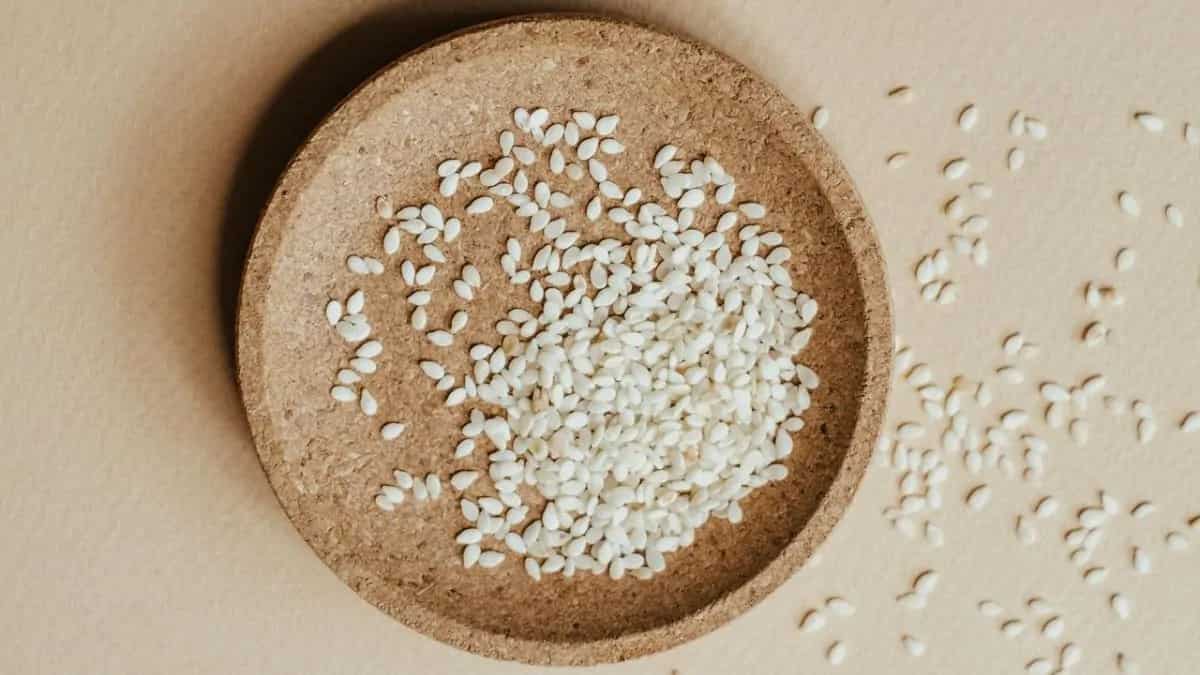
IN mid-January, winter in North India announces its soft turning point. Bonfires crackle for Lohri. Til-gur laddoos appear in kitchens. Sesame seeds—small, pale, unassuming—are roasted, mixed with jaggery, and shared with the instruction to forget old bitterness and speak sweetly.
It’s a familiar ritual. Almost domestic in its predictability. Yet the role sesame plays during this season is far older, and far stranger, than most of us pause to consider. Across cultures, this seed has been treated not merely as food, but as something charged — with memory, protection, and the promise that life continues beyond visible limits.
The Seed That Arrived Before Us
Sesame is often described as the world’s oldest oilseed, domesticated in the Indian subcontinent over five millennia ago. But its cultural life stretches further than agriculture. In early Hindu texts, sesame appears less as a crop and more as a substance with divine origins.
Several legends trace its creation to Vishnu himself. In some tellings, the seeds emerge from drops of his sweat during the cosmic churning of the ocean. In others, they form during a moment of divine fury. Either way, sesame is born from exertion — effort translated into nourishment. It is not accidental food. It is earned.
That sense of gravity carries into ritual use. Sesame appears repeatedly in Hindu rites connected to death and transition. During til tarpanam, seeds are offered to ancestors to ease their passage. The god Yama is said to have blessed sesame as a purifier, earning it the title “seed of immortality”. It is food meant to bridge worlds, not merely fill stomachs.
Even in observances like Shatila Ekadashi, sesame is used in six prescribed ways — on the body, in water, in fire, in food, in charity. Few ingredients receive such total attention. Sesame is allowed everywhere. It passes freely between the sacred and the everyday.
Why Sesame Opens
Thousands of kilometres away, in a very different cultural register, sesame becomes the key to hidden wealth. The phrase “Open Sesame”, immortalised in Ali Baba and the Forty Thieves, is so familiar it feels inevitable. Yet its origin is neither decorative nor random.
One explanation lies in botany. When sesame pods mature, they dry and split open suddenly, releasing their seeds with a sharp crack. The treasure opens itself. Say the right word — or wait for the right moment — and abundance appears.
There is also a linguistic wrinkle. Some scholars argue that “Open Sesame” may be the result of mistranslation, introduced by the French translator Antoine Galland in the early 18th century. The original phrase may have invoked a mountain, not a seed. Even so, the image stuck. Sesame, not stone, became the symbol of concealed riches.
Long before Ali Baba, Middle Eastern cultures had already placed sesame close to the divine. Babylonian myths claim the gods drank sesame wine before creating the world. In Assyrian lore, sesame oil was used in ritual magic. The seed wasn’t passive nourishment. It had agency.
Stories of Abundance That Refuse to End
Across Asia, sesame folklore often circles back to the same idea: plenty that does not run out.
In Bhaktapur, Nepal, the Til Madhav Narayan Temple is dedicated to an incarnation of Vishnu discovered through an odd market mystery. A trader notices that no matter how much sesame he sells, his stock never diminishes. The seed becomes proof of divine presence — not through spectacle, but through quiet persistence.
Egyptian folktales echo a similar tone. One story centres on a half-jinn child who spins an impossible tale of growing an entire acre of sesame on a date palm. The riddle is not about agriculture. It’s about restraint — about knowing when enough is enough, and when greed blinds people to what is already in front of them.
These are not grand moral epics. They are practical myths. Sesame rewards patience. It punishes excess. It survives.
Benne, Bells, and the Sound of Hope
When sesame travels again — this time across the Atlantic with enslaved West Africans — it takes on a different name: benne. But its symbolic weight remains intact.
In Gullah and Geechee communities, benne seeds were planted at the edges of fields and scattered near homes to ward off harm. The plants themselves carried meaning. As sesame pods dried, they rattled in the wind. In Arabic, one of sesame’s names — juljulan — refers to a small bell or echo.
That sound mattered. For people living under brutal conditions, the rustle of ripening sesame became a signal of continuity. A reminder that something had survived transplantation. That a future, however fragile, could still be imagined.
Why Sesame Still Matters
It would be easy to treat all this as a symbolic excess layered onto an ordinary ingredient. But sesame earns its mythology. It grows where other crops fail. It tolerates drought. It stores oil efficiently. It keeps.
That resilience is why it appears, year after year, in winter rituals. Why it is eaten with jaggery during Sankranti, when the sun shifts its course. Why it sits comfortably in both funeral rites and festive sweets.
Sesame does not announce itself. It waits. Then, under the right pressure — heat, time, attention — it opens.
So when you bite into a til-gur laddoo this season, you’re not only tasting sweetness. You’re participating in a story that has travelled across fires, oceans, temples, and kitchens — one small seed at a time.