For those unfamiliar with the ancient traditions, the Zoroastrian calendar can appear delightfully complex because it features two distinct new year celebrations. The first is Jamshedi Navroz, which coincides with the vernal equinox around March 21. This celebration is anchored to the solar cycle and honours the rebirth of nature, a tradition widely observed by Iranians and communities who follow the Fasli calendar. However, the Zoroastrians who adhere to the Shahenshahi and Kadmi calendars follow a liturgical year that does not account for modern leap year adjustments. Over many centuries, this lack of intercalation caused the religious calendar to drift backward relative to the sun. Consequently, the sacred new year has shifted forward on the Gregorian calendar, landing squarely in the middle of August. Today marks this auspicious August Navroz, followed by tomorrow's observance of Pateti.
The Ancestral Heart In Iran
In Iran, the historical cradle of the Zoroastrian faith, the culinary traditions of the new year are intimately tied to the seasonal cycle and ancient philosophy. Iranian Zoroastrians historically observe their religious new year during the warmer summer months if they follow the Qadimi tradition, though the broader cultural celebration happens in March. The Iranian kitchen during this season relies heavily on fresh green herbs, which symbolise the eternal vitality of life and the bounty of the earth. Dishes like Sabzi Polo, a masterclass in fragrant rice layered with massive quantities of dill, coriander, parsley, and fenugreek, are served alongside white fish. Another staple is Kuku Sabzi, a thick, emerald-green herb frittata packed with walnuts and barberries. These dishes reflect an ancient Persian culinary blueprint that pairs aromatic herbs with wholesome, sustaining ingredients.
The Symbolism Of The Haft Sin Table
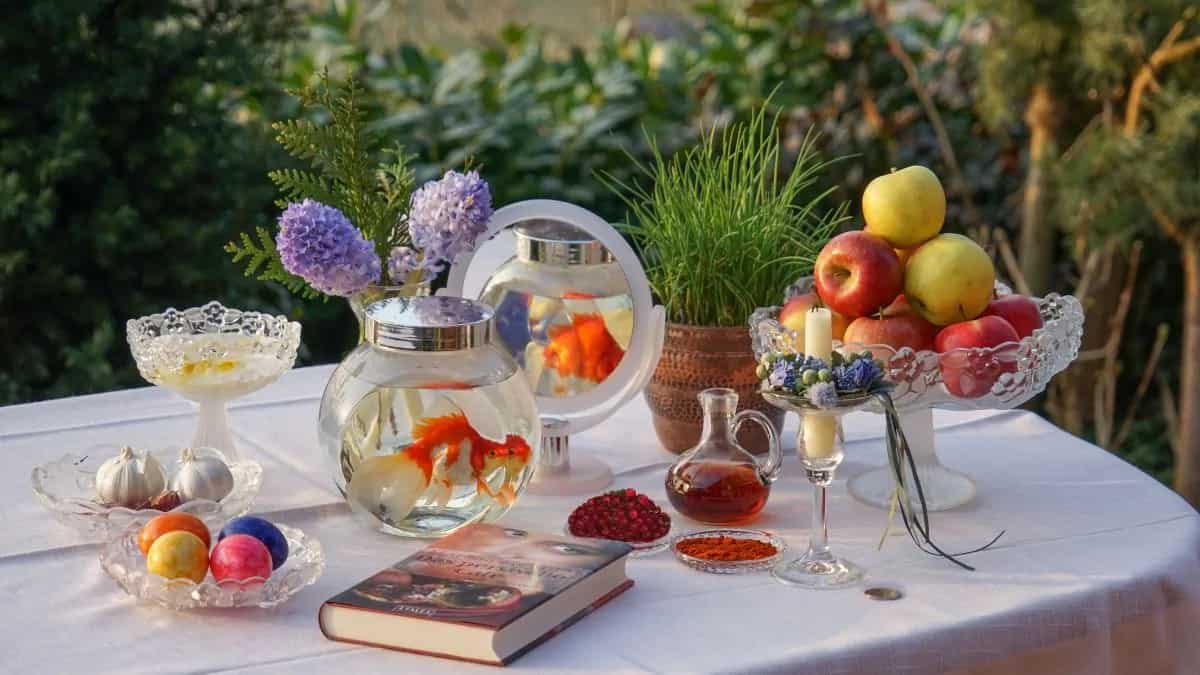
No discussion of Zoroastrian festive traditions is complete without exploring the Haft Sin table, a ceremonial spread traditionally prepared during the spring equinox and often replicated or honoured in spirit during other observances. The table is meticulously arranged with seven symbolic items, all beginning with the Persian letter Sin. These include Sabzeh representing wheat or lentil sprouts for rebirth, Samanu a sweet and intensely rich wheat germ paste signifying affluence, Senjed denoting the dried fruit of the oleaster tree for love, Seer representing garlic for health and medicine, Seeb or apples for beauty, Somagh for sumac berries representing the colour of sunrise, and Serkeh or vinegar for age and patience. The table is further enhanced with a mirror to reflect light, painted eggs for fertility, and a bowl of water containing a floating green leaf or orange to symbolise the earth.
Image credit: Wikimedia Commons
Culinary Customs In Afghanistan
Across the border in Afghanistan, the Zoroastrian and broader Persian-influenced communities weave unique regional flavours into their festive observances. Afghan culinary traditions for the new season heavily feature dried fruits, nuts, and hearty grains that speak to the mountainous terrain. A hallmark of the Afghan festive table is Haft Mewa, a magnificent sweet compote made by soaking seven varieties of dried fruits and nuts in water for several days. This fragrant nectar typically includes dark raisins, green raisins, red and yellow sweet apricots, pistachios, walnuts, and almonds. The resulting liquid becomes a deeply refreshing, naturally sweetened beverage that highlights the region's agricultural wealth, served alongside spiced rice dishes and slow-cooked lamb stews.
Image credit: NYT Cooking
Traditions Across Central Asia
In Central Asia, particularly in regions with deep historical ties to ancient Sogdiana, the new year is met with communal culinary rituals that require immense collective effort. The most famous traditional preparation is Sumalak, a sweet, dark brown paste made entirely from germinated wheat sprouts and flour. Cooking Sumalak is a communal event where women gather around massive cauldrons over wood fires, taking turns to stir the mixture continuously for up to twenty-four hours. As they stir, they sing traditional folk songs and make silent wishes. The resulting paste is entirely sugar-free yet intensely sweet due to the natural enzymatic breakdown of the sprouted wheat, and it is shared generously among family, friends, and neighbours as a blessing for the year ahead.
Image credit: Wikimedia Commons
The Parsi Feast In India
For the Parsi community in India celebrating today, the morning begins with a deeply comforting and sweet breakfast to ensure good fortune. Households prepare Ravo, a rich and velvety semolina pudding slow-cooked in milk and butter, heavily infused with cardamom and rose water, then garnished with fried almonds and raisins. Alongside it sits Sagan ni Sev, roasted vermicelli caramelised with sugar and scented with nutmeg.
By afternoon, the dining table transforms into an extravagant feast showcasing the community's unique culinary synthesis of Persian roots and Gujarati coastal influences. A central feature is Dhan Dar Patio, pairing fluffy white rice and a mild yellow toor dal with a fiercely spiced, tangy tomato and onion gravy made with prawns or fish. The patio relies on a complex sweet and sour balance achieved through dark jaggery and sugarcane vinegar. Another mandatory dish is Patra ni Machhi, where fresh pomfret fillets are coated in a vibrant green coconut, coriander, and mint chutney, wrapped tightly in banana leaves, and steamed until succulent. Meat lovers enjoy Sali Boti, tender mutton slow-cooked in a rich, tangy tomato gravy and crowned with crisp potato matchsticks known as sali, as well as Chicken Farcha, where chicken pieces are marinated in spices, dipped in beaten egg, and deep-fried to a golden crunch. Dessert brings Lagan nu Custard, a dense, baked custard flavoured with nutmeg and cardamom, often followed by traditional malai ice cream made without any artificial freezing agents, relying purely on slow-churned, reduced milk infused with saffron and pistachios.
Image credit: Celebration In My Kitchen
Diaspora Adaptations In The UK, US, And Canada
In western nations, the Parsi diaspora ensures that these intricate August recipes survive modern geographical constraints through resourcefulness and dedication. Families living in London, Toronto, or New York frequently adapt their menus based on local market availability without losing authenticity. For instance, diaspora home cooks often substitute traditional pomfret with local white fish varieties such as cod, sea bass, or halibut when preparing Patra ni Machhi, wrapping the fillets in foil if banana leaves cannot be sourced from local Asian grocers. Sourcing authentic sugarcane vinegar and jaggery for Sali Boti might require trips to specialised Indian or Iranian supermarkets, but the final dish maintains its signature sweet and sour profile. Community centres and local Zoroastrian associations across the United Kingdom and North America host large gatherings today, where traditional menus are lovingly recreated, ensuring that younger generations remain deeply connected to their culinary heritage.