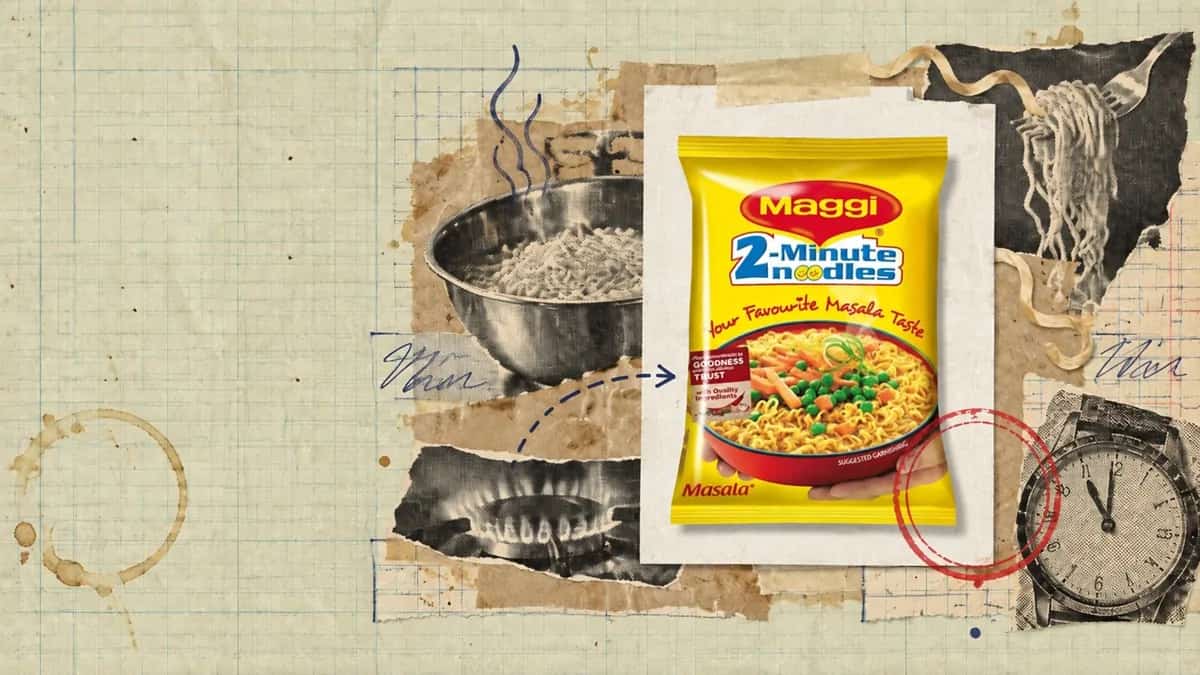
THERE IS A VERY SPECIFIC HOUR — after the house has gone quiet, after the respectable dinner has been eaten and forgotten — when the body does not want lentils. It wants Maggi. Not the polite, packet-faithful Maggi of hostel lore. The other one. The one you build like a small, slightly unhinged architecture: the cake broken into four, the Tastemaker dumped in with the confidence of a person who has stopped asking permission, then chilli flakes until the steam stings, then cheese that slumps into the gravy, and on the side, two eggs whose yolks are still a threat.
I have eaten this meal more times than a dietitian would like to know. Tonight I did something weirder. I stopped mid-craving and asked the only question a person in love with a processed food should eventually ask: what, exactly, am I putting into the system? Not as a confession. As a lab notebook written in the first person.
This is that notebook. Version One is Masala Maggi loaded with fresh chillies and chilli flakes, topped with cheese, and flanked by two sunny-side-up eggs. Version Two is egg Maggi, the eggs folded into the noodles themselves, finished with cheese. Each version is run at one packet and at two. The numbers are estimates, because home kitchens are not calibrated labs, and because “a lot of chilli” is a personality trait rather than a gram weight. I am reading labels and doing kitchen arithmetic, not measuring what happens in my body after dinner.
1. THE ANATOMY OF A YELLOW CAKE
A classic MAGGI 2-Minute Masala pack is two objects pretending to be one meal: a fried noodle cake and its Tastemaker sachet. Packs in the market vary in weight. For this audit I use the 75 g serving Nestlé India lists as one packet, cake and seasoning together.
Nestlé India’s published panel gives that 75 g serving 288 kcal, 6.2 g protein, 44.7 g carbohydrate, 9.4 g total fat, 750 mg sodium and 5.17 mg iron. It states saturated fat as not more than 6.2 g, an upper limit rather than an average. The panel does not give fibre for this product. These are the packet figures I use throughout.
>> The noodle cake is an engineered starch delivery system
The noodle cake starts with refined wheat flour — maida. Removing bran and germ changes the grain’s fibre and nutrient profile before the cake is even fried. What remains is a quick-cooking starch with the bite I expect from Maggi. Nestlé says it fries its noodles in palm oil; the published cake and seasoning together carry 9.4 g fat per 75 g serving. Boiling the cake at home does not undo that earlier fry. It does, mercifully, make dinner happen in minutes.
On the plate, the cake brings nearly 45 g of carbohydrate. For a short window I am fed and a little luminous, and on some nights I am soon considering the second packet. The feeling is mine; the extra 44.7 g of carbohydrate would be on the label.
>> The Tastemaker is a spice cabinet with a chemistry set
The masala sachet is the reason Maggi tastes like Maggi and not like sad boiled pasta. Onion, coriander, chilli, turmeric and cumin help build a familiar spice-cabinet smell. Those ingredients contribute flavours that the nose reads as “home”.
The savoury note has a chemistry set alongside the spice cabinet. Nestlé discusses INS 635, a flavour enhancer distinct from MSG, and says ingredients can contribute naturally occurring glutamate. The point my tongue makes is simpler: the broth tastes louder than the spice list suggests. The sodium number needs no interpretation. One serving delivers 750 mg, about 38% of the WHO adult recommendation of less than 2,000 mg a day, before cheese or a second pack. The same panel declares 5.17 mg iron, 17% of its own iron reference. The packet has a reason to boast, but I would read the entire label before joining in.
Nestlé says it does not add MSG (INS 621) to the noodles or Tastemaker. That claim is different from saying a savoury product has no glutamate at all. It is also different from saying that my delight in a hot, salty bowl is a moral failure. I am going to eat it again; chemistry does not have to make the confession for me.
>> The year the packet went to court
Which brings up the episode nobody in this country needs reminding of, and which sits exactly on the label. In 2015 the FSSAI ordered a recall of nine variants, citing disputed laboratory results on lead and the then “No Added MSG” claim. Nestlé contested the conclusions. The Bombay High Court set the ban aside over procedural and testing failures, and ordered accredited retests; that ruling was not itself a declaration that every packet was safe. Nestlé reported results within permitted lead limits, and the noodles returned to sale that November.
I cannot turn that history into a laboratory result for tonight’s bowl. What I can read on the current published panel is 750 mg sodium per serving. That figure was sitting in plain sight, ready for the moment I reached for a second cake.
2. WHAT THIS MEAL DOES INSIDE A HUMAN
Version One is several metabolic events sharing a plate.
The noodles are the carbohydrate event. Blood sugar rises after starch is digested; my pancreas supplies insulin. How sharp or gradual that rise is in a bowl with eggs and cheese, I cannot read off a label. On the sofa after an already respectable dinner, though, I know which part of this plate made a second cake seem plausible.
The fat comes from the fried cake, the cheese, the eggs and, in Version One, my frying pan. Saturated fat is not poison. Over time its amount and what replaces it in the rest of a diet matter for LDL cholesterol. Tonight I notice the nearer effects: a richer bowl, more energy in each bite, and a lingering fullness that may be unwelcome if I lie down too soon.
The salt is the least romantic ingredient and the most physiologically loud. My tongue cannot tell me whether the loaded bowl is near 1,200 mg sodium or near 1,950. The concern is less any single bowl than what happens when high-sodium dinners become a pattern, especially if I am already managing blood pressure or kidney problems. My late-night craving does not get an exemption from that arithmetic because I enjoyed it.
The eggs change the story. Two large eggs bring about 12.6 g of complete protein, roughly 294 mg of choline, plus B12, selenium, lutein and zeaxanthin. They also bring cholesterol; frying them on the side or folding them into the liquor does not make the yolks disappear. All that protein and fat is why egg Maggi feels like a meal to me and plain Maggi feels like a prelude to more Maggi.
The cheese is more protein, calcium, sodium and saturated fat, and the reason the bowl looks like an apology you are not going to make. For a repeatable estimate, I use 30 g of Amul A+ slices: about 95 kcal, 5.4 g protein, 7.5 g fat, 4.8 g saturated fat and 312 mg sodium. That is the honest “topped with cheese” portion for this particular model, not a promise about every cheese in my fridge. It also brings the specific pleasure of dairy fat meeting chilli oil.
The chilli has a research literature with a sense of humour. Capsaicin is responsible for much of its heat and acts on the same heat-sensing receptors that tell me a pan is too hot. A large observational cohort in China found an association between frequent spicy-food eating and some health outcomes; it cannot tell me what extra flakes do for this dinner. The acute effects are clearer: a flush, a runny nose and, if I get ambitious, heartburn. A lot of chilli will not cancel two packets of noodles. It will make the meal more interesting.
3. THE TWO VERSIONS, DEFINED SO THE NUMBERS CAN BE HONEST
Home cooking is sloppy and nutrition tables pretend it is not. These are the assumptions behind every figure that follows, chosen to match how this meal is actually built at midnight rather than how a brochure would plate it.
• Maggi: one 75 g classic Masala serving from Nestlé’s published panel, cooked with its full Tastemaker in the packet’s water and not drained.
• The second packet: an identical 75 g serving, cake and Tastemaker. The classic “still hungry” move.
• Cheese: 30 g, or one and a half 20 g Amul A+ slices, melted on top; still 30 g with two noodle packets. A real topping, not a garnish.
• Eggs, Version One: two large, sunny-side-up, fried in one teaspoon of neutral oil (about 45 kcal), served on the side with the yolks intact.
• Eggs, Version Two: the same two large eggs, cracked into the Maggi and softly set in the noodle liquor, with no frying oil.
• Chilli, Version One: three green chillies and two teaspoons of flakes, modelled at about 20 kcal. “A lot” is still a personality trait.
• Chilli, Version Two: an ordinary pinch of flakes, modelled at about 5 kcal. Egg Maggi is usually hot, not punitive.
Figures are rounded, brands and fry-pans vary, and the oil left in the egg pan is the biggest hidden swing.
Version One, the late-night architecture. Masala Maggi, chilli until the steam is a warning, cheese collapsed over the top, two sunny-side-up eggs on the side with the yolks available for breaking into the gravy. The more theatrical plate, and the one carrying the extra fat from the egg pan.
Version Two, the one-bowl argument. The same cake and Tastemaker, two eggs stirred through so the liquor turns opaque and the strands get coated, cheese on top. No separate fry: slightly less fat, the same protein, a little less theatre, a little more cohesion. This is the version you eat out of the pan.
4. THE NUMBERS, BECAUSE LOVE SHOULD BE ABLE TO COUNT
Everything in this section is my estimate for a home kitchen, built on the assumptions above and Nestlé India’s published panel. None of it is a laboratory measurement.
Where the calories come from in the one-packet meals: the cake and Tastemaker bring 288 kcal, two large eggs about 144, and 30 g of the modelled cheese about 95. The one teaspoon of oil for sunny-side-up adds 45 kcal, the theatrical tax. I allow roughly 20 kcal for Version One’s extravagant chilli and 5 for Version Two’s pinch. The sums are about 590 kcal for fried eggs on the side and 530 kcal for eggs folded in. Cooking method accounts for most of the difference; the different amounts of chilli account for the rest. Protein lands in much the same place.
With two packets I keep the same two eggs, 30 g cheese and, for Version One, the same one teaspoon of oil. The extra cake and sachet add the panel’s 288 kcal. That takes the two-packet plates to about 880 kcal with fried eggs and 820 kcal with eggs folded in. I am increasing the noodles, not hosting a second pair of eggs for dinner.
The rest of the arithmetic has its own joke. One loaded packet supplies roughly 24 g protein and 1,200 mg sodium; two supply roughly 30 g protein and 1,950 mg sodium. Iron rises from about 7 mg to 12 mg, mainly because each noodle serving contributes 5.17 mg. Total fat is about 31 g or 41 g for Version One, depending on packet count, against 26 g or 36 g for Version Two. The saturated-fat estimates are roughly 15 g and 21 g for Version One and 14 g and 20 g for Version Two, if the noodles are near their labelled maximum. Those last figures depend on the cheese and oil as well as the packet’s “not more than” declaration; they are not precise measurements of every bowl.
For scale, WHO recommends adults consume less than 2,000 mg sodium a day and keep saturated fat below 10% of energy: about 22 g on a 2,000 kcal reference day. That 22 g is a benchmark for that example, not everybody’s personal limit. My two-packet bowl approaches the sodium recommendation in one sitting; a different cheese or extra salt could take it past the line.
5. ONE PACKET AGAINST TWO, AND ONE VERSION AGAINST THE OTHER
The interesting comparison is not Maggi versus kale. Nobody eats Maggi because they lost a debate with kale. The interesting comparison is this meal against itself.
>> One packet versus two
The second cake and Tastemaker add 44.7 g carbohydrate, 6.2 g protein and 750 mg sodium — and that last number is the line I would underline in the kitchen. The eggs and cheese stay put. Total meal protein moves from about 24 g to about 30 g, while the noodles alone approach 90 g carbohydrate and the whole bowl approaches an adult day’s sodium recommendation. The second packet makes a bigger bowl; whether it makes me proportionately fuller is something the label cannot know. It is the classic “still hungry” move with a measurable price.
If the craving is volume, peas, spinach, a handful of cabbage or leftover sabzi give me options besides a second cake. They do not win the nostalgia contest. If the craving is the Tastemaker flavour itself, a second sachet brings its own salt, and Nestlé’s panel does not say how the 750 mg splits between cake and powder.
>> Version One versus Version Two
At matched egg and cheese counts, the versions are nutritional cousins. Version Two uses no frying oil, saving about 45 kcal and roughly 5 g fat. It also has less chilli in my recipe, which explains the rest of the roughly 60 kcal difference. Version One wins on ritual: the yolk-break is a small ceremony, and ceremonies are part of why we eat. Protein is a dead heat. Sodium is a dead heat. Version One’s chilli load may increase the chance I regret my life choices at 1 a.m. if I have reflux.
The plain noodle serving gets roughly 60% of its energy from carbohydrate. Adding eggs and cheese brings more protein and fat to the whole meal. That is the best argument for building the bowl this way: I have taken a starch-heavy convenience food and forced it to grow a protein spine. It still has the noodle packet’s sodium. A spine cannot do everything.
>> Against a “real” Indian dinner
The home thali I might have eaten — roti, dal, a vegetable, perhaps curd — is impossible to reduce to one standard calorie number. It usually offers me more kinds of food, and potentially much more fibre, than this particular bowl. The thali is maintenance; the Maggi is a mood regulator with a nutrition label. It is the frequency of that substitution that could turn a comforting eight-minute dinner into an unexamined habit.
6. THE CASE FOR IT, AND THE CASE AGAINST IT
>> What this meal does well
It is a more substantial protein event once the eggs are in. About 24 g in the one-packet version is far more than the packet’s 6.2 g alone. The eggs bring complete protein, and the cheese adds more. I am not trying to be a bodybuilder at midnight; I am trying to make supper feel like supper.
Fat and protein can change the way a meal is digested. Plain Maggi can feel to me like a glucose dart; eggs and cheese make the bowl feel as if the dart has gone through syrup. That is how the meal feels to me, not a measurement of my blood glucose.
Iron fortification counts. The published 75 g serving contributes 5.17 mg, and two servings more than 10 mg before the eggs. That is worth crediting to the packet.
Capsaicin is an interesting research subject and a poor accountant. Spicy food has a reputation for revving the metabolism, but I would not knock a single calorie off tonight’s bowl on its account. The chilli earns its place on taste.
Choline, lutein, B12, calcium. These are largely the eggs’ and cheese’s gifts. They are why “I added things” is more than culinary vanity. The protein and choline do count; so do the sodium and saturated fat that came along for dinner.
Psychological utility. A predictable, inexpensive, eight-minute meal that tastes like my own childhood is comforting. I do not need to dress that comfort up as a nutrient. Sometimes it is just dinner with better branding.
>> What this meal does badly
Sodium wears the least interesting costume. One loaded packet in this model is about 1,200 mg; two are about 1,950 mg, close to the WHO’s recommendation of less than 2,000 mg sodium for an adult day, before a morning chai with biscuits exists. The WHO identifies raised blood pressure as the main effect of a high-sodium diet. I cannot chilli-flake my way out of a habit that approaches that recommendation at supper.
The carbohydrate is plentiful for an hour when I may already have eaten dinner. The second packet adds another 44.7 g from noodles alone. That is a lot of starch to take to bed.
Saturated fat stacks from the fried noodle cake, dairy fat in the cheese and the eggs; the oil adds a little more in Version One. The two-packet fried model lands around 21 g if the noodles are near their labelled maximum, close to the roughly 22 g benchmark for a 2,000 kcal day at 10% of energy. The cheese, oil and actual product change that estimate. Occasional is one question. Habitual is another.
Fibre is the number the Maggi panel does not give me. I can see what is missing from my recipe: pulses, vegetables and whole grains. WHO advises adults to get at least 25 g of naturally occurring fibre a day. This bowl is not doing much work in that project unless I add those foods.
Ultra-processing is a pattern problem rather than a single-bowl problem. Under the NOVA classification, instant noodles are an ultra-processed food. That is a description of formulation, not a diagnosis delivered by one bowl. The practical risk, to my mind, is that a refined, salty, extraordinarily convenient dinner can become the default while dal and vegetables quietly leave the week.
Reflux, sleep, thirst. If I am prone to it, capsaicin plus a rich bowl plus lying down is how I meet my own sternum at 1:15 a.m. After a salty bowl, I sometimes wake up parched. Both can be quality-of-life taxes the label will not list.
7. SO… IS IT HEALTHY?
My one-word answer is no, not as a staple. The longer answer depends on the packet count, the weekly frequency, and what the rest of the day looked like.
A one-packet Version Two, eaten occasionally in a life that also contains dal, fruit, vegetables and sleep, is roughly a 530 kcal meal with 24 g protein, some iron, some choline and about 1,200 mg sodium. That is not health food, and it is not a crisis either. It is a processed comfort meal partly redeemed by eggs, with a sodium figure I can no longer pretend I did not see.
A two-packet Version One, eaten often, is a different object: about 880 kcal, nearly 90 g carbohydrate from the noodles, about 1,950 mg sodium in this model and saturated fat that could approach the 2,000 kcal day’s benchmark. A saltier cheese or extra salt can take it further. The eggs do not erase the second cake and sachet. They are doing their best in a burning building.
Health, here, is not a virtue contest between Maggi and quinoa. It is dose, context and replacement. If one-packet egg Maggi gets me fed on a difficult night, that convenience matters. If it replaces rajma-chawal four nights a week, the arithmetic turns. The noodles did not change. The pattern did.
The components explain the split personality. Starch from maida gives me the noodle fix. Eggs and cheese give the plate protein and nutrients the cake alone does not. Fat gives it richness and, if it becomes a habit, a reason to pay attention to the week. Chilli gives me theatre and a story to tell. Salt gives a GP a reason to look twice at the two-packet bowl. None of this is mysterious. It just rarely sits on the same page as the sentence "I really love Maggi".
8. HOW TO KEEP THE AFFAIR FROM BECOMING A CUSTODY BATTLE
• Default to one packet. If I want more bowl, peas, spinach, cabbage or leftover sabzi can join the eggs before I reach for a second cake.
• Cook the eggs in the Maggi when I feel like it. I keep the protein and lose the fry-oil surcharge. On other nights, the yolk-break ceremony is worth one measured teaspoon.
• Use the Tastemaker deliberately. Using less may reduce sodium, but the published panel does not divide that 750 mg between cake and sachet, so I cannot promise a precise saving.
• Keep the chilli for taste. It is the garnish I love; I will not ask it to make a second packet nutritionally vanish.
• Cheese is optional theatre. Ten grams still melts. Thirty grams is a decision, and the cheese brand changes the sodium maths.
• Notice how the late bowl feels. If chilli or richness gives me reflux, I can leave more time before bed or use less of it next time.
• Notice the frequency. If this becomes my default dinner, the question is what else has left the week. That is a bigger question than whether I can defend one beloved bowl.