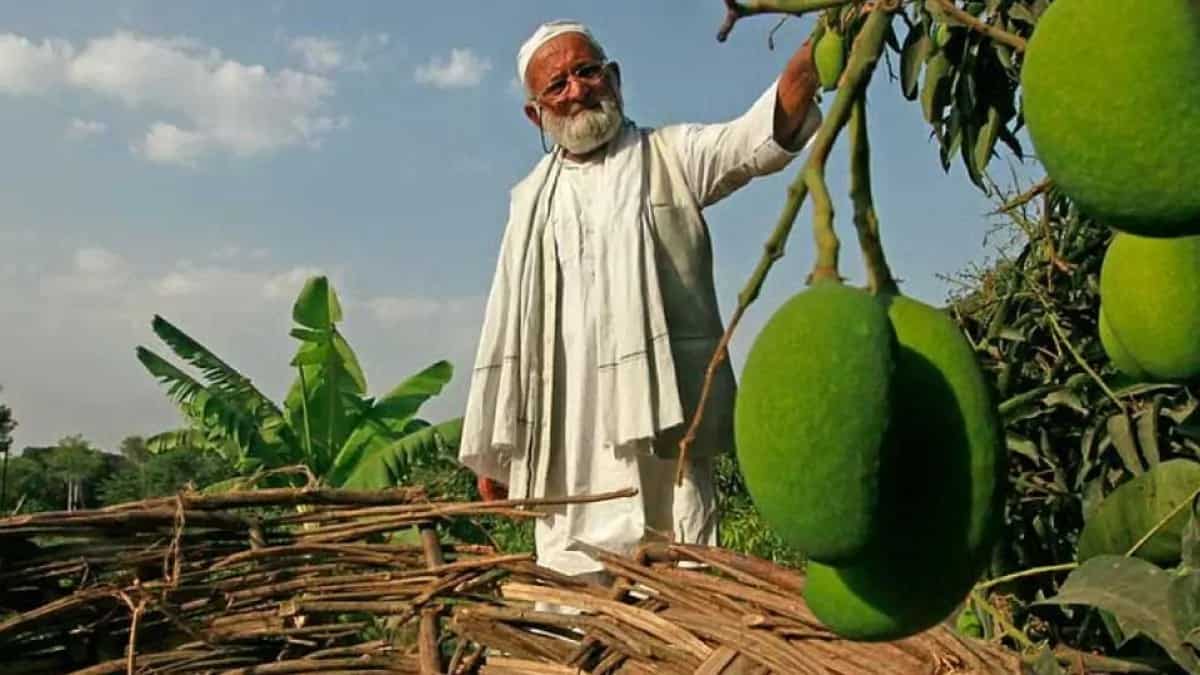
In the mango-growing region of Malihabad in Uttar Pradesh, one orchard has drawn the attention of farmers, researchers, and mango lovers from across the world. The reason for this is Kalimullah Khan, an 84-year-old horticulturist who has received the title of the ‘Mango Man of India’, based on his work with mango grating. According to reports, a single tree in Khan’s orchard in Uttar Pradesh bears more than 350 varieties of mangoes. The tree carries different varieties of mangoes, from alphonso and kesar to langra, dasehri, and chaunsa. These varieties differ in flavour, colour, aroma, and texture, and yet, all grow from the same tree and the same root system.
(Image Credit: http://hajikaleemullahkhan.in/)
What Is Grafting?
The process that is making this possible is called grafting. This is an agricultural technique where branches from one plant are grafted onto another tree, allowing them to continue growing together. While the process of grafting is not new, using it to maintain hundreds of varieties on a single tree successfully certainly requires years of precision, observation, experimentation, failure, and care.
How The Experiment Began
Khan’s journey into horticulture never began in classrooms or scientific laboratories. In fact, the Mango Man of India failed in his Class 7 exams, and that’s when he decided to devote his time, energy, and efforts to growing mangoes in his father’s orchard. He started spending more time there and developed an interest in mango cultivation and eventually became involved in decades of experimentation.
(Image Credit: http://hajikaleemullahkhan.in/)
Khan’s interest in grafting started in the late 1950s. One of his earliest ideas involved growing multiple mango varieties on a single tree, which some people around him believed was possible at that time. But Khan did not achieve success that quickly. The first few experiments were unsuccessful. This was later followed by a natural calamity, when the first tree he planted was destroyed in floods. But this did not stop him, and he started over. But the setback pushed him to study soil conditions, drainage systems, and how the way mango trees reacted to different environmental changes. This made him better equipped for the environmental conditions and possible calamities. Meanwhile, he continued with his grafting experiments. By the 1980s, Khan started using an old mango tree, which is approximately 125 years old today, from his family orchard as the foundation for larger experiments. Eventually, he realised that the same mango tree was capable of bearing more varieties after he started grafting on the same tree.
What Makes The 125 Year Old Tree Unique
This tree is special not only because of the number of mango varieties it produces, but also because each variety retains its own characteristics. Some mangoes growing on the tree are
small and fibrous, while others are sweet, pulpy, fragrant, and have bright colours. Several of the varieties are well-known Indian mangoes, while some are hybrids developed over years of experimentation. As per reports, Khan also named some mangoes after well-known personalities, including Sachin Tendulkar, Amitabh Bachchan, Narendra Modi, and Aishwarya Rai, depending on their features.
A Living Archive Of Mango Diversity
Over the years, Khan’s orchard has become more than just a farm. It is often described as a space that preserves mango diversity from across India. Different varieties are reportedly sourced from several parts of the country, which allows the orchard to bring together mangoes that would otherwise remain limited to specific regions. The collection includes mangoes known for their sweetness, strong aroma, bright pulp colour, or long shelf life.
The orchard also stands proof of the fact that mangoes are tied to Indian food culture. In India, mangoes are not just seasonal fruits but are connected to regional identities, farming traditions, pickles, desserts, and summer eating habits.
(Image Credit: http://hajikaleemullahkhan.in/)
Recognition Across India And Beyond
Kalimullah Khan’s work eventually earned national recognition when he received the Padma Shri in Horticulture in the year 2008. His name is also registered in the Limca Book of Records for his unique tree. His orchard is visited by researchers, farmers, and horticulture enthusiasts, who are interested in understanding his grafting techniques. Published reports suggest that visitors from countries such as Iran and Dubai have travelled to Malihabad to study the tree and learn more about his methods. As age and health have limited Kalimullah Khan’s daily work in the orchard, the legacy continues through his family, particularly his son Nazimullah Khan, who now helps manage the farm and maintain the grafted trees.
Kalimullah Khan believes that the orchard is his lifelong pride, which requires patience and curiosity. He also believes that deserts can grow mango trees with effort. Khan and his companion, the 125-year old tree, are a reminder of how experimentation, farming traditions, personal passion, and, of course, your love for food, can have an influence on the country’s culinary landscape.