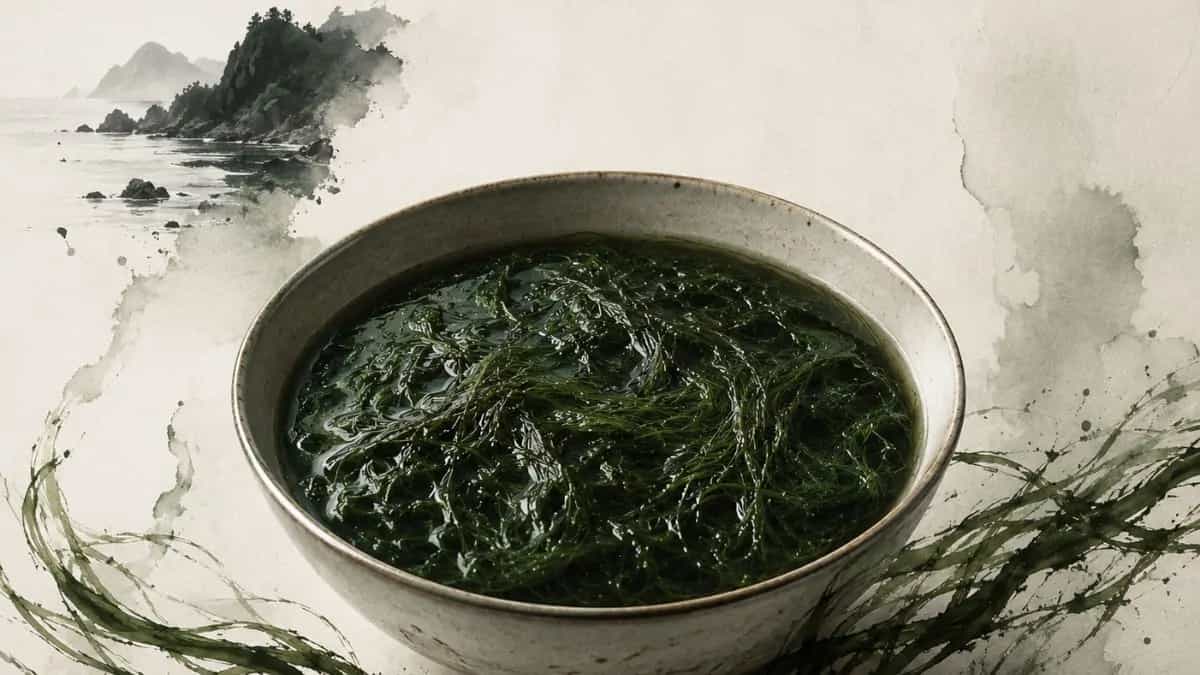
THERE is no steam rising from the bowl.
The soup is dark green and glossy, its surface crowded with threads so fine that they appear less like seaweed than strands of silk dropped into broth. To someone encountering it for the first time, it may look merely warm — perhaps even cool enough to swallow immediately.
This would be a mistake.
Maesaengi soup retains heat with almost comic efficiency. The seaweed is said to be made up of around 60 per cent air, while its dense web of delicate fibres traps the heat beneath the surface. A freshly boiled bowl can therefore appear completely placid while remaining fiercely hot underneath.
From this deception comes one of Korea’s best-known culinary jokes: “Give maesaengi soup to the annoying son-in-law.”
The imagined scene is one of domestic revenge performed without raised voices or obvious malice. A mother-in-law serves the husband she dislikes a generous bowl of apparently harmless soup. He, eager or unsuspecting, takes a large mouthful and burns his tongue. Everyone else knows to approach maesaengi slowly.
The joke depends upon the soup being familiar enough for the danger to be understood. But maesaengi itself has travelled a considerable distance — geographically, socially and gastronomically — to become such a recognisable part of Korean winter food culture.
Today, it appears on restaurant menus, in temple cuisine and in the kitchens of celebrity chefs. It is marketed as a premium seasonal ingredient, praised for its minerals and fibre, and increasingly sold in freeze-dried form beyond its short winter harvest.
Only a few decades ago, however, many coastal farmers regarded it as little more than a weed.
THE PLANT THAT DID NOT BELONG
Maesaengi, or Capsosiphon fulvescens, is a pine-green algae composed of impossibly fine, tubular strands. Its softness has earned it the description “silk of the sea”; another comparison likens eating it to drinking threads of cotton candy.
Even its name suggests fragility. Maesaengi is a pure Korean word translated as “to pluck fresh moss immediately” — an image of something tender, fresh and not meant to linger.
It flourishes along Korea’s southern coast, particularly around Jangheung and Wando in South Jeolla Province. These waters are also used to cultivate gim, the laver that is dried into the familiar, crisp seaweed sheets eaten with rice and used in dishes such as gimbap.
For laver farmers, maesaengi was once an intruder.
It grew in the same waters and became entangled in the valuable gim nets. When the two seaweeds were dried together, the maesaengi could cause the laver to crumble. Farmers therefore had to stand in the bitter cold, often with numb and freezing hands, picking the fine green threads from their harvest.
The work was laborious precisely because maesaengi is so delicate. It could not simply be tugged away in neat clumps. Every strand seemed to cling to what the farmers were trying to protect.
Yet coastal communities did not entirely discard the troublesome growth. Instead, they began boiling it with oysters. What had been pulled from the nets as an agricultural nuisance became the basis of one of Korea’s most distinctive winter soups.
The pairing seems almost inevitable in retrospect. Oysters, sometimes called the “milk of the sea”, bring richness and salinity. Maesaengi contributes a mild oceanic umami, a faint sweetness and a creamy, slippery texture sometimes compared to perfectly prepared okra. Together, they form maesaengigulguk: a bowl in which two ingredients from the cold southern sea soften and deepen one another.
It was a culinary discovery born not from abundance or prestige, but from the refusal to waste what the water had provided.
A CROP THAT CANNOT BE HURRIED
Maesaengi remains closely tied to winter. Its traditional harvest lasts only from late November until February, when the water temperature falls to between 5°C and 10°C, with around 8°C considered ideal.
Farmers place bamboo mats in shallow coastal waters, giving the algae a surface on which to grow. Once ready, every slippery strand must be gathered by hand from the freezing sea.
The crop is famously temperamental. It grows only in clean, unpolluted water and does not depend upon fertilisers or chemicals. Its presence is therefore treated as a sign of a healthy marine environment — an edible barometer of the water in which it has formed.
Even the weather can alter its quality. Heavy snow, rather than damaging maesaengi, can protect it from oxidation and produce a better harvest.
Everything about the crop appears to resist industrial convenience. It requires cold water, clean seas, careful timing and human hands. Its season is brief, its structure fragile and its behaviour in the kitchen unforgiving.
Before it can be cooked, maesaengi must be swished gently through cold salt water and strained through a fine sieve, removing sand and sediment without bruising the threads. Once added to a dish, it needs only a minute or two over the heat.
Boil it too long and it begins to vanish. Its emerald colour fades towards olive or black, while the strands themselves can melt away into the liquid.
Acidity presents another danger. Other Korean seaweeds, such as parae, can be dressed with vinegar. Maesaengi cannot. Acidic condiments attack its delicate structure, causing it to dissolve.
It is, in other words, an ingredient that demands restraint. It asks the cook to wash softly, season thoughtfully and stop before the temptation to do more ruins everything.
HOW THICK SHOULD THE SEA BE?
Few dishes demonstrate the distance between a food’s place of origin and its metropolitan reinterpretation as clearly as maesaengi soup.
In Jangheung and other areas along the southern coast, it may be prepared with very little water. The resulting dish is thick with seaweed — dense enough to be lifted with chopsticks rather than sipped from a spoon.
Visitors from Seoul who search for spoons can be teased as city slickers who do not understand how maesaengi ought to be eaten.
In the capital, the seaweed is more commonly loosened into a thinner broth. A spoon becomes necessary, while the dilution makes its marine flavour gentler and more accessible to those who have not grown up with bowls thick enough to resemble a portion of the sea itself.
Neither version is simply a question of consistency. The chopstick-versus-spoon debate contains within it an old culinary tension: between the people who know an ingredient as part of their landscape and those who encounter it after it has migrated into restaurants, supermarkets and national fashion.
To eat maesaengi thickly is to experience its texture almost undiluted. To add more broth is to translate it.
Its culinary life has expanded accordingly. Beyond oyster soup, maesaengi is folded into savoury jeon pancakes, stirred into rice porridge, added to knife-cut kalguksu noodles and occasionally served as a birthday soup in place of the traditional miyeokguk.
It has also found a place in refined vegan temple cooking. The Buddhist monk Jeong Kwan, known for her deeply contemplative approach to Korean cuisine, has prepared braised maesaengi using shiitake mushrooms and water infused with lotus leaf — a dish that replaces the richness of shellfish with the quieter depths of plants.
The ingredient’s delicacy, once a source of frustration for farmers, has become part of its allure.
FROM COASTAL SECRET TO NATIONAL SUPERFOOD
Modern enthusiasm for maesaengi is not based upon texture and folklore alone. It is also widely valued for its nutritional profile, including calcium, iron, iodine and dietary fibre. Dried maesaengi is roughly 22.7 per cent minerals and can contain up to 6.6 per cent crude protein.
In Korean food culture, it has long been associated with hangover recovery, blood health, digestion and the nourishment of growing children and older people. Such traditional beliefs have helped recast the plant as a restorative winter food, well suited to the period when cold weather makes a hot, mineral-rich bowl particularly appealing.
Celebrity chefs and high-end restaurants have further raised its profile. Freeze-drying has loosened the old constraints of the growing season, allowing maesaengi to be stored, transported and eaten throughout the year. An ingredient once known almost entirely to southern coastal communities can now travel far beyond the waters in which it grew.
Yet something essential is lost when maesaengi is described only as a superfood.
Its real significance lies in the history held within those green strands: the laver farmers who cursed it, the frozen hands that pulled it from their nets, the cooks who placed it in a pot rather than throwing it away, and the regional knowledge that still determines whether a bowl requires chopsticks or a spoon.
Even its most famous joke contains a kind of instruction. Do not trust appearances. Do not rush. What seems cool may be scalding; what appears to be a weed may become a delicacy.
The “silk of the sea” must be harvested when the water permits, handled without force and cooked only briefly. Then it must be eaten with patience, one cautious mouthful at a time.