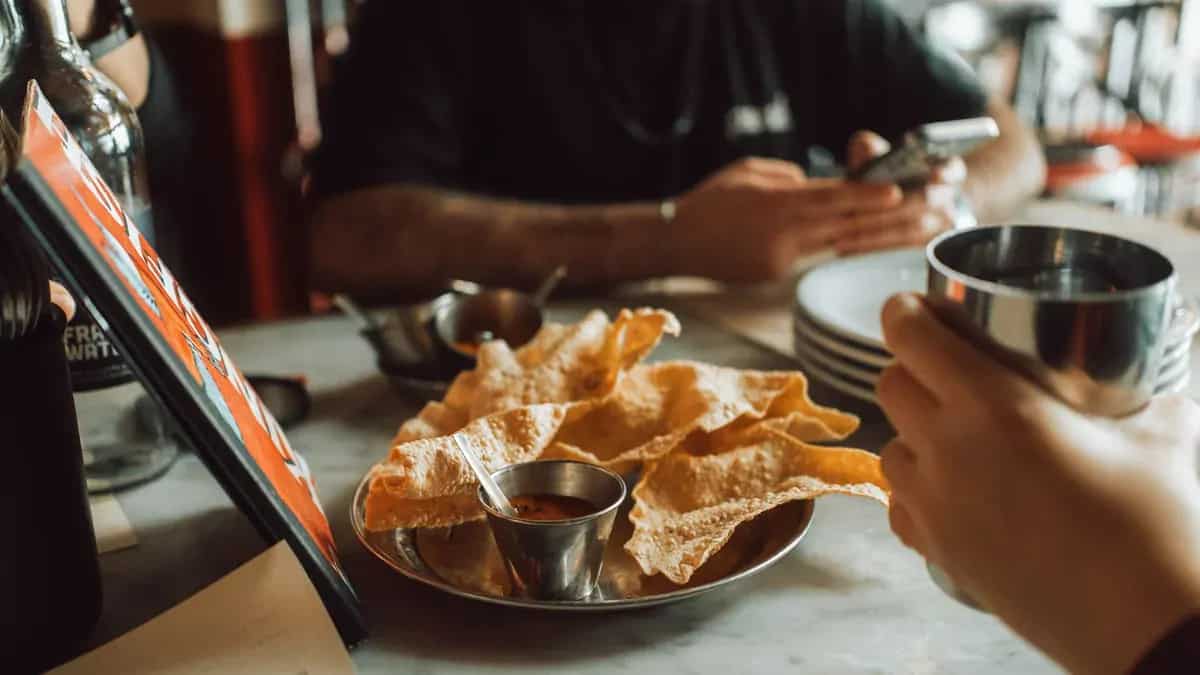
The first thing you notice about a papad isn’t the flavour—it’s the sound: a dry crackle as it gives way, the brief warmth of roasted urad rising when a tin is opened. Lijjat’s origin is often retold like a slogan—seven women, Rs 80, Mumbai, 1959—but the part that turned a home-kitchen product into a nationwide habit is quieter: a member-run system built to keep one promise steady, packet after packet.
What The Lijjat Papad Origin Story Really Is
When people search “Lijjat Papad history,” they’re usually after more than a quotable line. They want (1) where it began—in human, local terms—and (2) how it kept working at scale, without turning into a different papad in every packet.
One-sentence origin summary: In 1959, seven women in Mumbai pooled Rs 80 (widely reported) to start making papad under a cooperative model—what is known as Shri Mahila Griha Udyog Lijjat Papad—and growth followed from protecting consistency and availability, not chasing novelty.
Scope note, so this stays honest: this piece covers origin + the cooperative operating model + a selective, decade-based growth arc + cultural impact. It’s not a full corporate history, and it avoids “exact numbers” unless they’re verifiable.
What the story isn’t—because these simplifications keep showing up:
- Not a single-founder legend. Lijjat is best understood as a women-run cooperative, with collective ownership and responsibility.
- Not an NGO storyline. It’s a production-and-income model built around work, standards, and governance—not charity.
- Not a rags-to-riches fable. The durable part is discipline: repeatable process, checks, and the patience to earn trust slowly.
If “cooperative” feels abstract, keep it plain: the people doing the work also own the enterprise, and rules are meant to serve members collectively—not outside shareholders.
Mumbai, 1959: The Founding Moment And Why Papad Made Sense
Picture Mumbai in 1959 without the soft-focus nostalgia: tight neighbourhood economies, kirana shelves that rewarded reliability, and household kitchens that doubled as the most practical “infrastructure” available. Capital was limited; reputations travelled quickly; work needed to fit real constraints.
Papad made sense as a starter product—not because it was fashionable, but because it matched those constraints:
- Shelf-stable: dried papad holds for weeks, lowering spoilage risk.
- Repeatable technique: mixing, portioning, rolling, drying—steps that can be taught and checked.
- Everyday demand: it fits lunch thalis, rushed dinners, and tea-time snacking.
- Low wastage: you can scale in small batches without betting on perishables.
- Easy local movement: flat, light packets suit neighbourhood distribution.
Early selling, as widely seen in small food businesses of the period, likely leaned on local networks—nearby customers, shopkeepers willing to stock what looked consistent, word-of-mouth built through routine shopping rather than one dramatic “launch.” The problem being solved wasn’t merely “how to sell papad.” It was how to secure steady livelihood with dignity, through work that could be done from home or community spaces.
Example (why papad was commercially forgiving): If a batch of chutney turns, you lose the day. If papad dries well, you gain time—time to find buyers, adjust salt, learn humidity’s moods, and keep cash moving while skills settle into muscle memory.
How The Lijjat Cooperative Worked Day-To-Day
Plenty of people can make papad. The hard part is making the same papad—the same snap, the same roast behaviour—across many homes, seasons, and hands. Lijjat’s differentiator wasn’t a secret ingredient as much as a shared operating system designed to protect sameness.
Member-based ownership in practice
In a cooperative, women don’t only “work for” a brand; they belong to it as members. In practice, that shared identity changes incentives: the brand name isn’t an external boss—it’s a collective asset. When production is decentralised, this matters because quality becomes shared reputation, not an individual shortcut.
Decision-making without corporate theatre
A cooperative still has to make decisions—procurement, standards, dispute handling, expansion. Instead of corporate hierarchy, cooperatives commonly rely on collective oversight through committees and member-led governance. The point isn’t fancy structure; it’s legitimacy: rules people understand, and accountability that feels local.
Standardisation and quality: the craft of consistency
Papad is deceptively technical. Small shifts in dough hydration, rolling thickness, drying time, humidity, or oil temperature can change snap, blistering, and bitterness.
One way cooperatives typically protect consistency is by making quality visible and checkable:
- Recipe anchors: stable base ingredients and spice ratios that don’t drift with every cook.
- Process cues: portioning and thickness control so roasting/frying stays predictable.
- Sorting/checking: imperfect pieces are identified early and kept out of packs so a consumer doesn’t meet “surprise papad.”
Example (a concrete system win): Thickness is destiny. Too thick and it turns leathery; too thin and it scorches fast. A consistent thickness doesn’t only protect taste—it protects the customer’s cooking experience. When papad behaves predictably over a gas flame, the cook trusts their timing, and that quiet confidence becomes repeat purchase.
Decentralised production, centralised backbone
Scale becomes possible when you separate what must be uniform from what can be distributed.
- Decentralised: rolling, drying, day-to-day production in many homes or community units.
- Centralised: standards, brand identity, packaging expectations, and distribution—one backbone so the shelf reads as one promise.
Papad suits this split because the labour is modular: you don’t need one giant line to roll discs; you need many steady hands following the same cues.
How “system” becomes consumer trust
Most shoppers don’t buy governance models; they buy outcomes. Over time, a system like this becomes trust in three everyday ways:
- Taste stays familiar across packs.
- The packet is easy to find when you reach for it.
- It cooks predictably—roasted, fried, or microwaved—without unpleasant surprises.
A common misconception is that Lijjat scaled mainly because it was cheap. Price matters, but staples become habits when they’re consistent and reliably available.
Key Moments That Enabled Scale
A precise, exhaustive timeline often turns into a numbers parade—and public retellings can vary. More useful is a selective arc tied to what enabled growth.
- 1959: The start in Mumbai with seven women and Rs 80 (widely reported).
Enabler: a shelf-stable product and repeatable process suited to low capital.
- By the 1960s: Replication beyond the first circle of members.
Enabler: teachable steps and shared standards, so new production didn’t dilute texture.
- By the 1970s: Wider presence in everyday retail networks.
Enabler: distribution discipline—showing up in ordinary shops consistently.
- Across the 1980s–1990s: Brand recognition hardens into a default choice in many homes.
Enabler: naming and packaging consistent enough to ask for, easy enough to spot.
- 2000s onward: Competing in a louder snack market without becoming a novelty brand.
Enabler: resilience through the cooperative core—member ownership plus process consistency.
Where sources disagree on fine-grained details, it’s safer—and more accurate—to focus on the mechanisms that are clearly legible in the model.
Why Lijjat Became Culturally Iconic
Icon status isn’t awarded; it’s accumulated through repetition. Lijjat became culturally iconic because it delivered the same sensory reassurance often enough that it fused with routine.
The product experience: crunch as reliability
Hear a papad meet hot oil: a brief hiss, a quick bloom, the disc stiffening into something brittle. Over a flame: tiny blisters rising, toasted urad and spice arriving fast, a faint edge-char if you hesitate.
That reliability shows up as:
- Texture: a clean snap—neither stale crumble nor chew.
- Flavour profile: salt and spice that sit beside dal, curd rice, or a thali without hijacking the meal.
- Kitchen behaviour: it roasts and fries in ways hands can learn and repeat.
Example (frequency builds icon status): Papad plays more roles than most packaged foods—side with lunch, crushed into chaat, served with evening tea, nudged beside pickle when the meal feels plain. Frequency multiplies memory.
Brand memory cues: everyday signals, not advertising poetry
Ubiquity is built from mundane signals: the packet behind the counter; the name spoken in the same breath as “dahi” and “atta”; a design familiar enough to spot in a hurry. Over years, the brand becomes a shortcut for households that don’t want experimentation in a staple.
The deeper symbol: livelihoods inside a daily habit
There’s meaning here beyond nostalgia, without sentimentality. A women-led cooperative embedding itself in ordinary meals changes what work can look like: income tied to skill, routine, and shared rules. The icon isn’t only the papad; it’s the idea that everyday food can carry everyday dignity.
If you want to explore how snacks like papad and regional crisps map onto place—without turning this into a travelogue—follow Food Trails.
Lessons For Women-Led Food Entrepreneurship
Lijjat’s story is often quoted as inspiration; it’s more useful as trade-offs.
- Principle 1: Systems beat slogans. Define what “good” looks like—ingredient baselines, texture targets, process steps—and keep it non-negotiable.
- Principle 2: Community scale requires trade-offs. Decentralisation creates livelihoods and reach, but it demands training and checks; speed is tempting, consistency is expensive.
- Principle 3: Trust is built over time through distribution and consistency. A spike sells curiosity; steady availability sells habit.
- One caution: don’t romanticise the model. Cooperative governance is work—decisions, disputes, accountability.
Example (how to apply today, briefly): Before expanding beyond one kitchen, a home-based snack brand can document a simple SOP so new helpers reproduce the same thickness, roast time, and salt level.
If you’re here because Lijjat lives in your kitchen, a next step is cooking with it: try papad chaat, papad sabzi, or crushed papad for texture in salads and raita via Discover recipes.
The Rs 80 origin line is memorable, but it’s not the mechanism. The mechanism is a cooperative system that turned a fragile thing—trust—into something you could stack on a shelf and count on at dinner. In the end, that everyday crackle is more than snack noise: it’s the sound of livelihoods made steady through repetition and shared rules. Tell us what papad means in your home—your roasting method, your favourite brand (Lijjat or local), your family ritual—at Slurrp Community.
Some parts of this article were created with AI assistance.