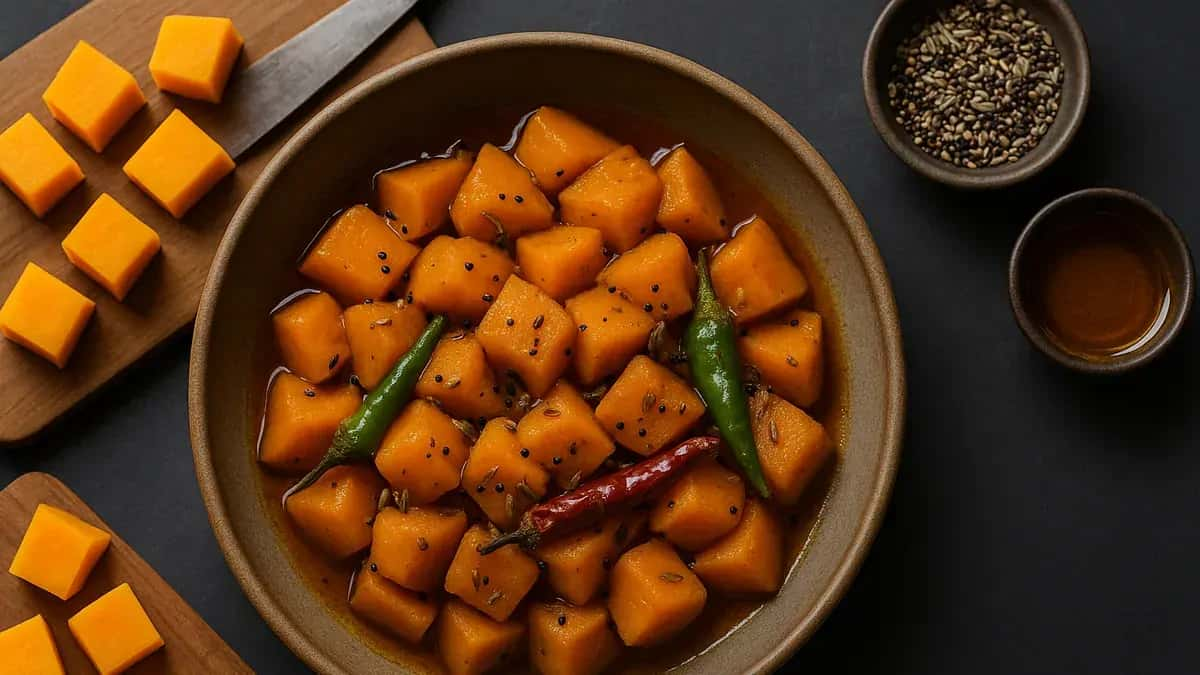
A good Kumror Chokka announces itself quietly: mustard oil warmed to its edge, seeds crackling for a few seconds, then neat pieces of pumpkin turning glossy as they soften—each still able to stand on its own. Get the cut wrong and the same ingredients slump.
If you want cultural context without losing the thread of this technique, follow our Bengal-focused food trails: /food-trails.
Kumror Chokka, Explained
Kumror Chokka is a Bengali pumpkin preparation cooked with minimal aromatics—often no onion or garlic—so the flavor comes from the pumpkin itself plus mustard oil and a brief tempering of whole spices. It’s not a curry and not a mash: the goal is tender pieces that hold their shape, lightly coated in spiced oil.
On the plate, “chokka” should feel dry-leaning but not parched—no watery gravy, no broken fibers. Expect pumpkin sweetness (sometimes nudged with a pinch of sugar), mustard oil’s sharp aroma, and the bite of tempered seeds. The two levers that decide success are simple: a consistent cut and careful moisture management.
The One Thing To Get Right: The Pumpkin Cut
Target cut: 2–3 cm (about 1 inch) cubes or short rectangles, as even in thickness as you can manage. Pick one shape; don’t mix wedges, slabs, and chunks.
Why it matters:
- Uniform thickness = predictable doneness. Same distance to the center means a clear window where pieces are tender but still strong.
- Surface area controls browning vs steaming. Tiny dice soften before they can glaze; big uneven chunks brown outside while staying firm at the core.
- Shape controls breakage. Thin wedges snap when you toss; sturdy cubes/rectangles can be turned gently without shredding.
Common mistakes (and what happens):
- Too small (around 1 cm dice): cooks fast, turns jammy, breaks with stirring.
- Uneven pieces: some stay chalky while others melt; you keep cooking “for the raw ones” and lose the rest.
- Thin wedges/slivers: soften, then fracture at the edges.
- Irregular shapes: uneven browning—dark spots on some pieces, steamed-looking others.
Quick visual cue: in the bowl, pieces should look like they came from the same template—similar footprint, similar thickness, no outliers.
Cut example:
- Ideal: 2–3 cm cubes/short rectangles.
- Not ideal: thin wedges (break) or tiny dice (go mushy before moisture cooks off).
Ingredients (Minimal, Traditional, Flexible Without Losing The Point)
Pumpkin (kumro): choose a firmer, drier pumpkin if you can. Watery pumpkin still works, but it needs more lid-off time to evaporate moisture and has a shorter doneness window.
Core ingredients (serves 3–4 as a side):
- Pumpkin: ~500 g, peeled and de-seeded
- Mustard oil: 2–3 tbsp
- Panch phoron: 1 tsp
- Turmeric: 1/2 tsp
- Ginger: 1–2 tsp grated (or ginger paste)
- Chili: 1–2 green chilies slit (or 1 dried red chili)
- Salt: to taste
Mustard oil (what it does, how to use it): it brings a sharp, savory perfume that makes a no-onion dish feel complete. Warm it until it’s shimmering and just at the edge of smoking, then lower the heat before adding spices. (In some kitchens—especially with very strong mustard oil—you may prefer stopping just short of visible smoke.)
Panch phoron substitute: use any 2–3 in small pinches: cumin, fennel, mustard seed, fenugreek, nigella (kalonji). Keep it light.
Oil substitutions (with expectations):
- Best: neutral oil + 1 tsp mustard oil at the end.
- Acceptable: neutral oil alone (milder; technique stays the same).
Water use: aim to cook mostly with the pumpkin’s own moisture. Keep 1–2 tbsp water as a rescue only if the pan is dry and threatening to scorch before the pumpkin softens.
Optional: a pinch of sugar/jaggery helps if your pumpkin is young/green and not very sweet.
How To Make Kumror Chokka
Step 1: Prep the pumpkin for browning (not steaming)
- Peel, de-seed, and cut into uniform 2–3 cm cubes/rectangles.
- Pat dry. Wet pumpkin steams first, softening edges before they can glaze.
Step 2: Heat mustard oil correctly, then temper without burning
- In a wide pan over medium heat, add 2–3 tbsp mustard oil.
- Heat until the oil shimmers and you see the first wisp of smoke (or just before, if your mustard oil is especially pungent), then lower the heat.
- Add 1 tsp panch phoron (and dried red chili, if using).
- Let it crackle 10–20 seconds—fragrant, not dark.
If seeds darken fast, your heat is too high—pull the pan off the burner briefly.
Step 3: Add pumpkin, then season to draw moisture—gently
- Add pumpkin and toss to coat in spiced oil.
- Add turmeric + salt within the first minute. Salt draws out moisture, which becomes your cooking liquid.
- Add ginger and green chilies.
Handling rule: toss or fold, don’t stir aggressively.
Step 4: Control moisture with the lid (use water only as a rescue)
- Cook 2–3 minutes lid-off to start moisture release and lightly sear a few faces.
- When the pan looks lightly wet, cover and cook on low for 6–10 minutes, checking once or twice.
- If the pan looks dry and you smell scorching before the pumpkin is tendering, add 1–2 tbsp water, cover, and continue.
Step 5: Finish lid-off for glaze and clean edges
- When nearly done, remove lid and cook 1–2 minutes so excess moisture evaporates and the pieces look glazed, not watery.
- Adjust salt. Add an optional pinch of sugar/jaggery if it tastes more vegetal than gently sweet.
Doneness cue example (use 2–3 together):
- Knife tip slides in with slight resistance.
- Edges look glossy and stained yellow with oil and turmeric.
- A piece holds its shape when lifted.
- No watery pool in the pan—just a thin coat of spiced oil.
Troubleshooting: Keep The Pieces Intact
Problem: It’s turning mushy.
- Likely causes: cut too small, too much water, too long under the lid, frequent stirring.
- Do now: remove lid and raise heat briefly to drive off moisture; stop stirring and shake the pan gently.
- Next time: keep pieces at 2–3 cm, add water only as a rescue, and start checking a few minutes earlier (watery pumpkins overcook quickly).
Problem: It’s undercooked but pieces are breaking.
- Likely causes: heat too high early, thin wedge-like pieces, rough tossing while still firm.
- Fix: add 1–2 tbsp water, cover on low in short bursts (2–3 minutes), then finish lid-off. Lower heat and fold gently.
Problem: It tastes flat (especially in a no-onion dish).
- Check the real flavor engines: mustard oil aroma, properly toasted tempering spices, ginger warmth, salt balance.
- Fix points: temper until fragrant (not burnt), adjust salt at the end, and if needed add 1 tsp mustard oil off-heat for aroma.
Have a local pumpkin that behaves differently (watery, starchy) or you’re unsure about the best cut size for it? Ask the Slurrp community: /community.
How To Serve And Store Kumror Chokka
Serve warm with steamed rice, or alongside luchi.
To store, cool completely, refrigerate in a shallow container, and reheat in a pan lid-off with a teaspoon of oil—microwaving tends to steam and soften edges.
If you adjust oil quantity or add sweetener and want a quick estimate, run your version through the Slurrp Nutrimeter: /nutrimeter.
Conclusion
Kumror Chokka rewards restraint: cut the pumpkin evenly, and finish with a dry-leaning glaze rather than a watery pan. Turn off the heat when the knife meets slight resistance and each piece lifts cleanly—still itself, not halfway to mash.
Ready to cook more from the region? Browse what to make next on Slurrp: /discover/recipes.
Some parts of this article were created with AI assistance.