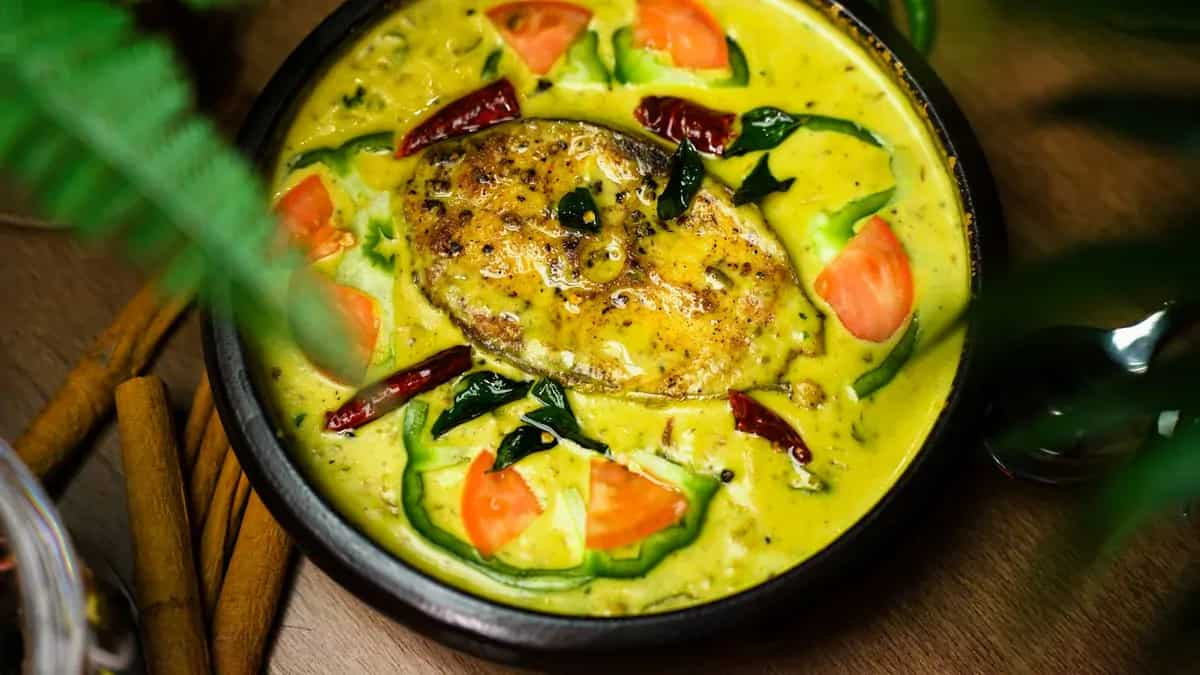
You know it’s going right when the pan smells like warm coconut and green chilli—clean, almost sweet—and the curry stays the colour of beach sand at noon. No brick-red oil. No tamarind tug. Just a pale, softly aromatic gravy that coats fish without bullying it. This Kerala fish moilee recipe is the weeknight version: minimal ingredients, one wide pan, and two non-negotiable rules—gentle heat for the coconut milk, gentle handling for the fish.
Kerala Fish Moilee, Defined
Fish moilee (often spelt molee) is Kerala’s lighter, coconut-milk fish curry—built on onions/shallots, ginger, green chillies, curry leaves, and coconut milk rather than tomato, tamarind, or a long roasted spice list. The flavour target is deliberately mild: coconut-forward and satiny, with curry-leaf perfume and ginger warmth, and heat that stays in the background.
“Minimal ingredients” here means a strict core that delivers moilee’s identity without detouring into festival-style complexity: no long masala blends, no heavy garam masala, and—importantly for many searches—this is a fish moilee without tomato (and without tamarind). Depth comes from technique instead: sweating onions until sweet (not browned) to keep the curry pale, and letting fish cook in calm heat.
Minimal Ingredients Checklist & Smart Substitutions
This dish rewards restraint. Shop once, cook fast, and keep the flavours clear.
Core checklist (the non-negotiables)
- Fish (thick pieces; see options below)
- Coconut milk (canned or fresh)
- Coconut oil (for aroma)
- Onion or shallots
- Ginger
- Green chilies
- Curry leaves
- Salt
Optional add-ons (choose 1–2 max)
- Turmeric (a pinch for warmth and a faint golden hue)
- Black pepper (gentle bite; best added late)
- Lime (brightness at the end—never early)
Fish options (what works on a weeknight)
Aim for thick pieces that can simmer without turning to flakes.
- Best shape: steaks or thick fillet chunks, about 2–3 cm / ~1 inch thick.
- Good everyday options: seer/king fish and pomfret (classic), or sturdier supermarket stand-ins like salmon and cod.
- Avoid for your first try: very thin fillets (they overcook before the sauce settles) or fish that shreds easily.
A practical cue: if you can lift a raw piece with tongs and it doesn’t droop dramatically, it’s usually moilee-friendly.
Coconut milk: canned vs fresh (and how to make “thin” + “thick”)
Moilee is easiest to control when you treat coconut milk as two stages:
- Thin coconut milk = the simmering base
- Thick coconut milk = the finishing splash
If you’re using canned coconut milk (most weeknight-friendly):
Substitution example: Mix 1 part canned coconut milk + 1 part water to make “thin” coconut milk. Reserve the remaining coconut milk as “thick” to add at the end.
If you’re using fresh coconut milk:
- First press (thicker, richer) = your thick finish.
- Second press (lighter) = your thin simmering base.
Substitution rules that protect moilee’s taste
- Coconut oil vs neutral oil: coconut oil gives moilee its signature perfume. Neutral oil works, but the curry smells flatter; compensate with fresh curry leaves if you can.
- Shallots vs onion: shallots bring softer sweetness and keep the curry paler; onion is fine—slice thin and cook patiently.
- Fresh vs frozen curry leaves: frozen is acceptable. Rub them between your fingers before adding to wake up aroma.
- Green chili heat varies: start with fewer chilies; you can always add another slit chili late and warm briefly.
Want more ideas in the same flavor lane? Explore more Kerala-style fish and coconut curry recipes.
Weeknight Method: Kerala Fish Moilee In ~30 Minutes
Timeline: Prep 5–10 minutes. Cook 15–20 minutes. Total: ~25–30 minutes.
Cookware: A wide pan or skillet (lid optional) beats a deep pot—the fish can lie in a single layer, so you don’t have to stir.
Step 1: Prep fish and aromatics (5–10 min)
- Fish: Pat dry. Lightly salt both sides. Cut into large chunks if using fillets.
- Onion/shallots: Slice thin (thin slices sweat faster and melt into the sauce).
- Ginger: Grate or chop finely.
- Green chillies: Slit lengthwise.
- Curry leaves: Rinse quickly and pat dry.
Step 2: Sweat the aromatics—keep it pale (5–7 min)
Warm coconut oil in your wide pan over medium-low heat.
- Add onion/shallots with a pinch of salt.
- Cook until soft and sweet, not browned.
- Add ginger and slit green chillies; cook 30–60 seconds until ginger smells warm and no longer raw.
Step 3: Add thin coconut milk; bring to a gentle simmer (3–5 min)
Pour in your thin coconut milk.
- Bring it to a gentle simmer—small bubbles at the edges.
- If using turmeric, whisk in a pinch now (or bloom it briefly in the oil before the onions for a deeper yellow).
Step 4: Slide in fish; cook with calm heat (6–10 min)
Lower the heat so the sauce barely simmers.
- Lay fish in a single layer.
- Don’t stir. Spoon sauce over the top to baste.
- Cook until the fish turns opaque and begins to flake at the edges.
Fish handling example: For delicate fillets, cut into larger chunks and spoon sauce over the top instead of stirring; shake the pan gently to move liquid around the fish.
Step 5: Finish with thick coconut milk + curry leaves (1–2 min)
When the fish is nearly done, add:
- Thick coconut milk
- Curry leaves (reserve a few for the top if you like)
Heat through gently for 60–90 seconds.
- Explicit rule: once thick coconut milk goes in, do not boil.
If using black pepper, add it now.
Step 6: Rest, then adjust (2–5 min)
Turn off the heat and let the moilee rest.
- Taste and adjust salt.
- Add lime only at the end.
Optional: Estimate nutrition with NutriMeter if you want numbers without cluttering the cook.
Best Practices (The Rules That Prevent Splitting + Breakage)
Moilee fails in two predictable places. Fix both, and the recipe becomes repeatable across fish types and coconut milk brands.
Rule 1: Don’t split coconut milk (temperature + timing)
Coconut milk is an emulsion (fat + water). Push it into a hard boil and the emulsion can break—grainy sauce, oil slicks. Keep the curry at a low simmer, and treat thick coconut milk as a finishing ingredient: add it when the fish is nearly cooked and warm it briefly.
Rule 2: Keep fish intact (layout + timing)
- Single layer prevents pieces knocking into each other.
- Keep bubbles lazy, not aggressive.
- Most 1-inch pieces finish in 6–10 minutes; stop when the centre turns opaque—carryover heat finishes the last bit while it rests.
Rule 3: Balance mild heat with green chilli technique
Green chillies can be grassy, fruity, sharp, or bluntly hot depending on variety and age—so use technique, not extra spices.
- Mild: 1 chilli, slit; keep seeds mostly intact; remove before serving.
- Medium: 2 chillies, slit; scrape a few seeds into the sauce.
- Rescue too-mild curry: add another slit chili and warm 2 minutes, then pull it out when it tastes right.
Rule 4: Consistency control (reduce early; thin early)
- If it’s too thin: reduce the sauce before adding thick coconut milk.
- If it’s too thick: add a splash of water to the thin phase (or right before fish goes in), then return to a gentle simmer.
Serve, Store, Reheat + Quick Troubleshooting
Moilee is at its best right after resting—when the surface stops trembling and the curry leaves smell green at the edges.
Serve (pick one)
- Steamed rice (fast, reliable; it absorbs the sauce)
- Appam (the lacey rim grips coconut gravy)
- Idiyappam (string hoppers; mild backdrop for delicate fish)
Store
Refrigerate in a covered container and eat within 1–2 days (sooner for very delicate fish). Cool until it’s no longer steaming before sealing, so condensation doesn’t thin the sauce or dull the aromatics.
Reheat (to keep it silky)
Reheat on low, nudging the sauce back to a gentle simmer. If it looks tight from the fridge, add a small splash of water and warm slowly.
Freezing
Freezing is possible but not ideal: coconut milk can thaw slightly grainy, and fish tends to soften. If you must freeze, aim for a short freeze (up to a few weeks) in a tight container, thaw in the fridge, then reheat gently—expect minor texture change.
Quick troubleshooting
- Split/grainy sauce: take off heat; whisk in a small splash of warm water or coconut milk until it smooths, then rewarm gently.
- Too thin: next time reduce before thick coconut milk; for now, simmer gently until it tightens.
- Too thick: loosen with a splash of water; warm slowly.
- Too spicy: dilute with a little more coconut milk; taste, then correct salt.
- Bland/flat: adjust salt, then add lime at the end for lift.
- Fish overcooked/breaking: use thicker pieces and shave a minute or two off the simmer next time.
Make-ahead (simple): slice onion/shallots, ginger, chilies earlier and refrigerate; keep coconut milk chilled; cook the fish only when you’re ready to eat.
Conclusion: The Two Rules That Make Moilee Weeknight-Repeatable
Keep the heat calm and the fish quieter than you think it needs: simmer, don’t boil, and baste, don’t stir. If you do just that, the curry stays pale and smooth, and the pieces come out in clean flakes instead of confetti. Serve it with steamed rice (or appam if you have it), squeeze lime only at the table, and you’re done.
If you’re stuck choosing a fish swap or a coconut milk brand that won’t misbehave, ask in the Slurrp Community.
For the longer cultural trail behind Kerala’s coconut-milk coastlines, wander through Food Trails.
Some parts of this article were created with AI assistance.