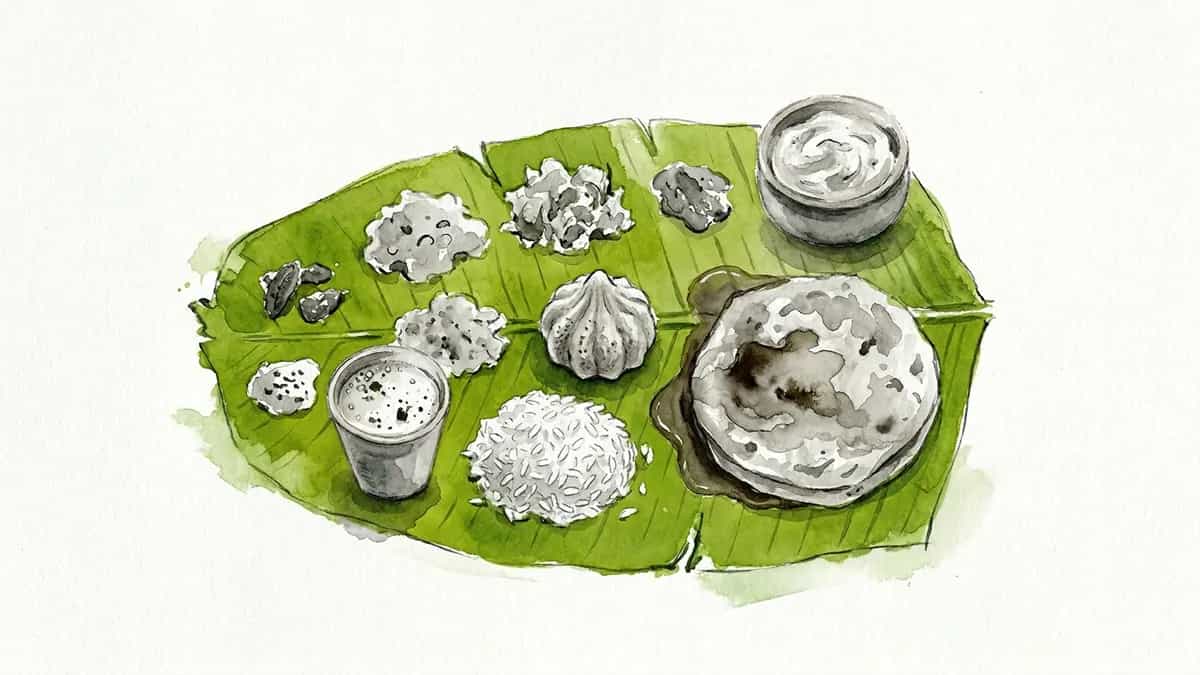
ONE FINE SATURDAY AFTERNOON, I occupied the place of honour at a friend’s dining table and stared at a plate containing a bowl full of decadent ras malai, a spicy and creamy Konkani cashew curry, a suralichi wadi (gram flour roll), dahi boondi and warm poli (flatbread) dripping with ghee. The crinkle of poha papads frying in hot oil on the kitchen stove reached my ears before they made their way onto my plate. Hungrily, I dove in.
This was a kelvan luncheon, one of the 25 feasts I attended, hosted by friends and family ahead of my impending nuptials. After gorging myself at these kelvans — complete with sweet and spicy culinary delights and sometimes even a rogue cocktail (when notorious uncles and cousins decided to get involved) — of two things I was certain: one, I would definitely have to resize all the blouses from my wedding trousseau to fit my bulging frame. And two, that the ‘kelvan’ was more than just a pre-wedding tradition executed perfunctorily.
In normative Maharashtrian cultures, a bride’s relatives and friends pour their heart into planning the kelvan to pamper her before she heads off into the unfamiliar world of the marital home.
**
Comprising scrumptious sweets, mouthwatering feasts and a showering of gifts, the kelvan is an age-old practice followed in western Indian regions, predominantly in upper-caste Maharashtrian households in honour of the bride and the groom, ahead of the wedding. It is one among the many micro traditions associated with marriage ceremonies, characterised by its subtle cheer and familial bonding, that is removed from the glaring ostentation of the Big Fat Indian Wedding.
The period between the sakharpuda (engagement) and the wedding ceremony is replete with long luncheons and dinners hosted by relatives, friends and the respective social circles of the bride and groom. These delicious spreads are nothing but the kelvan.
Where the bride and groom’s family hosts a ‘Gharcha Kelvan’ or the Kelvan-At-Home just a few days prior to the wedding, extended family, relatives and friends inevitably seize the bride and groom’s social calendars immediately after their engagement to pose the urgent question:
“Mag, kelvan kadhi karuya? (So, when shall we host the kelvan?)”
For the kelvan has deep cultural resonance in Maharashtrian homes, transcending a simple get-together of close ones for a meal. This is no ordinary feast.
In fact, a kelvan can be accepted by the bride and groom only after they perform the muhurta, or the ritual which signifies that wedding preparations are now under way.
Once the muhurta is executed, the kelvan becomes an opportunity for the bride’s relatives to host her as a single woman, in her ‘youthful prime’, one last time before she is wedded. In times of lore, when marriage meant moving from one village to another, this was also an opportunity for the bride’s relatives to spend time with her before she altogether left her hamlet.
If that’s not enough, for the more pragmatic ones, kelvan was a way to care for a family engulfed in wedding preparations by offering a meal and lightening the sheer burden of cooking one at home!
**
Feminist historian Vina Talwar Oldenburg once traced the history of dowry to stridhan or the jewellery and wealth a girl received from her maternal home until as late as the 19th century, before dahej became a dominant practice. Socio-cultural understandings can link the kelvan to a similar tradition that persists, of bestowing gifts upon a young girl as a ‘safety net’ over which she would have at least partial material control upon marriage.
The feasts she devours, the fun she savours, and the gifts and knick knacks she receives during the kelvan are so designed that they would not only fill her with happiness and lasting memories but also enable her to have a few personal possessions in her new home. Along with saris, the young woman is many-a-times gifted other items symbolising bounty and abundance, such as a haldi-kunku container, a silver lamp, bedsheets and small wooden boxes to store these belongings — essentially, articles that a young bride would use to set up her new home.
It is only natural then that earlier, the kelvan, meant for making merry and providing a semblance of material security was a practice reserved only for the bride. It is only now, with changing cultural patterns, that a kelvan is organised for the groom too, and sometimes for the bride and groom together.
**
In Maharashtrian homes, kelvan is often referred to as ‘gadagner’, whose etymology can be traced to two words: gadu and neer meaning a copper pot full of water. But gadagner connotes more than just offering a potful of water to the bride and groom’s family.
It means donning the cape of an immaculate host who crafts an exquisite gastronomical feast for guests. In fact, the word kelvan too comes from kelne which means ‘looking after,’ indicating an occasion to host honoured guests and serve them a delicious culinary repast.
Undoubtedly, food is most integral to a kelvan. In its contemporary rendition, friends and family often find themselves heading out to restaurants and cafes for the kelvan but that is not without whispers from those two incorrigible gossiping aunties in every family who murmur: ‘When did it become so difficult to fry a few puris at home?’
Most often than not, a kelvan meal almost always consists of kheer-puri or shrikhanda-puri and is served on a banana leaf that stands for prosperity and good luck. At other times, a kelvan features a mouthwatering modak with a stuffing made using freshly grated coconut and sugar, seasoned with cardamom and kesar. This mixture is tucked inside a rice flour coating that is pinched into a round dumpling, steamed and served with plenty of ghee.
Moorings of the kelvan in upper-caste traditions become all too evident in these elaborate preparations. A traditional set-up would almost always brim with the panchapakwaan or ‘a spread of five sweets’ for the kelvan. From such a vast spread, served in certain homes on silver thaalis or plates, what emerges is a cultural emblem of social standing — in several Marathi communities, who hosts the biggest kelvan becomes a hallmark of status and strong ties with important families.
**
A classic Maharashtrian kelvan features (beyond the modak or shrikhanda puri) sides like kothimbir wadi, lip-smacking mint and coriander chutneys, vegetables including curried gourd, brinjal and potatoes, and masale bhaat. The bhaat or rice is tossed in aromatic spices, garnished with freshly grated coconut and finely chopped coriander, and finished with a dollop of ghee.
During a luncheon, the meal is nearly always followed by buttermilk or masala chaas to calm the stomach. In certain communities bearing coastal Konkan’s food heritage, modak, cashew curries and ghavan-ghatla (rice pancakes) and coconut milk continue to delight brides and grooms. In other regions far from the seashore, puranpoli or kheer remain the sweet treats savoured during this meal.
And eating one’s fill at the event is never enough. What follows after polishing off the plate is ‘agraha’ or the custom of the host serving the guest’s favourite sweets. This practice runs rampant during kelvans so much so that it is a matter of respect to accept the delicacy served during the agraha…or risk offending the host! Since the agraha begins after eating one’s fill, the last morsel of the meal ends up being served lovingly by the host, and it is this bite that tips one over the edge, into resizing their wedding trousseau!
Such a kelvan filled with chatter, laughs, banter and gifts is warming, it is like an embrace from a close knit community enthused about the beginnings of a new relationship. In Maharashtrian households, even as the big day has now become engulfed in myriad trends from high couture to grandiose decor to over the top food spreads, it is these kelvans which retain an endearing charm emanating from the comforting glow of familial bonding.