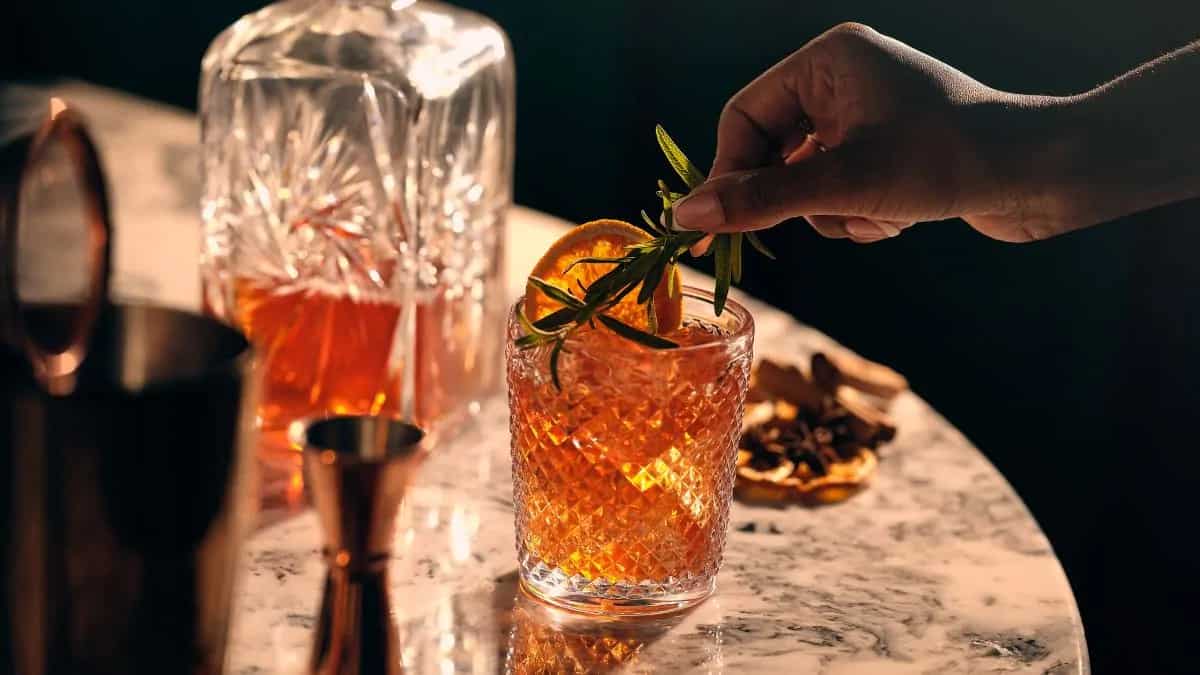
For decades, the image of whisky drinking in India has been remarkably fixed. A gathering, a bottle of single malt on the table, and a question that could only ever have one correct answer: soda, or water? The idea of doing anything more imaginative with the liquid (certainly nothing involving a cocktail shaker) was, at best, eccentric. That image is quietly dissolving, and what is replacing it says a great deal about where India is headed as a drinking culture. This International Whisky Day, we spoke to some of the best in the biz to find out what it means to drink whisky the ‘right’ way and what the future looks like for the whisky cocktail wave.
Setting The Context: How India Used To Drink Whisky
India is the world's largest whisky market by volume, a statistic that has long been cited with a mixture of pride and condescension - pride because of its scale, condescension because of its character. For most of its modern drinking history, India's relationship with whisky has been shaped by two distinct but equally rigid traditions.
At the mass market end, whisky was functional - a spirit consumed in large quantities, often heavily blended and stretched with soda into something light enough to drink across an entire evening. At the premium end, single malts became status objects, bottles displayed and poured with reverence, but almost always accompanied by a splash of water or soda. Drinking Scotch neat was aspirational. Doing anything more experimental with it was not, generally speaking, the done thing.
The Indian palate was also, for many years, shaped by limited exposure to what whisky could actually be. Imported Scotch was expensive and heavily taxed. Domestic Indian whisky, though consumed in enormous volumes, was largely built around molasses-based neutral spirit rather than malted barley, giving it a character quite different from the Scotch that set the global benchmark. The result was a market that was vast in scale but relatively narrow in its expectations.
The Shifting Tide, How Whisky Drinking Is Changing
That context has changed substantially. The past decade has seen the emergence of serious, craft-led Indian single malts that have begun to attract genuine international attention - not as curiosities, but as genuinely competitive expressions. Distilleries are drawing on India's unique terroir, its climate, its botanicals, and its grain traditions to produce whisky that tells a story no Scottish or American producer could replicate.
Vikram Damodaran, Chief Innovation Officer at Diageo India, frames this as a moment of rediscovery. "India actually has one of the oldest distillation legacies, going back thousands of years," he notes. "So in many ways, this isn't new territory for us - it's more of a rediscovery." His brand, Godawan, is a single malt built around Indian botanicals and shaped by the country's intense climate, which accelerates the interaction between spirit and cask in ways that Scottish distillers simply cannot replicate. The result is bold, layered, and unmistakably Indian.
Globally, the whisky world in 2026 is more plural than it has ever been. Scotland remains the benchmark, but Japan, Taiwan, and now India are producing expressions that sit alongside the finest Scotch on any serious back bar. Cross-continental blending - once an almost unthinkable proposition - is becoming a genuine creative frontier.
Seven Islands, for instance, a new pure malt expression by Tilaknagar Industries Ltd. brings together Scottish and Indian single malts into a spirit that draws on the precision of one tradition and the warmth and spice of another. "Blending has been at the heart of the craft for centuries," Sanaya Dahanukar, Marketing Manager, Tilaknagar Industries Ltd. observes. "The idea that a whisky must belong to a single place to be considered authentic is relatively recent."
The Whisky Cocktail Revolution
Into this more confident, more diverse whisky landscape has come cocktail culture - and it has arrived in India not as a passing trend, but as something structural.
The best bars in Mumbai, Delhi, and Bengaluru are now producing work that sits comfortably alongside their equivalents in London or New York. A generation of bartenders trained in technique, deeply curious about ingredients, and empowered by access to quality spirits has transformed what a night out can mean. And whisky, with its extraordinary range of flavour profiles, has found a natural and expanding place in that conversation.
Sanaya and the Seven Islands team experienced this shift directly at India Cocktail Week in Mumbai. "The response was encouraging," she recalls, "and it sparked conversations around how a layered whisky can add depth to a cocktail without losing its identity." That last phrase is crucial. The cocktail shift is not about submerging whisky's character into a drink - it is about finding expressions with enough personality to hold their own alongside other ingredients, to contribute rather than merely occupy space.
ABD Maestro have gone further, building their YELLO Designer Whisky - a blend of Speyside and Highland Scotches with Indian malts - explicitly around this dual ambition. "YELLO Designer Whisky was crafted not to replace tradition," Bikram Basu, Managing Director, ABD Maestro explains. "It brings the best Scotch and Indian malts together for depth, balance, and character. Simultaneously, the blend is friendly for cocktails." Signature serves like the Spotlight Spritz and the Golden Pear Couture are not afterthoughts; they are part of the brief from the beginning.
How Do You Decide Which Whisky Is Meant To Be Mixed?
The distinction is more technical than it might first appear, and understanding it helps to explain why not every whisky belongs in every glass. A whisky crafted for neat consumption is built around integration and subtlety. Every element - grain, botanical, barrel - is calibrated to express itself clearly in the glass without competition. As Damodaran describes it, "nothing feels added on; instead, it feels intrinsically part of the spirit." High age statements, pronounced oak influence, peat, or complex cask finishes can all reward the undistracted attention of a neat pour. They create the kind of layered experience that reveals more the longer you sit with it.
A whisky designed for mixing operates by different logic entirely. Its job is not to dominate but to underpin - to be present throughout a cocktail without overpowering the other ingredients. "A whisky designed for mixing will not overpower with specific nuances," explains Bikram of YELLO, "but will be friendlier to work subtly with the ingredients and let them take centre stage while being present all through." This requires a certain restraint in the blending, a cleanness of profile that becomes a canvas rather than a statement. The most interesting whiskies - and this is where Indian producers are finding a compelling creative space - are those built for both. "Trends evolve; fundamentals endure," Bikram adds.
A harmonious, well-balanced whisky that avoids over-engineering will perform in a highball as well as it performs neat, because its character is defined by coherence rather than any single dominant note. That flexibility is not a compromise in ambition. It is, arguably, a higher standard of craft.
What Does It Mean To Drink Whisky The ‘Right’ Way?
This is, ultimately, the question that the entire conversation circles back to - and every producer spoken to for this piece gives a version of the same answer: there is no single right way.
"I don't think there's a rulebook when it comes to enjoying a single malt, especially in a country as diverse as India," says Damodaran. A few drops of water to unlock hidden notes, ice, soda, a carefully constructed cocktail - none of these are admissions of defeat. They are invitations to understand how a whisky breathes and reveals different facets of itself under different conditions. Even a slight change in temperature or dilution, he points out, can surface a completely different side of the spirit.
Seven Islands frames it differently but arrives at the same place. The most important question when evaluating a whisky, Sanaya suggests, is: "What do I actually taste once I set aside what I expect to taste?" Expectation often shapes perception, particularly with whisky, where the associations of a region, a distillery, or a price point can crowd out the actual experience of the liquid. Approaching a glass with genuine openness - rather than a checklist - is what allows a whisky's full character to emerge.
What all of this adds up to is a quiet but significant cultural shift. Drinking whisky the right way, in 2026, means engaging with it on its own terms, which requires actually paying attention. Whether that attention is best exercised over a neat pour or through the lens of a well-made cocktail is a matter of the moment, the mood, and the whisky itself. The gatekeeping that once defined premium whisky culture in India - the insistence that single malts must be drunk with reverence and without a shaker in sight - is giving way to something more genuinely curious.
What’s In Store For The Future Of Whisky
If the trajectory of the past decade holds, the Indian whisky story is only going to get more interesting.
Damodaran speaks of moving "from adopting global standards to defining our own" - of building an authentically Indian playbook for single malts, grounded in terroir, in distillation conditions, in the stories of the people behind the spirit. That is a generational project, not a marketing campaign. But the foundations are being laid, and the international whisky community is paying attention.
The cross-continental blending being pioneered by producers like Seven Islands and YELLO opens a creative frontier that neither Scotland nor India could access alone. It also challenges assumptions about what authenticity means in a category that has always, at its best, been defined by craft and curiosity rather than geography. "The focus is not on geography as a limitation, but on flavour as the outcome," Sanaya says. That orientation - towards what is in the glass rather than what is on the label - feels like the right one for a category navigating rapid change.
For the drinker, the future looks like greater choice, greater quality, and fewer rules. The tumbler is not going anywhere. But it is going to have to share the table with the highball glass, the coupe, and whatever the next generation of bartenders decides to reach for. A whisky confident enough in its own identity can meet all of them. That is precisely what the best of India's new wave of producers is working to build - and, increasingly, succeeding at.