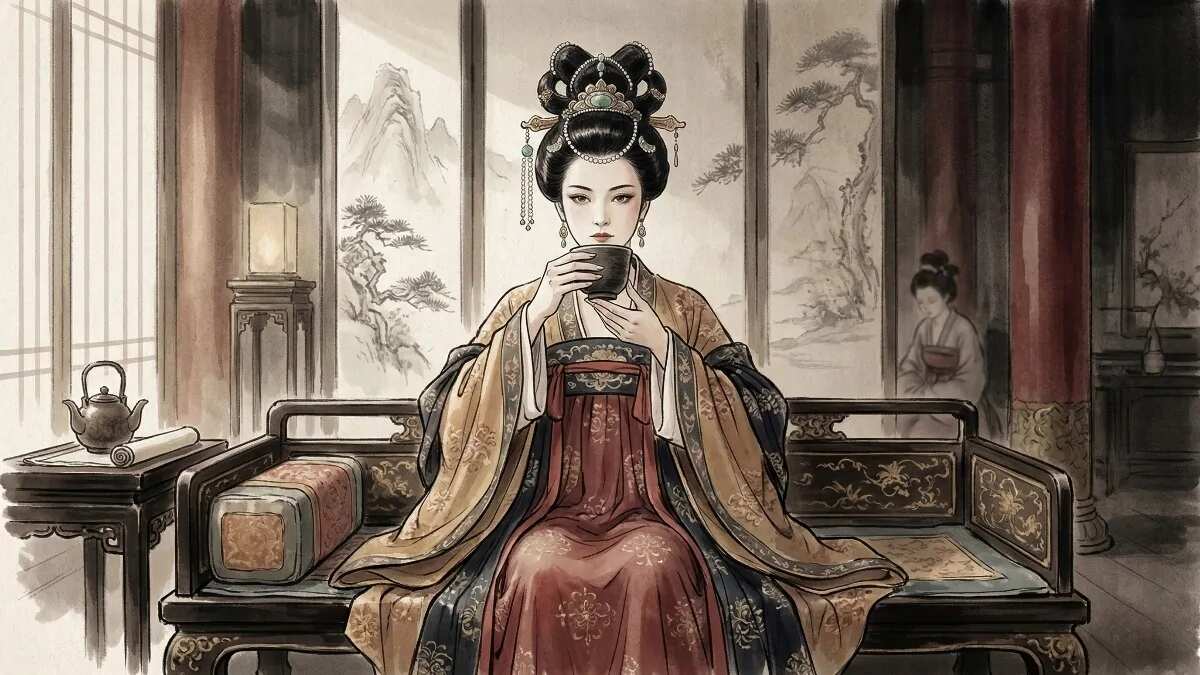
PICTURE THIS: it is the Tang Dynasty, somewhere around the 7th century. Emperor Taizong, ruler of one of the most powerful empires in the world, wants to do something nice for his chancellor, Fang Xuanling — a man so devoted to his work that the Emperor feels he deserves a reward. The gift he has in mind? A small selection of beautiful concubines.
Fang declines. His wife, Lady Fang, has made her feelings on the matter extremely clear.
The Emperor, not a man accustomed to being told no, decides to make an example of her. He summons Lady Fang and presents her with a choice: accept the concubines, or drink the cup of poison sitting before her. Lady Fang, without flinching, drinks.
She does not die. The cup was vinegar — sharp, sour, and very much not poison. The Emperor had bluffed, and Lady Fang had called it. From that moment, the story goes, chī cù — literally, "eating vinegar" — became the Chinese expression for romantic jealousy. And over thirteen centuries later, it still is.
If you have spent any meaningful time watching C-dramas, you already know this phrase. It tends to appear in the delicious scenes where one half of the main couple spots the other laughing a little too warmly with someone else, and the camera lingers just long enough on the tight-lipped, slightly murderous expression that follows. Subtitles will usually render it as "jealous," but chī cù has a texture that plain jealousy doesn't quite capture — it implies something physical, something involuntary, the sourness rising in your chest before you've even decided to feel it.
Which is, when you think about it, exactly what vinegar tastes like.
The metaphor has roots. In Shaanxi province — the culinary heartland of Chinese vinegar, where locals reportedly get through up to nine litres a year — vinegar isn't just a condiment, it's practically a cultural identity. The language has grown around it accordingly. To say someone has "knocked over the vinegar jar" is to say their partner has been caught flirting. A jealous person might be called a níng méng jīng — a "lemon spirit." And among younger Chinese internet users today, suān le, "I'm sour," does the same work as "I'm so jealous" in English, with a knowingness that makes it land harder.
In Hubei province, the feeling even shows up at weddings — the groom's mother will sometimes arrive in a theatrical opera costume wearing two small vinegar jars around her neck, a wry acknowledgment that her son now loves someone else more than her. It is at once funny and genuinely poignant, which is very much the register that chī cù operates in.
Vinegar's talent for capturing the thornier sides of love is not, it turns out, exclusively Chinese. The Victorians got there too, though with considerably less poetry and considerably more cruelty.
As the mass production of lace-trimmed Valentine's cards boomed in Britain and America in the 1840s and 1850s, a thriving parallel industry emerged almost immediately. These were the "vinegar valentines" — cheaply printed cards designed not to woo but to wound. Ugly caricatures, stinging verses, anonymous senders. And, adding a particularly vicious touch: before prepaid postage became standard, the recipient had to pay to collect them. You paid to be insulted.
The targets were gleefully specific. Unwanted suitors were depicted as animals. Women who were deemed too plain, too vain, or too old to be marriageable were mocked in verse. By the early 1900s, suffragettes had become a favourite subject — caricatured as mannish spinsters and abusive wives, punished in print for the crime of wanting the vote. There is nothing remotely affectionate in any of it. If chī cù is the sourness of loving someone too much to share them, the vinegar valentine is sourness deployed as a weapon — rejection, contempt, and social censure rolled into a card that cost its sender almost nothing and its recipient rather a lot.
Historians, perhaps inevitably, have drawn a fairly straight line from the anonymous vinegar valentine sender to the anonymous internet troll. The impulse, it seems, is as durable as the condiment itself.
What is it about vinegar? It is, after all, transformation in a bottle — wine that has gone too far, sweetness that has curdled into something sharper and more astringent. It preserves things. It keeps them exactly as they were, suspended, unable to move on. There might be something in that.
Or perhaps it is simpler than that. Perhaps vinegar just feels right — that specific pucker, that catch in the throat, the way it makes your eyes water slightly before you've even decided how you feel about it. Some emotions don't need elaborate metaphors. They just need the right taste.
Lady Fang knew. She drank the cup anyway.