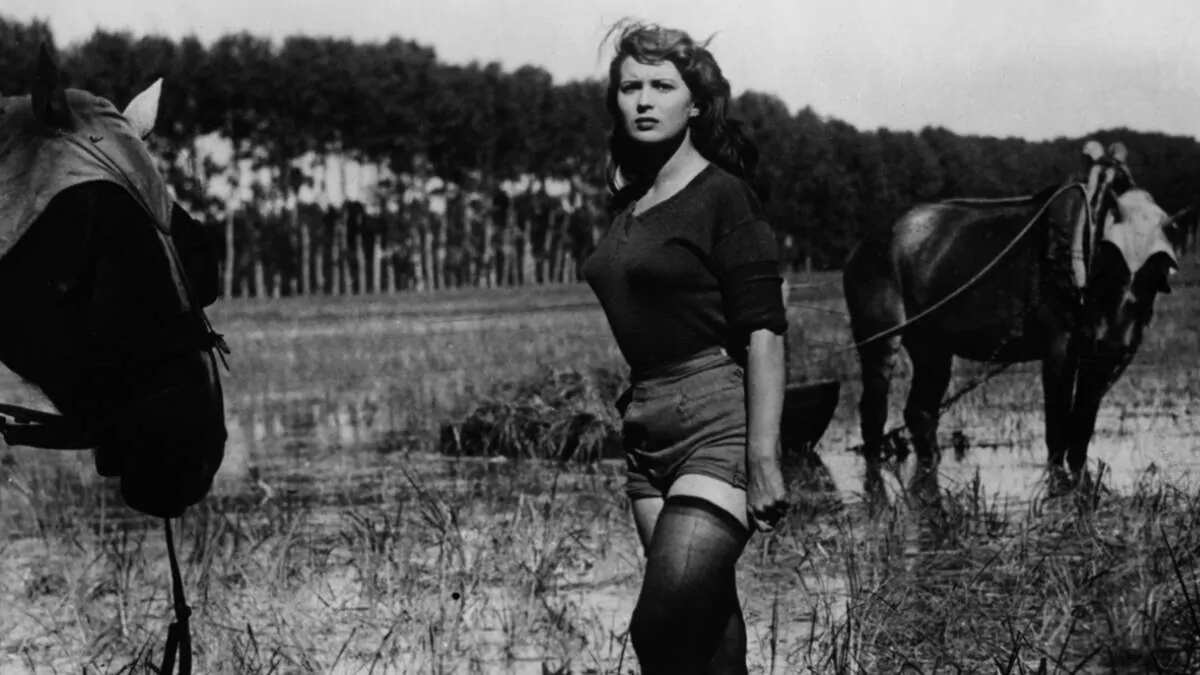
IN an era before the dawn of pesticides and mechanisation, an all-female workforce was employed to “disinfect” and harvest Italy’s rice crops. These Italian rice weeders may be a thing of the past, but they have a remarkable political legacy.
Italy was, and remains, Europe’s largest rice producer. The rice weeders, known in Italian as “mondine”, could be found knee-deep in flooded fields from May until July, across Italy’s “rice belt” which spans the northern regions of Piedmont, Emilia Romagna, Lombardy and the Veneto.
Idyllic though the glassy mirrors of the flooded rice fields may seem now, the paddies often resounded with the sound of weeders’ protest songs. To avoid punishment for talking during working hours, weeders developed an incredible repertoire of polyphonic call-and-response songs, often lamenting miserable working conditions or exploitative employers.
As one Italian senator put it in 1953, the labour of rice weeders deserved its own circle of hell in Dante’s inferno. Apart from eight-hour days under the beating sun, rice weeders were tormented by malaria-carrying mosquitoes and malnourishment, and suffered much higher miscarriage rates than other women workers.
In fact, when the actress Silvana Mangano was shown how to imitate the rice weeders’ labour for her role in the cult left-wing film Bitter Rice, in 1949, she reportedly said: “Like this, for eight hours? I wouldn’t do this work even for a million a day!”
It is perhaps because of these exploitative conditions that collective and political activism thrived in the rice fields. From the 1900s, rice weeders joined up in their droves to left-wing organisations such as the Italian communist and socialist parties, but also to the Unione donne italiane (the Italian Women’s Union) and working class institutions such as the Case del popolo (People’s Houses) and cooperatives.
Under Italian fascism, between 1922 and 1943, other left-wing groups were forced underground. But the rice weeders won important concessions from the fascist government through strikes and protest. These concessions included paid travel, and improved provisions for food and shelter.
During the Nazi occupation of Italy, many rice weeders deserted the rice fields, and in 1944 refused to work for their oppressors. Some did not return to work until the fall of fascism.
The rice weeders were also active in Italy’s liberation from the Nazis. Many were part of the Italian Resistance. Some hid partisans in their homes, or acted as couriers between battalions.
Tragically, as with women’s wider participation in the liberation of Italy from the Nazis and fascists, the weeders’ contributions to the war have often gone unrecognised. One rice weeder who was a member of the Resistance recalled how after the war her husband was given an award for his role as a partisan. When she too was offered an award, her husband intervened, saying “one in the house is enough”.
The weeders also protested against their replacement by agricultural machinery. However, their role was definitively replaced by pesticides and mechanisation in the 1960s.
Today, Italy’s rice weeders have gained a following for their songs and their dress. Choirs now perform the weeders’ songs at festivals in Italy and abroad, sometimes in incongruous collaborations with young rock bands.
The success of the film Bitter Rice catapulted the weeders into the public consciousness because of how they dressed. Previously, the weeders had worn long skirts in the fields, but in the film, Mangano wore shorts and ripped stockings. The weeders subsequently adopted this style, and it became their most remembered – and reproduced – characteristic.
Flora Derounian is the author of Women's Work in Post-war Italy: An Oral and Filmic History (The University of Chicago Press) and a lecturer in French at the University of Sussex. This essay originally appeared on The Conversation and is republished here under the Creative Commons Licence.