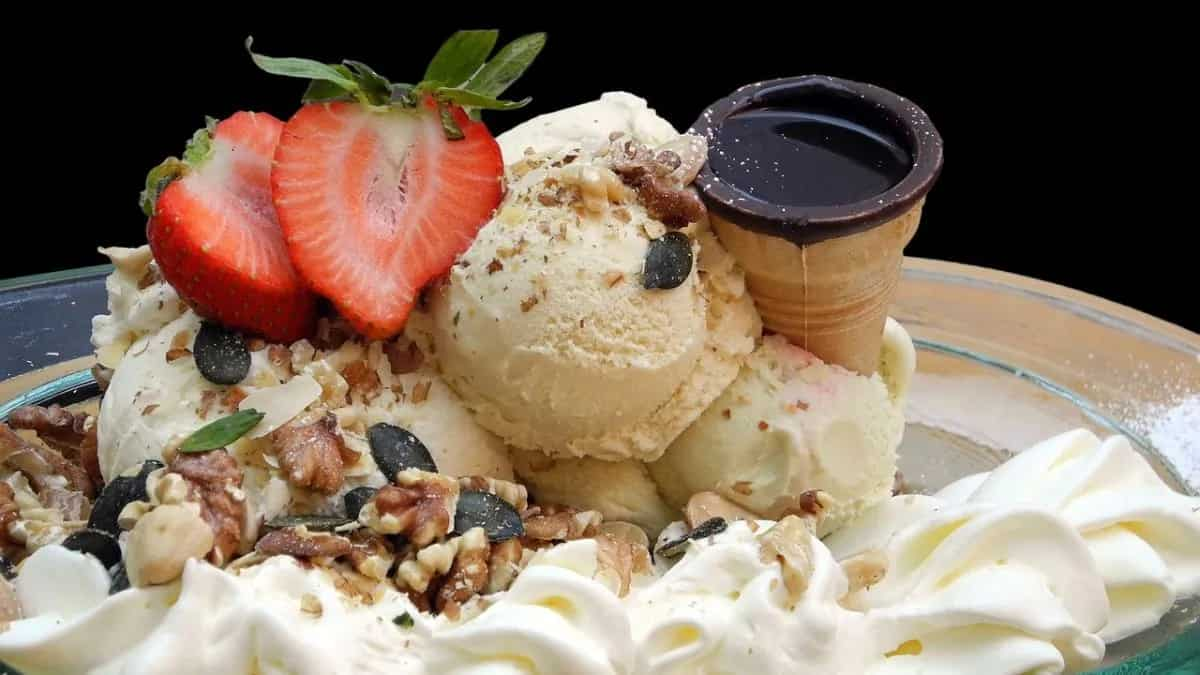
Anyone who has spent time navigating the bohemian enclaves of India will recognise the pattern. Whether tucked into a pine-scented hillside in the Parvati Valley, overlooking the ghats of Pushkar, or listening to the waves in northern Goa, backpacker menus share a distinct, international DNA. Alongside banana pancakes, falafel, and espresso, one particular entry stands out for its theatrical name: Hello to the Queen. It is neither a classic Indian mithai template nor a recognised Western dessert standard. Could be roughly defined as a sundae, it is served in a wide glass bowl or broad ice cream goblet, the dish presents an unstructured pile of crushed biscuits, sliced bananas, warm chocolate fudge syrup, ice cream, and toasted nuts. It functions as a thermal and textural experiment designed for communal eating. Over decades, it has evolved into a staple culinary landmark for travellers traversing the subcontinent.
Pushkar Roots And The Backpacker Trail Economy
While many regions in Himachal Pradesh and Goa claim a piece of the history, long-time cafe proprietors in Rajasthan point to Pushkar as the primary incubator for the dish during the late twentieth century. As a bustling magnet drawing massive waves of backpackers from every corner of the globe, Pushkar developed a vibrant rooftop cafe culture tailored directly to international wanderers. According to local lore, the dessert was born late one night when an Israeli tourist, struck by a severe case of the munchies, asked a local cafe owner to prepare a sweet, high-energy concotion using whatever packaged treats were lying around. The host layered crushed biscuits, warm chocolate sauce, bananas, and ice cream to satisfy the guest s craving. The creation was an instant hit, quickly spreading along the established travel corridor from the desert roofs of Pushkar up into the Himalayan valleys of Dharamkot and Old Manali, and down to the coastal shacks of Palolem and Arambol.
Post-Military Travel And The Israeli Enclave Phenomenon
The presence of Hello to the Queen across India is deeply linked to specific demographic movements, primarily the influx of Israeli travellers. Israel maintains mandatory military service for young adults: three years for men and two years for women. Following the completion of their service, a significant percentage of young Israelis embark on extended international journeys, known locally as the Tiul Aharei Tzavah (the trip after the army).
India has consistently ranked as one of the primary destinations for this post-service journey, offering an affordable environment for rest, decompression, and cultural exploration. Over decades, specific locations in India formed targeted hubs catering directly to this demographic. Enclaves such as Dharamkot, Kasol, Rishikesh, Pushkar, and Arambol developed entire ecosystems tailored to Israeli preferences, featuring Hebrew signage, Chabad houses, and specialised menus.
In certain pockets, establishments began serving exclusively to Israeli clientele or designing their operations entirely around group dining preferences. Dishes like falafel, laffa bread, and shakshuka became standardised local offerings, seamlessly integrated into Indian town markets alongside traditional thalis.
The Munchies Hypothesis And Culinary Improvisation
The creation of Hello to the Queen is closely associated with late-night cravings and substance-induced appetites, commonly referred to as the munchies. The hippie trail historically intersected with regions known for cannabis cultivation and consumption, particularly the Parvati Valley and coastal Goa. Cannabis consumption routinely induces intense appetite stimulation, specifically increasing cravings for high-calorie, sweet, and fatty foods.
Cafe owners recognised that late-night patrons required quick, rich desserts that did not require complex baking equipment or skilled pastry chefs. The assembly of Hello to the Queen required no ovens: basic kitchen staff could layer crushed biscuits, pour heated chocolate sauce, slice fruit, and scoop ice cream within minutes. The erratic, over-the-top combination of hot fudge and cold ice cream directly satisfied the sensory demands of a customer base experiencing late-night cravings. The dramatic name likely originated as a humorous exaggeration blurted out by an intoxicated diner, which attentive hosts quickly transcribed onto printed menus.
The Great History Debate: Israeli Roots Or Indian Adaptation?
A persistent debate surrounds the true geographic origins of the dish. Within Indian backpacker circuits, the dessert is frequently referred to as an Israeli recipe, occasionally listed under the Hebrew translation Shalom la Malkah. Guidebooks and online travel forums frequently repeat the assertion that Israeli backpackers brought the recipe with them from home.
However, documentary evidence and culinary records within Israel reveal that no such traditional dish exists in Israeli domestic cuisine or standard restaurant culture. Visitors returning to Tel Aviv or Haifa find no trace of Hello to the Queen in local bakeries.
The dish represents a purely synthetic creation born on Indian soil. Indian kitchen staff adapted simple packaged ingredients to match the high-calorie demands of foreign tourists, while Israeli travellers adopted the dish as a comforting staple of their travel subculture. The resulting feedback loop led both groups to attribute the dish to the other, securing its status as an authentic hybrid of international travel history.
The Authentic Backpacker-Style Recipe
Ingredients (Serves 2)
-  150 grams plain digestive biscuits or butter cookies
-  2 ripe medium bananas, sliced into rounds
-  3 tablespoons unsalted butter
-  2 tablespoons dark brown sugar
-  4 large scoops standard vanilla dairy ice cream
-  100 ml thick dark chocolate sauce (warmed)
-  30 grams toasted almonds or walnuts, coarsely chopped
Method
1. Coarsely crush the biscuits by hand or inside a sealable bag using a rolling pin. The texture should remain chunky rather than ground into a fine powder.
2. Melt the unsalted butter in a non-stick pan over medium heat. Add the brown sugar and stir until dissolved.
3. Add the sliced bananas to the pan and cook for 90 seconds per side until slightly softened and coated in caramel. Remove from heat.
4. Take two large glass bowls. Place a thick layer of crushed biscuits at the bottom of each bowl.
5. Pour a generous layer of warm chocolate sauce directly over the biscuit base.
6. Distribute the warm caramelised bananas evenly over the chocolate layer.
7. Add two large scoops of vanilla ice cream directly on top of the fruit layer in each bowl.
8. Finish by drizzling the remaining warm chocolate sauce over the ice cream and topping with the chopped toasted nuts. Serve immediately to preserve the temperature difference between the warm sauce, hot fruit, and cold ice cream
Ultimately, Hello to the Queen is far more than the sum of its humble, packaged ingredients. It remains a living artefact of cultural exchange, capturing a very specific era of global travel where improvised kitchen experiments could transform into enduring culinary folklore. Whether ordered on a crisp evening in the Himalayas or after a long day on the dusty rooftops of Rajasthan, this chaotic bowl of hot fudge, cold ice cream, and crushed biscuits continues to unite wandering souls from every corner of the globe. To spoonfuls shared among strangers who become lifelong friends, it remains the undisputed sovereign of the Indian travel trail.