The day after Diwali, Govardhan Puja, also known as Annakut, is celebrated, making it an important cultural event in many parts of India. Diwali is frequently seen as the high point, but Annakut has significance and tradition of its own. Annakut is a celebration of giving. The direct translation of the phrase ‘Annakut’ is ‘mountain of food,’ and that's not simply a lyrical vision. A complex feast, often consisting of hundreds of dishes, is prepared by devotees and layered to resemble a hill or tiny mountain.
Image Credit: Wikimedia Commons
This is presented to Lord Krishna and is directly related to the Govardhan incident in Hindu mythology, where Lord Krishna lifts a hill to protect people from excessive rain, protecting them from the wrath of Indra, the rain god. The offering is symbolic of many things like gratitude, prosperity, sustenance, humility and survival. The underlying message of Annakut is that nature and humans need to coexist in harmony. One needs to be aware of all the natural elements the Earth offers, never take them for granted, and always be kind to anyone who needs them.
The History
One of the most important books in Hinduism, the Bhagavata Purana, is where the tale of Annakut originates. It centres on the time frame when Lord Krishna lived in Vrindavan. The people of the village were preparing to worship the rain god, Indra, in the hopes that he would grant them a bountiful harvest. However, Krishna had doubts about this even as a young boy. He advised people to pay respect to the Govardhan Hill, which provided them with year-round food, water, grass for their animals, and shelter, rather than offering prayers to Indra. Put differently, Krishna urged them to honour Mother Nature and the soil that truly sustained their way of life.
This did not sit well with Indra. He punished the villagers with storms and torrential rain for 7 days because he was upset over being disregarded. Using only his tiny finger, Krishna raised the entire Govardhan Hill like an umbrella to shield the residents and their animals. Indra eventually understood his mistake and put an end to the rain. The tradition of Annakut started when the people of Vrindavan arranged a lavish feast to celebrate their safety. In the present, the act of feeding and serving a mountain of food in commemoration of Lord Krishna and the Govardhan narrative is an expression of appreciation for the help of nature and heavenly guardianship.
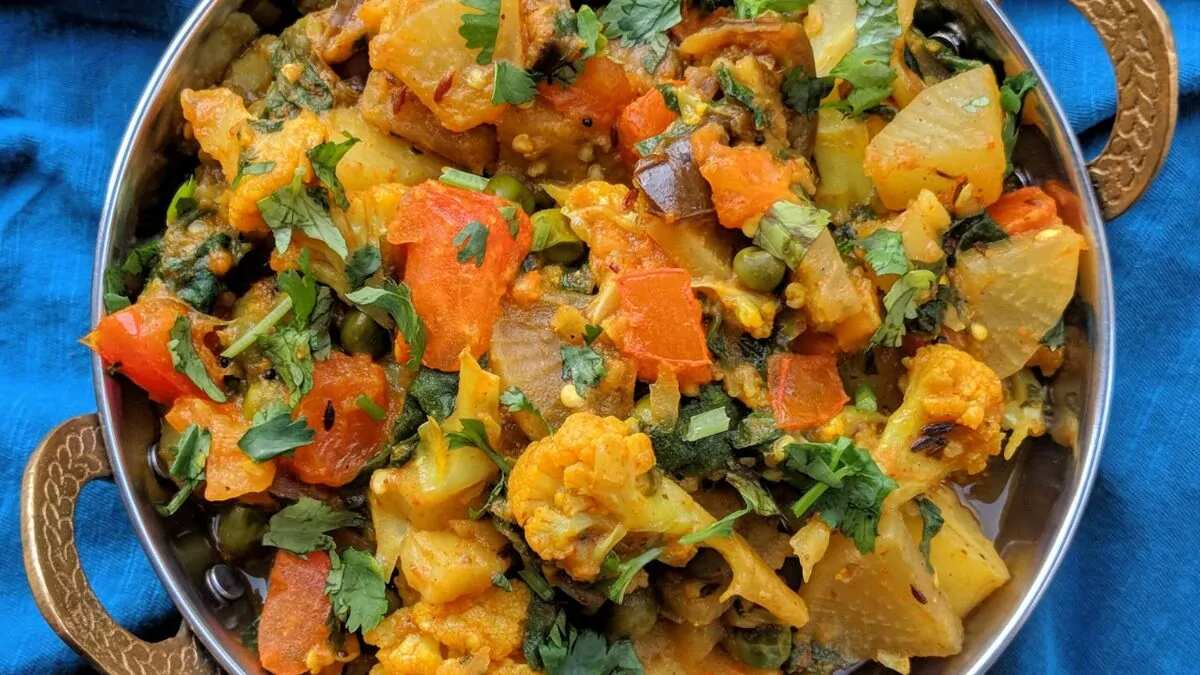
Another simple explanation for the Annakut celebration is that Diwali signifies the start of a new season in the Hindu calendar. During this time, a variety of different vegetables such as carrots, cauliflowers and peas start arriving at the market. Annakut curry is made to celebrate this abundance of fresh vegetables and presented to God as a token of thanks for the harvest. In the Annakut recipe, a small amount of each vegetable is utilised. Although the majority of vegetables are now available year-round, many Indian households still observe this tradition. The ultimate result is a massive pot of Annakut curry prepared with 100 different ingredients and served to family, friends, and guests. The number 100 simply tells you to include as many vegetables as you can find; it is not a requirement for the recipe. The best part is that all these together taste divine.
Image Credit: Wikimedia Commons
A Traditional Annakut Feast
The assortment of vegetables served during Govardhan Puja is an illustration of how Indian festival cuisine has always included inherent ways that maintain and improve health. Earlier generations tried to make sure that healthy meals were eaten even on holidays. It is typically found in northern India and serves as a representation of how delicious food is incorporated into celebrations. This puja is held the day following Lakshmi Puja, when people are craving basic, easily digestible dishes after eating their fill of sumptuous food throughout Diwali.
That's what the Annakut sabzi or curry does. All of the seasonal veggies are combined and cooked with minimal amounts of spices. Most families have their own recipe, but there isn't a set list of components. You can prepare Annakut curry by combining a small amount of any vegetable that is available in the market; many store owners also sell these vegetables in packets. It is first offered to the deity and then given to everyone as prasad. It is challenging to prepare it for modest portions because you would end up with roughly 1 kg of vegetables if you used even a piece of each vegetable that you have.
Image Credit: Wikimedia Commons
Usually, the sabzi or curry is eaten with breads like roti, paratha and puri. Or you can eat it separately, that’s tasty too. And if you’re not a fan of Indian breads, you can always pair the Annakut with basmati rice, pulao, jeera rice, kadhi, kheer, laddu, peda and so on. Basically, a mix of sweet and savoury dishes seals the deal for this festive delicacy.