The modern kitchen demands elevation. We stand at granite counters, wielding detached knives against wooden boards, entirely removed from the ground beneath us. Yet, looking back just one generation, the spatial geography of the South Asian kitchen was radically different. The epicentre of culinary creation was not the countertop but the floor. Here, a brilliant and highly evolved tool governed the space: the floor blade. Found across the subcontinent under various names, this stationary cutting instrument reflects a culinary philosophy where the human body, the earth, and the raw ingredient engage in an intimate, tactile choreography. Traditional domestic architecture intentionally featured cool stone or clay floors designed to accommodate seated work, keeping the cook grounded and connected to the immediate environment. By anchoring the preparation process to the floor, the cook operated within a calm, stable centre of gravity that dictated the entire rhythm of the household.
Ergonomics Of The Stationary Blade
To understand the floor blade, one must first appreciate the biomechanics of traditional Indian living. The practice of squatting, closely related to the yogic posture of malasana, was the default resting and working position for centuries. Sitting close to the earth was never a sign of lacking furniture; it was a deeply rooted ergonomic choice. When a cook squats behind a floor blade, they anchor the wooden base with their foot or knee. This turns the human body into a sturdy workbench. The blade remains completely stationary, pointing upwards or curving inwards, while both hands are left entirely free to manoeuvre the vegetable, meat, or fish. It is a fundamental reversal of Western culinary mechanics. Instead of moving the knife through the food, the South Asian cook moves the food against the knife. This allows for extraordinary precision, speed, and safety, as the artisan has complete control over the angle and pressure applied to the ingredient. Furthermore, this grounded posture naturally aligns the spine and engages the core, preventing the lower back strain commonly associated with hours of standing. The kinetic energy flows directly from the shoulders down to the fingertips, enabling an unbroken, hypnotic rhythm during extensive food preparation.
Image credit: Wikimedia Commons
The Bengal Boti And Riverine Traditions
Across the vast topography of the subcontinent, the floor blade morphs to suit regional diets, local metallurgy, and cultural practices. In Bengal, the instrument is known as the boti. It is an indispensable artefact of the Bengali kitchen, intimately tied to the regions profound love for fish and complex vegetable preparations. The boti typically features a heavy iron blade mounted on a wooden footrest. However, Bengal differentiates its tools based on the ingredient. The vegetable boti has a gentler curve, ideal for finely shredding banana flowers or dicing robust gourds. In contrast, the fish boti, sometimes called the anshboti, possesses a wider, heavier, and sharper crescent blade. Cutting slippery, heavily scaled river fish requires tremendous dexterity. The cook often rubs ash on their hands for grip, using the stationary boti to cleanly decapitate, scale, and steak the fish in swift, rhythmic motions that no handheld knife could easily replicate. The sheer weight of the anshboti allows it to slice cleanly through thick bones without tearing the delicate flesh of prized catches like the hilsa. This meticulous butchery technique ensures every edible part of the fish is preserved for the pot, reflecting a zero waste philosophy deeply ingrained in Bengali culinary heritage.
Image credit: Wikimedia Commons
The Konkani Vili And Coconut Craft
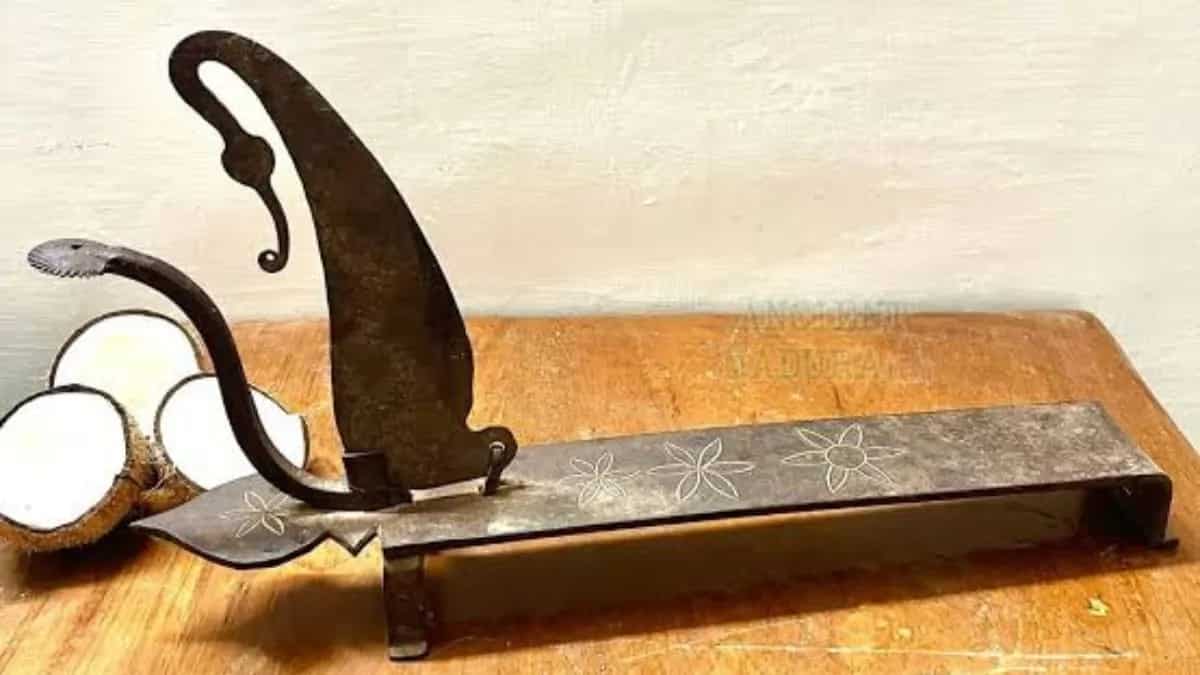
Journeying southwards to the coastal belts of Maharashtra and the Konkan, the blade transforms into the vili or morli. Here, the diet shifts towards a heavy reliance on coconuts and indigenous greens. The vili often incorporates a beautifully synthesised dual function. At the very tip of the curved iron blade sits a small, serrated circular disc used exclusively for grating coconut. A Konkani cook will seamlessly transition from slicing gourds on the main blade to scraping fresh coconut flesh on the serrated crown, all without shifting their posture. The bases of these blades are sometimes carved into intricate shapes, resembling animals or geometric patterns, elevating them from mere utilitarian tools to cherished household adornments. As the cook rhythmically scrapes the coconut, the fine white shavings fall gently onto a plate positioned directly below, ready to be ground into the rich, spiced gravies that define coastal cuisine. This seamless integration of grating and slicing into one singular motion highlights the incredible efficiency of regional domestic engineering.
Image credit: Wikimedia Commons
Southern Engineering Of The Aruvamanai
Further down the peninsula in Tamil Nadu and Kerala, the instrument is revered as the aruvamanai in Tamil or the chirava in Malayalam. The southern geography demands tools capable of tackling remarkably tough fibres, such as plantain stems, jackfruit, and mature coconuts. The aruvamanai is incredibly robust, often forged with thicker carbon steel to withstand heavy, repetitive force. The wooden bases are wider, providing maximum stability on red oxide or stone floors. In many traditional Tamil households, the aruvamanai was engineered to fold. The iron blade could be pushed down to rest flat against the wooden block, making it easy to store in narrow shelves or carry into the central courtyard for communal cooking preparations during large festivals. Preparing a massive jackfruit involves oiling the hands to combat the sticky sap while forcefully bearing down against the unyielding blade to extract the sweet pods. The foldability also served a crucial safety function, ensuring the razor sharp edge was tucked away safely when not in use, protecting curious children playing nearby.
Image credit: Manjapai Collective
Also read: Journey To The Blue Mountains: Discover The Rich Heritage Of Badaga Cuisine Of The Nilgiris
Communal Courtyards And The Odia Panikhi
In Odisha, a similar tool known as the panikhi is deeply woven into the daily domestic rhythm. The panikhi features a slightly different curvature and is essential for prepping local delicacies. The act of sitting together in the courtyard, each woman anchored to her panikhi or boti, formed the bedrock of social interaction. Food preparation was not a solitary, isolated chore performed facing a blank wall. It was a communal circle. Seated on the floor, women formed a natural amphitheatre. They shared stories, passed down recipes, and collectively handled colossal amounts of food required for joint families. The floor blade facilitated this communal gathering, grounding the workers in a shared spatial plane. Young girls would sit beside their grandmothers, learning the precise angles needed to slice vegetables uniformly simply by observing the rhythmic dance of hands and iron. This shared culinary ecosystem transformed mundane chopping into a vital ritual of intergenerational bonding and silent education.
Image credit: Wikimedia Commons
Metallurgy And Inherited Modernity
The lineage of these blades is a testament to the highly skilled local blacksmiths, or lohars, who populated rural India. Forging a floor blade required an innate understanding of metallurgy and physics. The iron had to be tempered perfectly to hold a sharp edge while enduring years of friction. These blacksmiths did not create disposable goods; they crafted heirlooms. A well made boti or aruvamanai was often included in a brides trousseau, travelling with her to her new home. Over decades of use, the wooden base would darken with absorbed oils, and the iron blade would gracefully wear down, carrying the physical memory of thousands of meals. It was common practice for travelling sharpeners to visit neighbourhoods, turning their grinding wheels to breathe new life into dulling edges. This sustainable lifecycle ensured that a single blade could serve a family for generations, accumulating history and soul with every passing decade.
Image credit: Wikimedia Commons
Sensory Loss In Standing Kitchens
Today, modern architecture and the rise of the modular kitchen have pushed the floor blade to the fringes of urban domestic life. Standing kitchens favour the western chefs knife and the plastic chopping board. The transition has brought convenience but also a subtle loss of sensory connection. Chopping on a countertop is efficient, yet it lacks the full body engagement required by the floor blade. When seated on the ground, the cook is eye level with the ingredients, fully immersed in the textures and aromas. The steady, rhythmic sound of a vegetable meeting the stationary iron is a distinct culinary heartbeat that is slowly fading from our homes. The physical distance created by high countertops has inadvertently severed the tactile intimacy that once defined Indian food preparation, replacing the communal courtyard circle with an isolated, forward facing stance.
Image credit: Kavita Kane
Resilience Of An Earthbound Legacy
Despite this shift, the South Asian floor blade refuses to be entirely forgotten. It survives in the rural heartlands, in the bustling courtyards of wedding caterers, and in the quiet corners of ancestral homes where older generations refuse to abandon the tool they have trusted for a lifetime. To look at a vili or an aruvamanai is to see more than just curved iron and wood. It is a profound reflection of a culture that believed the best way to nourish the body was to start by sitting closely, humbly, and respectfully upon the earth. Increasingly, contemporary chefs and culinary historians are actively reviving these tools, recognising that true mastery of regional Indian cuisine requires understanding the original instruments that shaped it. In preserving the floor blade, we preserve a deeply grounded philosophy of life where cooking is an act of total physical and spiritual presence.