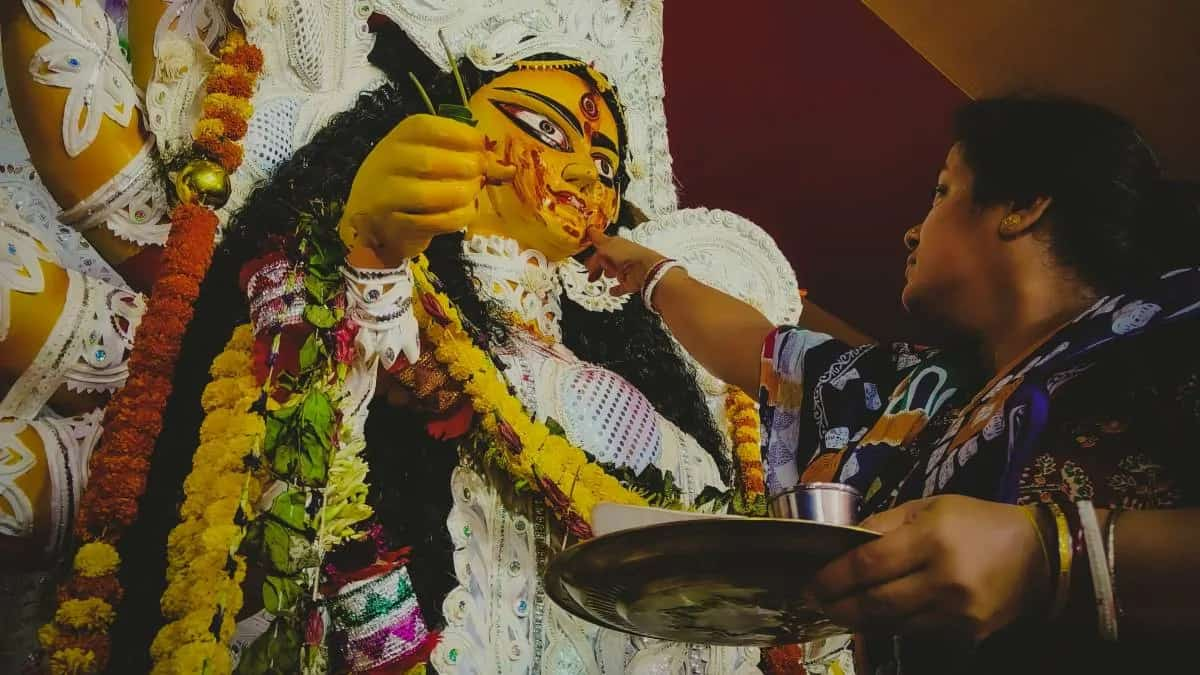
BY NOON ON ASHTAMI, the queue outside a pandal has a life of its own. It forms while the last anjali is still being chanted, bends back past the dhakis resting their drumsticks, and moves with the patience of people who have stood in it every autumn of their lives. At the front, volunteers ladle khichuri on to leaf plates: Gobindobhog rice and dry-roasted moong dal, cooked down slowly with ghee, ginger and whole spices, and not a shred of onion or garlic. Beside it go a spoonful of labra, the soft autumn stew of pumpkin, gourd, aubergine and sweet potato tempered with paanch phoron; a slice of fried aubergine; a sticky tomato chutney sweetened with dates; and, at the end, payesh.
This is bhog: food cooked for the goddess and offered to her, then shared as prasad. At community pujas, that sharing can extend to whoever turns up. Over the five days of Durga Puja it is served by the ladleful across Bengal and wherever Bengalis have settled, and it is so familiar that it is easy to mistake for something fixed – a single recipe handed down intact from some unspecified antiquity.
It is nothing of the kind. Whether the goddess may be offered cooked rice is a question Kolkata's oldest families still answer differently. Whether she eats meat depends on which way your ancestors leaned in a long argument between Shakta and Vaishnava devotion. Even the vegetables in a bowl of khichuri have their own histories of acceptance. And on the final morning, in some households whose roots lie in East Bengal, the goddess who has been fed the best the family can afford is given rice that has spent the night soaking in water.
To see why, it helps to start with who she is when she arrives.
UMA COMES HOME
In the Sanskrit texts, Durga is a war goddess, assembled from the combined power of the gods to destroy the buffalo demon Mahishasura. Ten-armed, lion-mounted, she is not obviously someone you would cook for. But in Bengal she is also somebody's child. Here she is Uma, daughter of the mountain king Himalaya and his queen Menaka, married to Shiva and living with him on Kailash. Every autumn she comes back to her parents' house for a few days, her children in tow. The agamani songs that welcome her and the vijaya songs that see her off are, at heart, about a mother waiting for a married daughter to visit.
That domestic story runs the kitchen. Sourish Bhattacharyya, a food writer and co-editor of The Bloomsbury Handbook of Indian Cuisine, tells Outlook Traveller Eats that bhog is best understood as a family's wish to spoil a daughter home from her in-laws with the finest meal the household can manage. The food commentator Ayandrali Dutta makes a related point in the same report: this is cooking as an act of affection, which helps explain why menus differ from family to family. Every family feeds its daughter the way it knows how.
The daughter also carries associations with the land that feeds her. Anoushka Jain, writing for Enroute Indian History, connects Durga's worship with folk and agrarian traditions, including forms such as Vana Durga, the goddess of the forest, and Shakambhari, associated with nourishing vegetation. At dawn on Saptami, a banana plant is bathed, wrapped in a sari and placed beside Ganesh as part of the Navapatrika. Popularly called Kola Bou, or banana bride, the bundle contains nine plants, among them turmeric, colocasia, arum and paddy. Belur Math's account describes it as a form in which the goddess is invoked.
The food historian Pritha Sen reads the bundle as a portrait of the Bengal harvest: the season's crops and the region's diet, tied together and worshipped. In that reading Durga is less a remote deity than an ancestress, a matriarch who provides for her descendants. The goddess who is fed is also the one who feeds.
SAINTS & ZAMINDARS
How a family meal for a visiting daughter became food for strangers is a longer story, with several strands rather than one point of origin. Rinku Ghosh, writing in The Indian Express, links the communal ideal to Chaitanya Mahaprabhu, the Vaishnava saint born in Nabadwip in 1486, whose devotional movement flourished in the early 16th century. Khichuri suits that ethic almost too neatly. Rice and lentils in a single pot is cheap, filling and easy to make by the cauldron, and it puts everyone's spoon in the same dish.
Then came the money. Through the 18th and 19th centuries, as Calcutta grew rich on the East India Company's trade, zamindars and merchant families – the babus and banias of the new city – established household pujas of great extravagance. These are the pujas now known as bonedi bari, after the old, established houses that hold them. They were devotion, but they were also display: a way of announcing a family's arrival, and of entertaining the colonial officials on whose goodwill its fortunes often rested. The Shobhabazar Rajbari puja is traditionally dated to 1757, the year of the Battle of Plassey. Stories linking its founding celebration to Robert Clive remain contested.
The kitchen was where these houses competed, and where they disagreed. Cooked rice carries more ritual weight in a Bengali Hindu household than almost any other food, hedged about with rules on who may cook it and who may share it. The question of whether the goddess should receive anna bhog, an offering of cooked rice, divides families that otherwise strain to outdo one another.
Some still decline. The Shobhabazar Rajbari excludes cooked rice from its bhog altogether, by ancestral rule. At the Daw family's house in Jorasanko, the goddess receives uncooked grain in great quantity – later given away to orphanages – alongside elaborate sweets and savouries made at home. Neighbouring mansions, in other words, could look at the same goddess and arrive at opposite conclusions about what she should eat, and both could claim the weight of tradition.
***
HUNGER & THE POTATO
Bhog could also become a way of feeding people when ordinary kitchens failed. Rinku Ghosh reports that during the Bengal famine of 1943, the Bhattacharjee family of Howrah distributed bhog made with banana stem and green amaranth to people facing starvation. It is one account of festival food becoming relief, rather than the origin of communal bhog itself.
A recent Outlook Traveller Eats retelling locates the family in Shibpur and adds a dream in which the goddess asks for those foods to be cooked for the hungry. The dream belongs to family lore. But the menu carries the force of the story: inexpensive greens and banana stem, rather than an elaborate feast, put the goddess's kitchen at the service of people who needed to eat.
Four decades earlier, another kitchen had made room for change. In October 1901, Swami Vivekananda organised the first Durga Puja at Belur Math, the headquarters of the Ramakrishna Order on the banks of the Hooghly. Bhattacharyya, interviewed by Outlook Traveller Eats, credits him with encouraging potatoes, cauliflower and green peas in the puja khichuri. In this account, vegetables once considered out of place in ceremonial cooking became part of the offering. It is not the last time a potato will cause comment in this story.
The movement beyond private mansions had begun earlier. The barowari, or subscription-funded puja, is traditionally associated with twelve organisers in Guptipara, Hooghly. Accounts disagree on its founding date, and the festival celebrated there was Jagaddhatri Puja. During the 19th and early 20th centuries, public organisation spread to Durga Puja too. Sarbojanin pujas, intended for everyone and run by neighbourhood committees, became part of Bengal's civic and political life. The pandal was a place where a locality could see itself as a public.
The food followed. Tanushree Bhowmik, a food historian interviewed by Ayandrali Dutta in The Federal, describes shared bhog as social glue: people sitting side by side on floor mats, eating the same khichuri off the same kind of plate, in a society otherwise organised around who could eat with whom. Whether the mats ever fully dissolved those lines is another matter. But the image of strangers eating in rows has outlasted the argument. Samrat Banerjee, a hospitality entrepreneur interviewed in the same report, locates the pull of bhoger khichuri in the care brought to everyday ingredients and in the setting in which they are shared.
MEAT WITHOUT ONION
Not all of the goddess's food is vegetarian. In Bengal's Shakta traditions, animal sacrifice, or bali – often of a goat – has long been part of some puja rites. In certain households it takes place at Sandhi Puja, the charged 48 minutes in which Ashtami gives way to Navami and Durga is worshipped as Chamunda. The timing and practice vary between houses and institutions.
The meat that follows can be cooked under a name that sounds like a contradiction: niramish mangsho, or vegetarian mutton. As Anoushka Jain in Enroute Indian History and Rinku Ghosh in The Indian Express describe it, the mutton is cooked without onion or garlic and seasoned instead with ingredients such as ginger, cumin and black pepper. Niramish here signals the absence of onion and garlic, not of meat. The curry builds its flavour without the sweetness of browned onions.
Many pujas use symbolic sacrifices of plants instead. An ash gourd, chalkumro, a length of sugarcane or a banana can take the animal's place. Belur Math records that Sarada Devi forbade animal sacrifice there from the first puja in 1901. Its account describes an offering of banana at Sandhi Puja and white pumpkin and sugarcane on Navami. The choice is part of a household's or institution's observance, rather than a single rule followed across Bengal.
Then there is fish. The assumption that sacred food must be vegetarian has never sat comfortably in Bengal, where fish is close to a staple and a sign of good fortune at weddings and births. Some of the oldest family pujas offer it to the goddess as a matter of Shakta custom. The Sabarna Roy Choudhury family, whose puja is among the oldest in the Kolkata region, offers preparations that include roasted fish and fish cooked with mustard.
WHAT EACH HOUSE REMEMBERS
Every bonedi bari keeps its own menu, and the details are the point. Priyadarshini Chatterjee's reporting in Scroll and family interviews published by Indulg Express offer a glimpse of that variety.
At the Harakutir Ray-Banerjee house in Pathuriaghata, Dashami brings chandoni kheer: milk thickened with cane jaggery, saffron and nuts until it takes on a sandalwood-like colour. At the Mitra residence on Nilmoni Mitra Street, luchi is fried in pure ghee and served with four kinds of unsalted fried vegetables. It is the Ghosh Bari in Pathuriaghata whose kheer is scented with sandalwood. Even two bowls of kheer can hold different family histories.
Such details belong to particular households, rather than a single menu prescribed for everyone. They live in families: in what a grandmother insisted on, what a cook remembered, what was done last year and must therefore be done this year.
AFTER DARK
The daytime belongs to the goddess. The nights, in Kolkata, belong to the street. As the pandals light up, so do the stalls that crowd around them, and many people who spent the morning fasting for anjali spend the evening eating. Rinku Ghosh in The Indian Express traces the festival appetite through rolls, chops and cutlets, chow mein and Mughlai parathas. Kosha mangsho and luchi belong to this wider Puja feasting, rather than automatically to the goddess's bhog.
And biryani, which brings back the potato. A large golden potato in the rice has become a signature of Kolkata biryani. Its story is usually tied to Nawab Wajid Ali Shah, who came to Calcutta in 1856 after the British annexed Awadh and eventually settled in Metiabruz. One popular account says his cooks bulked out the biryani with potatoes because the displaced court could no longer afford enough meat.
Manzilat Fatima, a descendant of the nawab, disputes that explanation. In accounts of the dish's history, including Somrita Urni Ganguly's essay for Sahapedia, she presents the potato as an innovation valued for its novelty, rather than simply an economical substitute for meat. In her telling it was a deliberate refinement.
The precise moment and motive behind the addition remain uncertain. What is easier to see is how thoroughly the potato has become part of the city's idea of biryani: a borrowed courtly dish made recognisably its own.
The stalls change from year to year. The bhog, in Ghosh's reading, is the anchor: the meal that holds a city of phuchka and biryani to its history, its farming calendar and its sense of itself as one people.
DASHAMI
On Vijaya Dashami, the daughter leaves. At many pujas, married women offer sindoor to the goddess and then smear it on each other. The idols are carried down to the river, and the dhak takes on a different rhythm.
In some households with roots in East Bengal, now Bangladesh – Bangals, in the city's affectionate shorthand – the goddess's farewell meal includes panta bhaat. It is one form of shital bhog, the broader offering of cold food: cooked rice left to soak overnight, during which it may naturally ferment. A 1931 account by the anthropologist Tarak Chandra Das, reproduced in Chatterjee's Scroll report, describes the Dacca custom of offering soaked rice with lotus-stalk chutney and boal fish soup. The accompaniments differ between families.
After the elaborate puja meals, these households send the goddess off with food prepared the night before. Families give two explanations, recorded in Chatterjee's report. In one, the household is too stricken by the daughter's going to cook anything elaborate. In the other, she has to hurry back to Kailash, and there is no time for a feast. Both are the kind of thing a family says when a daughter goes back to her husband's house.
In the kitchens that keep the custom, the rice for Dashami goes into its water the night before, while she is still in the house.