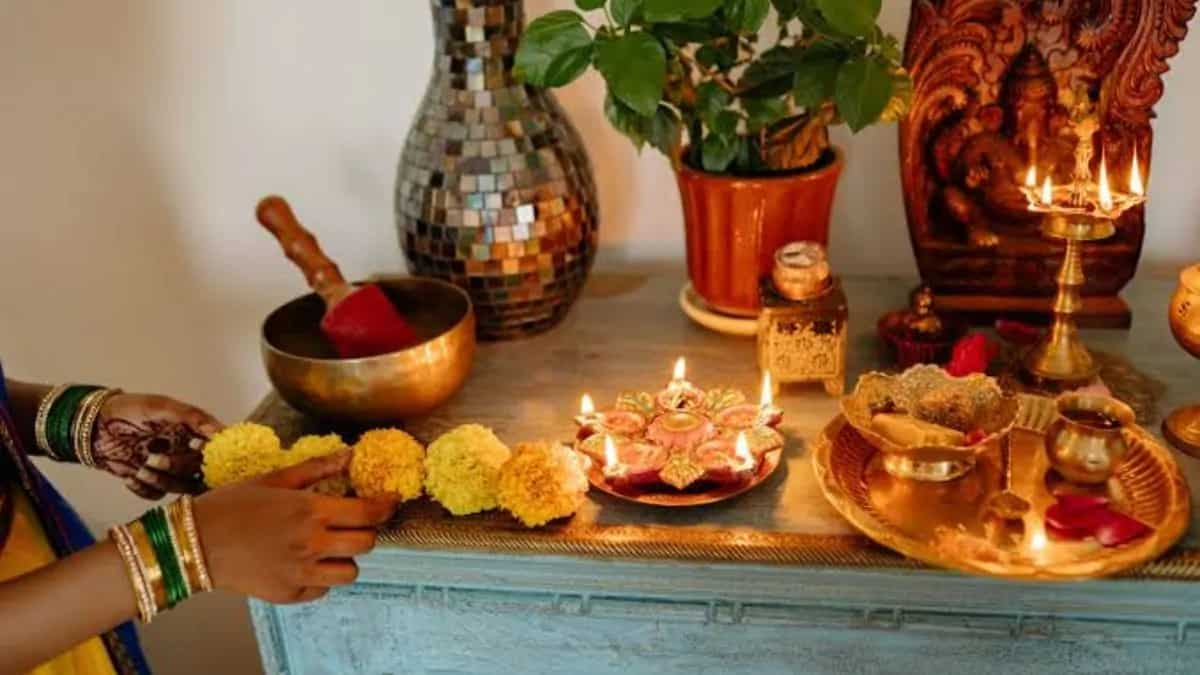
When Dhanteras arrives, households across India prepare for the first celebrations of Diwali by purchasing gold, silver, utensils and other auspicious items. However, the festival has another significant association that often receives less attention: Ayurveda, India's traditional system of medicine. Dedicated to Lord Dhanvantari, the divine physician, Dhanteras is also observed as Dhanvantari Jayanti, commemorating his appearance during the legendary Samudra Manthan. Carrying a pot of amrita, the nectar of immortality, Dhanvantari is regarded as the celestial custodian of medical knowledge and healing. His story offers an interesting perspective on why health has traditionally been considered as valuable as material prosperity.
Image credit: Unsplash
What Is The Significance Of Dhanteras?
Dhanteras, also known as Dhantrayodashi, marks the thirteenth lunar day of Krishna Paksha in the Hindu month of Kartik. It traditionally heralds the beginning of the five-day Diwali festivities and is associated with prosperity, auspicious beginnings and the worship of Goddess Lakshmi and Lord Kubera, the deity of wealth. The word Dhanteras combines two Sanskrit-derived terms: dhan, meaning wealth, and teras, referring to the thirteenth lunar day. The festival is particularly associated with purchasing precious metals, household utensils and other valuable possessions, as these are believed to invite prosperity into the home. However, wealth in the traditional understanding of the festival extends beyond material possessions. Dhanteras is also observed as Dhanvantari Jayanti, the occasion associated with the appearance of Lord Dhanvantari, who is worshipped as the divine physician and patron of Ayurveda. His association with the festival brings another dimension to its celebrations, highlighting the importance of health, longevity and wellbeing alongside financial prosperity. In 2026, Dhanteras falls on 6 November, Friday.
Who Is Lord Dhanvantari, The Divine Physician?
Lord Dhanvantari occupies an important position in Hindu mythology and the traditional understanding of Ayurveda. Revered as the physician of the gods, he is associated with the origin and transmission of Ayurvedic knowledge to humanity.
In Hindu iconography, Dhanvantari is commonly depicted with four hands carrying a conch, a discus, medicinal herbs or a leech, and a pot containing amrita. These objects represent different aspects of his divine identity, connecting him with healing, protection, medicine and longevity. He is also regarded as an incarnation or partial manifestation of Lord Vishnu in several Puranic traditions. His association with Vishnu reinforces his role as a divine figure who appears to restore balance and protect life. The Bhagavata Purana, particularly in its account of Samudra Manthan, identifies Dhanvantari as a manifestation of Vishnu and describes him as being well versed in the science of medicine. The text also associates him with Ayurveda, establishing the connection between his divine appearance and the traditional Indian system of healing.
Image credit: Pexels
The Story Of Samudra Manthan And The Nectar Of Immortality
The most widely recognised story associated with Dhanvantari comes from Samudra Manthan, the legendary churning of the cosmic ocean by the devas and asuras. According to Hindu mythology, the devas had lost their strength and were struggling to maintain their position against the asuras. Seeking a solution, they approached Lord Vishnu, who advised them to churn the ocean of milk to obtain amrita, the nectar that could restore their strength and grant immortality. The devas entered into an agreement with the asuras to undertake this enormous task together. Mount Mandara was used as the churning rod, while the serpent Vasuki served as the rope. With the devas and asuras pulling from opposite ends, the cosmic ocean was churned to release its hidden treasures. The process brought forth several extraordinary objects and divine beings, including Kamadhenu, the wish-fulfilling cow, the celestial horse Uchchaihshravas, the divine elephant Airavata, Goddess Lakshmi and the deadly poison Halahala, which was consumed by Lord Shiva to protect the universe.
Among the significant appearances during this event was Lord Dhanvantari, who emerged carrying a vessel filled with amrita. His arrival became particularly important because the nectar represented the possibility of overcoming mortality.
The story continues with the asuras attempting to seize the vessel. Lord Vishnu subsequently assumed the form of Mohini, an enchanting divine woman, to retrieve the nectar and distribute it among the devas. Dhanvantari's emergence with the pot of amrita became closely associated with the idea of healing, preservation and the protection of life. This is why he is remembered on Dhanteras, an occasion that celebrates prosperity alongside the blessing of good health. 
How Did Dhanvantari Become Associated With Ayurveda?
While the Samudra Manthan legend explains Dhanvantari's divine origins, another important tradition connects him directly with the transmission of Ayurveda to human beings. According to the traditional account found in the Sushruta Samhita, Dhanvantari incarnated on Earth as Divodasa, the king of Kashi, an ancient kingdom associated with present-day Varanasi.
In the opening chapter of the Sushruta Samhita, he is described as the divine Dhanvantari who appeared in the form of King Divodasa. A group of sages, including Sushruta, approached him seeking knowledge of medicine. They were concerned about the suffering caused by diseases, injuries and other physical ailments, and wanted to understand the principles of medical science so they could help humanity.
Divodasa subsequently imparted the knowledge of Ayurveda to these sages. Sushruta, one of his most renowned disciples, became particularly associated with the development of surgical knowledge. This tradition is especially significant because it connects Dhanvantari with the Sushruta school of Ayurveda, which is recognised for its extensive contributions to ancient Indian surgery. The Sushruta Samhita discusses surgical techniques, anatomy, instruments, wound management, fractures and various medical procedures. Dhanvantari is consequently remembered not only as the divine physician who emerged from the cosmic ocean but also as a teacher who made medical knowledge accessible to humanity. It is important to distinguish these traditional accounts from documented medical history. Dhanvantari's divine identity belongs to Hindu mythology, while the Sushruta Samhita is an important historical medical text that preserves an extensive body of traditional surgical knowledge.
Why Is Dhanvantari Considered The Father Of Ayurveda?
Dhanvantari is popularly referred to as the Father of Ayurveda because of his association with the preservation and transmission of its medical knowledge. Ayurveda itself is a Sanskrit term derived from ayus, meaning life, and veda, meaning knowledge or science. Broadly translated as the knowledge of life, it encompasses traditional approaches to health, disease prevention, diagnosis and treatment. The system is traditionally understood through the concepts of the three doshas: Vata, Pitta and Kapha. These represent different functional principles within the body and are used in Ayurvedic theory to understand individual constitutions and imbalances.
Ayurveda also encompasses dietary practices, medicinal plants, therapeutic procedures, daily routines and seasonal regimens. Its approach to health extends beyond treating illness, placing importance on maintaining physical and mental wellbeing.
Dhanvantari's association with Ayurveda is particularly prominent in the tradition of the eight branches of the medical system, known as Ashtanga Ayurveda. These include general medicine, surgery, diseases of the head and neck, paediatrics, toxicology, psychiatry, rejuvenation and reproductive health. His connection with Sushruta and the surgical tradition further strengthens his association with medical learning and practice. For generations, Ayurvedic practitioners have invoked Dhanvantari's blessings for knowledge, healing abilities and the wellbeing of their patients. His worship is therefore an expression of respect for the medical tradition and those who dedicate their lives to treating illness. 
Why Is Dhanvantari Worshipped On Dhanteras?
Dhanvantari's appearance during Samudra Manthan is traditionally associated with Kartik Krishna Trayodashi, the lunar date on which Dhanteras is observed. This association forms the basis of Dhanvantari Jayanti celebrations.
The pot of amrita that he carries is particularly symbolic. While the nectar represents immortality in the mythological narrative, its association with Dhanvantari also reflects the importance given to preserving life and seeking freedom from disease. This explains why Dhanteras has traditionally been associated with prayers for good health and longevity, alongside the worship of Goddess Lakshmi and Lord Kubera for prosperity. In many parts of India, Dhanvantari is worshipped through special prayers and offerings on this occasion. Ayurvedic institutions, practitioners and organisations also mark the day with ceremonies and activities that recognise the contributions of traditional Indian medicine. The association is especially interesting because it places health within the larger understanding of prosperity. The festival's significance is not limited to acquiring wealth or purchasing new possessions. It also draws attention to the value of physical wellbeing and the knowledge that helps preserve it.
National Ayurveda Day And Its Connection With Dhanvantari Jayanti
The association between Dhanteras and Ayurveda also acquired an institutional dimension when the Government of India introduced National Ayurveda Day in 2016. Initially, the annual observance was scheduled on Dhanvantari Jayanti, coinciding with Dhanteras. The occasion was intended to increase awareness about Ayurveda, its traditional principles, medicinal plants and contributions to healthcare. However, there has been an important change to the calendar. In March 2025, the Ministry of Ayush announced that National Ayurveda Day would be observed on 23 September every year instead of following the changing lunar date of Dhanteras. The decision was taken to establish a fixed annual date and facilitate more consistent national and international celebrations. Consequently, although Dhanteras continues to be celebrated as Dhanvantari Jayanti, National Ayurveda Day is now a separate annual observance. 
The Deeper Meaning Of Dhanteras And Its Ayurvedic Connection
The story of Dhanvantari gives Dhanteras a significance that extends beyond its association with shopping, precious metals and festive purchases. Through the imagery of Samudra Manthan and the emergence of the nectar of immortality, the festival draws attention to the relationship between prosperity and the preservation of life. Dhanvantari's legacy also highlights the importance of medical knowledge, the contributions of ancient Indian physicians and the long-standing traditions of Ayurveda. His association with Sushruta, in particular, connects mythology with one of India's most significant historical medical texts. As families prepare for Diwali in 2026, the festival offers an opportunity to revisit this lesser-discussed aspect of its history. The worship of Dhanvantari serves as a reminder that prosperity has traditionally encompassed more than material possessions. Good health, longevity and the ability to live a fulfilling life have always held an equally important place in the celebrations.