BY MID-JANUARY, the festive excess has usually been cleared away. The fridge is no longer crammed. The lights are boxed up. Life, in most places, has returned to routine. But in parts of Singapore and Malaysia, the season’s most enduring dish is often only just reaching its peak.
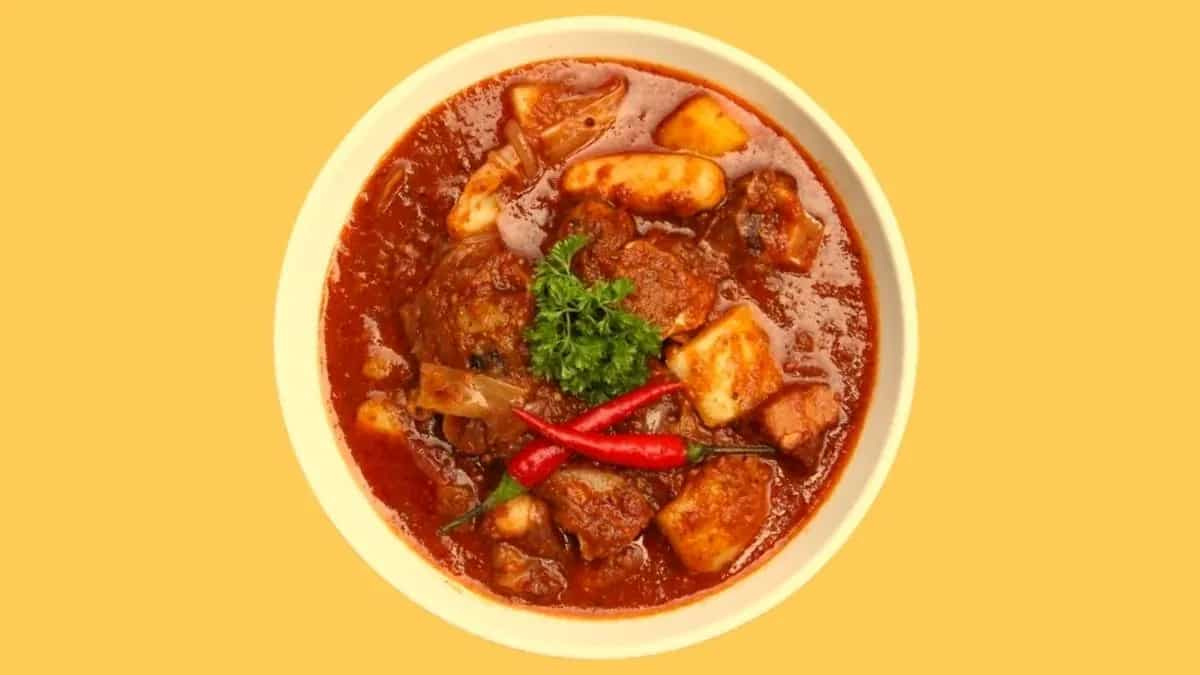
Curry Devil — Kari Debal — is a meal that refuses neat endings. Traditionally cooked from the remnants of Christmas roasts, it does not belong to the day itself so much as the aftermath: Boxing Day, the quiet days after, the liminal stretch when celebration cools into reflection. That makes January 14 an oddly fitting moment to talk about it — not as nostalgia, but as continuity.
This is also a moment of reckoning for the Kristang community, whose creole language is now spoken by as few as 2,000 people. As cultural conservation efforts intensify, Curry Devil emerges not merely as a festive speciality, but as an edible archive: slow, stubborn, and defiantly unsimplified in an age of shortcuts.
A DISH THAT TRAVELLED BEFORE IT SETTLED
Curry Devil’s story begins far from Southeast Asia, in the form of vinho d’alho — a Portuguese preparation of pork preserved in garlic and wine vinegar. The logic was practical as much as pleasurable: vinegar extended shelf life; garlic brought both flavour and fortification.
As Portuguese influence moved eastward, the dish adapted. In India, it became vindaloo, retaining its vinegar-forward bite while absorbing Indian spices such as cinnamon and anise. By the time the recipe reached Malacca in the 16th century, it encountered a different kind of kitchen altogether.
The Kristang community — shaped by Portuguese, Malay, Chinese, and Indian lineages — reworked the dish again, replacing European spice profiles with a local rempah. Galangal, lemongrass, candlenuts, and turmeric took centre stage. What emerged was not fusion for novelty’s sake, but necessity: cooking with what the land offered, while holding on to what memory demanded.
WHY THE DEVIL IS REALLY ABOUT LEFTOVERS
The name Kari Debal does not originally gesture toward hellfire. In Kristang, “debal” simply means leftovers — a straightforward description of purpose rather than temperament. The dish was designed to absorb any remaining fragments, including turkey, duck, pork, sausages, and whatever else was left from the Christmas table.
Over time, language shifted. The sound of “debal” drifted closer to “devil,” and the dish’s escalating heat did the rest. The modern name stuck, fuelled by chillies intended to make the eater sweat — an embodied experience that earned associations with the “fires of hell.”
Even today, some insist it should be called Curry Devil, not Devil’s Curry — a subtle but meaningful distinction that places the heat as a descriptor, not an owner.
INSIDE THE POT
Despite endless debate over authenticity, Curry Devil announces itself through a few unmistakable traits. First, the tang: vinegar — often white wine or rice — paired with mustard, sharp enough to cut through oil and spice alike. Then the aromatics: ginger, shallots, garlic, turmeric, worked into a thick paste and cooked patiently until the oil separates, the moment known as pecah minyak.
Proteins vary. Pork once dominated, but chicken and cocktail sausages are now common, especially in Malaysia, where halal-friendly adaptations allow the dish to travel beyond its original community. Vegetables remain contentious. Some families swear by cabbage or carrots; others consider anything beyond meat and potatoes an intrusion.
What no one disputes is time. Curry Devil improves as it rests. The vinegar preserves; the spices deepen. Like the culture that created it, the dish insists on patience.
WHAT GETS LOST WHEN IT GETS EASIER
Today, Curry Devil carries a quiet anxiety. Elders worry that younger generations prefer restaurants to ritual, convenience to labour. The dish’s traditional 24-hour arc — marinating, frying, resting, reheating — feels out of step with modern schedules.
There is also the matter of equipment. Purists argue that the curry’s soul cannot survive a non-stick pan. It demands an old-school aluminium pot and hours of relentless stirring — fry, fry, fry — until the gravy darkens and concentrates. Without that friction, something ineffable slips away.
A CONVERSATION THAT CONTINUES
To eat Curry Devil is to join a conversation that has been unfolding for half a millennium. It is a dialogue between continents, climates, and compromises; between preservation and change. The dish tastes better the next day, not by accident, but by design — its sharpness mellowed, its depth earned.
Served with steaming white rice or a crusty French baguette, Curry Devil remains an embarrassment of riches: a meal born of excess, sharpened by restraint, and sustained by memory. Like Kristang culture itself, it survives not by freezing in time, but by refusing to be rushed.