A woman I follow on Instagram boarded a train in Beaune. She was going to Paris. An old man sat across from her, and somewhere past Dijon they were talking about everything. By Paris, she had a story. She turned it into seven slides.
I watched them on my phone. The third one stopped me.
Henry Sidambarom was born in 1863 on the Source PÈrou estate in Capesterre, Guadeloupe. His father came from Tamil country. Henry was a gifted student. He ended up working in the colonial office in Basse-Terre that managed Indian immigration, which is a hard job when the people you are processing are your own. In 1904 he led a list in Capesterre's municipal elections and put more than a hundred men of Indian descent on the voter roll. His list won. On 23 February 1904 the governor, the Vicomte de la LoyËre, took the roll to court to have the names struck off.
The official reasoning was honest. An Indian should not be mayor. And if Indian workers were treated as full citizens, they might leave the plantations, and the sugar economy would lose its labour. Cheap cane, ranked openly above citizenship.
Sidambarom petitioned the Minister of Colonies in 1905. He kept writing, appealing, pushing. It took nineteen years. In 1923 Raymond PoincarÈ, then head of the French government, recognised the French nationality of Guadeloupe's Indians and their descendants. Henry published his account the next year and lived another twenty-eight, dying in his native Capesterre in September 1952 at eighty-nine. He had been appointed a substitute justice of the peace late in life, in his early eighties. The LÈgion d'honneur that his town asked for in 1948 never came.
Then slide five. A dish.
Colombo. The national dish of Guadeloupe and Martinique. Raw rice toasted and ground with coriander, cumin, turmeric, fenugreek and mustard until it thickens the sauce. A local berry, the bois d'Inde, standing in for spices the cooks could no longer find. And the name. Most sources trace it to the Tamil kulambu, a spiced gravy. Others say it comes from the port of Colombo, where some of the ships stopped. Either way, the slide said, the label came from outside the kitchen.
Image credit: Wikimedia Commons
I put the phone down. Then I picked it up and started reading.
What follows is what I found. It is a story about sugar, tea, coffee and rubber. About nineteen colonies, about 1.3 million people who signed contracts under the British flag alone, and several million more who moved under other names. About a hundred and fifty years of arithmetic. And about food, which is where the people who lost the arguments kept the evidence.
The ledger
Start with the numbers. They are the spine of everything else.
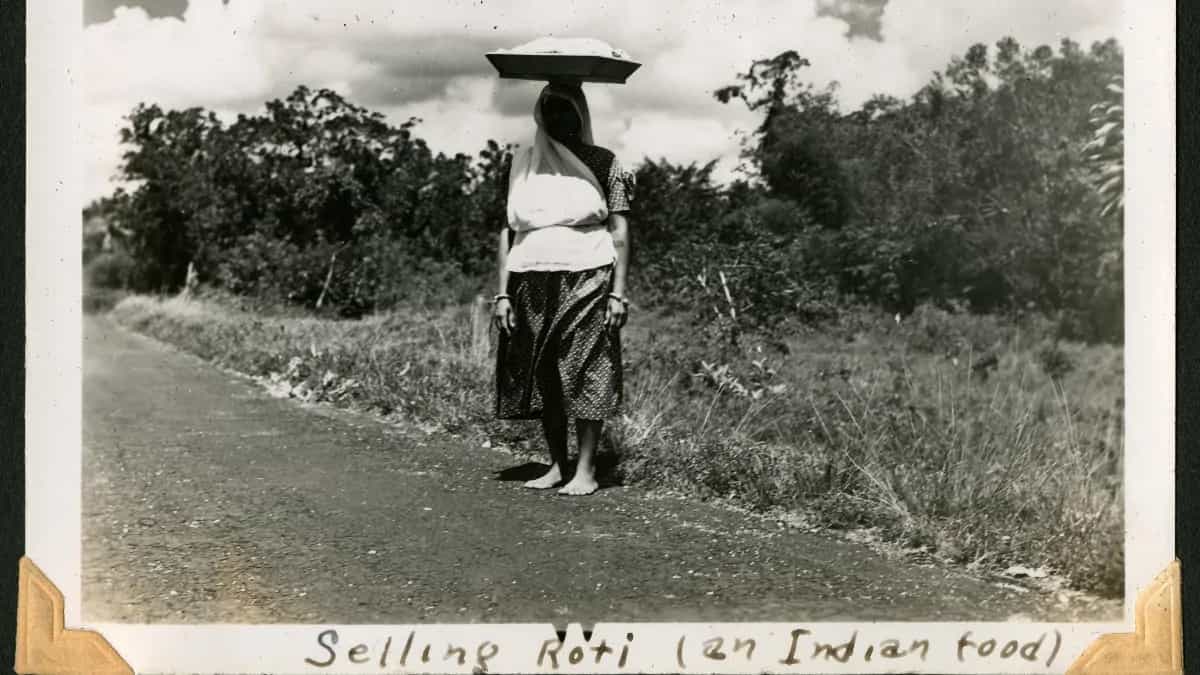
Between 1834 and 1917, roughly 1.3 million Indians went under contract to British colonies. Count the French, Dutch, and Danish territories and the figure approaches 2 million. They went to nineteen colonies. Mauritius took about 450,000. British Guiana about 240,000. Natal about 150,000. Trinidad about 145,000. RÈunion more than 120,000. Fiji 60,965. Guadeloupe and Martinique about 44,000 in thirty years. Suriname 34,000. Thirty-two thousand more laid a single railway across East Africa.
Add the men and women who went to Ceylon, Malaya and Burma under the kangani and maistry systems, a different contract with the same logic, and the gross recruitment between 1840 and 1942 runs to roughly 1.7 million for Malaya, 1.6 million for Burma and a million for Ceylon. Many came and went and came back. The count is of journeys, not heads. But the direction of travel is not in doubt.
Three questions explain the whole pattern. Why were they needed? Where were they from? What happened to them?
Why they were needed. One reason: emancipation. Slavery ended in the British Empire in 1833, in French colonies in 1848, in Dutch ones in 1863. The planters had a crop and no hands. Sugar was the crop that mattered most, but it was not the only one. Coffee in Ceylon, then tea. Rubber in Malaya. Cocoa and coconut. Coal and railways in Africa. Every one of them was labour- hungry, tropical and owned by someone who lived somewhere cold.
Mauritius shows the scale. By the mid-nineteenth century the island was Britain's main sugar colony and produced 9.4 per cent of the world's cane. It was the experiment. The British called it the Great Experiment, and it opened on 2 November 1834, when the Atlas put thirty-six workers ashore at Port Louis. Almost half a million followed through the Aapravasi Ghat, the immigration depot that UNESCO now protects as the birthplace of the modern indentured labour diaspora.
Where they were from. Calcutta supplied about two-thirds of the labour that went to Mauritius, Trinidad and Guyana. Most of it came from Bihar and what is now Uttar Pradesh. The south sent a second stream through Madras, Pondicherry and Karaikal: Tamils and Telugus, bound for RÈunion, Guadeloupe, Martinique, Natal, Ceylon and Malaya. The map of origins is the map of the food. Bihar went to Mauritius, Trinidad, Guyana, Suriname, Fiji. Tamil country went to the Indian Ocean, the French Caribbean, the Malay Peninsula.
What happened to them. The contract was called girmit, from the English word agreement. The workers who signed it were girmitiyas. The terms were five years of labour, with return passage at their own expense after five or at the government's after ten. Recruiters lied. About distance, about work, about wages. The ships took two or three months, and the men and women who shared a berth called each other jahazi bhai, ship-brother, ship-sister. Caste dissolved at sea because there was nowhere to keep it.
The Lalla Rookh, a three-masted schooner 126 feet long whose name is Persian for tulip-cheeked, left Calcutta for Suriname on 26 February 1873 with 410 people. It anchored at Paramaribo on 4 June with 399. Eleven had died. The Leonidas reached Fiji on 14 May 1879 after seventy-two days with 498 aboard. Seventeen had died of cholera and smallpox.
These numbers are for the voyage. The plantation was longer.
So the ledger runs like this: a crop, a gap in the workforce, a recruiting depot in Calcutta or Madras or Pondicherry, a ship, a contract, an estate. Repeat nineteen times. The rest is what happened inside the estate.
Go with me. Eleven stops.
Guadeloupe and Martinique
Crop
Sugar
Brought
About 44,000, 1853 to 1883
Roots
Tamil and Telugu
On the plate
Colombo
Start where the story started.
The French abolished slavery in 1848 and went looking. Between 1853 and 1883 they shipped more than 44,000 contract workers from India to Guadeloupe and Martinique. Britain stopped the traffic in 1883, citing its own policy against recruitment and the plain fact that Indian labourers tended to leave. Most were Tamil or Telugu. They signed up for five years. Free passage and pay, the contracts said.
In Guadeloupe they were treated as foreigners with British papers. Their children, born in Guadeloupe and registered in French civil records, were stateless in practice. That is the hole Sidambarom spent nineteen years closing.
Now look at what was in the pot while the courts argued.
The workers arrived with no spices. Nothing grew here that they recognised. So they rebuilt the blend from what the island offered. Colombo powder is built on coriander and black pepper, like a Sri Lankan or South Indian curry powder, but the French West Indies add thyme, peppercorns, and allspice. A Guadeloupean cook will tell you it is not quite a curry and not quite a stew. Raw rice goes into a dry pan and is toasted, then ground with the spices. The rice thickens the sauce in a way no flour would. Chicken, pork, goat, or fish. Chayote, yam, sweet potato, aubergine. Coconut milk if the family likes it. A squeeze of lime at the end, hard, so the sauce stands up.
Every family has a version. Nobody writes it down.
The name is the quarrel. Kulambu or Colombo. Tamil gravy, or the port in Ceylon where the ships took on water and coal. I have read both defended by serious people. I lean to the first, because the second assumes the name came from the ship's side, not the kitchen's, and the whole point of the dish is the opposite. Either way, someone outside the kitchen heard the word, mangled it, and attached it to a pot they did not cook in.
Today about 35,600 people of Indian origin live in Guadeloupe and about 36,000 in Martinique. Many carry French and Christian names. Few speak Tamil. They still make colombo.
RÈunion
Crop
Sugar and coffee
Brought
More than 120,000
Roots
Tamil, from Pondicherry and Karaikal
On the plate
Cari and rougail
Image credit: Wikimedia Commons
A short sail south-west of Mauritius, the same trade ran under the French flag.
Slavery ended in RÈunion on 20 December 1848. Indian labour was already being imported on a small scale, and now it grew. By 1858 about 64,400 Indian labourers were living and working on the island's sugar estates. Over the full period of French indenture, more than 120,000 came from India's east coast, mostly from the French settlements at Pondicherry and Karaikal. Historians who have gone through the records say the engagÈs were bought on markets and worked in conditions equivalent to those of the people they replaced.
They stayed. Today the Malbars, as RÈunion calls its Tamil-descended population, make up about a quarter of the island, roughly 180,000 people. The church baptised them. The Tamil language did not survive five generations of separation. The kitchens did.
RÈunion's plate has a grammar. Rice. A cari, the Creole curry whose name comes from the same Tamil word as the English one. A rougail, the chilli-and- tomato sauce, which comes as a side (the pilon) or as a main dish (the marmite). A pot of lentils or beans. Every household builds meals this way, and the structure is older than the cookbooks. Sausage rougail, with tomato, onion, garlic and turmeric, is the dish people will tell you they grew up on. The turmeric points back to India.
RÈunion is a French department. Its cuisine is Creole. Its bones are Tamil. Both are true.
Mauritius
Crop
Sugar
Brought
451,776, 1834 to 1910
Roots
Bihar
On the plate
Dholl puri
Mauritius is the place where the maths worked.
Between 1834 and 1910, 451,776 Indians migrated to the island. Of those, 157,639 left. Net gain: 294,137. By 1871, more than two-thirds of the population was Indian, and a quarter of those had been born on the island. Today about 68 per cent of Mauritians are of Indian ancestry. Mauritius is one of the few places where descendants of the contract workers became the demographic majority and, after independence in 1968, the political one. Sir Seewoosagur Ramgoolam, born in Belle Rive to a Bhojpuri-speaking family whose father was an Indian immigrant, became its first prime minister.
How did they get there? Through land. When the island's sugar economy declined after the 1860s, estates were sold off in pieces. The process was called the grand morcellement. Between 1864 and 1900, Indians bought 24 million rupees' worth of land. By 1921 they owned about 35 per cent of the cultivated area. A labourer's grandson owned a plot of the cane his grandfather cut.
Now the plate.
The dish is dholl puri, the unofficial national dish. A thin wheat dough with turmeric and cumin, stuffed with roasted, ground yellow split peas, and cooked on a tawa. Not deep-fried, though puri suggests it should be. It is rolled around a butter-bean curry and a rougail, the tomato-chilli relish with French and African lineage. A vendor wraps it in paper and hands it over. It costs almost nothing.
Where did it come from? Bihar, most people say. The workers who came in the 1830s brought wheat bread and dal. One story, told in Mauritius and impossible to verify, says rations were tight, and dal water was too precious to throw away, so families kneaded it into the dough, then began to fill the dough with crushed dal. True or not, it is a good story about a good dish. The most famous maker, Dewa & Sons in Rose Hill, started in the 1960s by selling door-to-door from a bicycle.
Mauritius is about Indians. It is also about everyone else. The rougail is Creole. The butter beans are African in spirit. The dish belongs to the island. The dal is the Indian part.
British Guiana
Crop
Sugar
Brought
About 240,000, 1838 to 1917
Roots
Bihar and Uttar Pradesh
On the plate
Curry, roti, dhal puri
Now the Caribbean. Go to Guyana first, because it took the most.
The first ships, the Hesperus and the Whitby, put Indians ashore in 1838. About 240,000 followed. Sugar estates on a flat coastal belt were worked by the people who replaced the enslaved. Cheddi Jagan, who became premier in 1961, was the eldest of eleven children in a family of cane workers.
Indian labourers in Guiana were issued rations. Rice, lentils, coconut oil, sugar, salt. And curry powder. A premixed British curry powder. One thing Indian cooks would never have used at home. They had no choice. A food historian writing on this ration scale notes that the biggest handicap was that, instead of the plethora of spices and herbs available to an Indian cook, workers were handed a single blend. That is why Guyanese food, for all its joy, tends to be variations on one theme, and why Indians in Guyana taught African neighbours how to cook with curry powder.
Image credit: Pexels
The estates were violent. On 13 March 1913 at Rose Hall, in East Canje, police killed fifteen workers and wounded thirty-nine, some of them seriously enough to need amputations. A woman was shot in the stomach. Six weeks earlier the labourers had gone on strike. Twenty-five armed constables had been posted to the estate. When a corporal tried to arrest an Indian worker, a second man intervened, and the two fell into a trench. The police fired into it. Gaiutra Bahadur's account in Coolie Woman, the best book written on the subject, notes that two special envoys from the Government of India were in Guiana that week. They read the headline in the Daily Argosy: BLOODSHED. Their report was embargoed, but the news was not. In India, Surendra Nath Banerjee asked the government what had happened at Rose Hall. The Viceroy, Lord Hardinge, had already read the inquiry's transcript. Within four years, recruitment for the colonies stopped.
Rose Hall was not the first. In 1872 police had fired at Devonshire Castle. Jagan, writing in later life, counted the dead of the cane estates as a roll call: Devonshire Castle in 1872, Rose Hall in 1913 with fifteen killed, Ruimveldt in 1924 with thirteen, Leonora in 1939 with four, Enmore in 1948 with five.
Guyana's table carries this. Curry, roti, dhal puri. Curry goat, which Guyanese call goat curry, and which is Trinidad's and Jamaica's and Suriname's and Belize's too. The Indian plate was mixed with African and Amerindian ingredients to make something that is neither one nor the other. It is now eaten in Queens, New York, in a neighbourhood called Little Guyana.
Trinidad
Crop
Sugar and cocoa
Brought
About 145,000, 1845 to 1917
Roots
Bihar and Uttar Pradesh
On the plate
Doubles and roti
Fly north-east. Trinidad is where you eat the best dish in the Caribbean for the price of a bus ticket.
About 145,000 Indians arrived between 1845 and 1917. At first, half were women. In 1840, the proportion dropped to a third of the number of men. Fix that fact in your mind, because the ratio shaped everything: the quarrels, the suicides, the violence, the moral panic that colonial officials used to justify keeping the system tight.
On 30 October 1884, in San Fernando, British troops fired on the Hosay procession, a Muharram festival held by Indian Muslims and joined by Hindus. The authorities had banned it from entering the town. The people ignored the ban. The Times reported twelve dead. The historian Kelvin Singh puts the figure at twenty-two, with more than a hundred wounded. It was the bloodiest event of British rule in Trinidad. It reached India. Together with Rose Hall and the voyages and the women, it fed a conclusion that would be reached by 1917: the system was not worth the shame.
Now go to Princes Town and watch a man sell breakfast.
Image credit: Wikimedia Commons
The man's name was Emamool Deen. In 1936, he and his wife, Rasulan, began selling curried chickpeas, channa, wrapped in a single fried flatbread. He had been looking after cattle on an estate. He was broke. His son Badru, the seventh of nine children, says the family sold its only goat to buy oil and dried channa, the cheapest things they could find. The channa was spiced with turmeric and cumin. The bread, bara, was a kinsman of the Indian bhatura.
Customers began to ask him to double the bara. Doubles. The name stuck.
A good doubles has three parts. A bara, fried, soft, cumin and turmeric in the dough. Channa, curried, almost sauce. And then whatever you want on top: tamarind sauce, cucumber, coriander chutney, pepper sauce in the amount you can bear. You say how much pepper at the counter. "One doubles with slight pepper" is a sentence you will hear in the roti shops of Queens.
Princes Town produced one more thing that matters. In May 1933, in the same town, a boy named Basdeo Panday was born into an Indo-Trinidadian family. He became a union man, a lawyer, and in 1995, prime minister, the first of Indian descent. He served until 2001. A dish and a premier from one small town, both inheritors of a plantation.
Roti, the wrap, comes from the same century. San Fernando, a businessman named Sackina Karamath, the mid-1940s by one account and 1937 by another. A takeaway customer needed a way to carry curry. He turned the roti, until then a side dish, into the wrapper. The idea spread to Guyana, Suriname and Jamaica. Today the roti shop is a fixture of Indo-Caribbean life from San Fernando to Queens.
Suriname
Crop
Sugar and bananas
Brought
About 34,000, 1873 to 1916
Roots
Uttar Pradesh and Bihar
On the plate
Roti and bara
Suriname is the smallest ledger and the starkest.
The Dutch signed a treaty with the British in 1870 to recruit Indians. Sixty- four ships followed, carrying about 34,000 people over forty-three years. The first, the Lalla Rookh, anchored on 5 June 1873. It is Indian Arrival Day there, a national holiday. Contracts ran for five or ten years, depending on the account. Many of the workers did not go home, and the Dutch government did not want to pay to ship them. In 1927, about 25,000 who had stayed became Dutch citizens.
Suriname's Indians call themselves Hindostanis. They speak Sarnami, a creole of Bhojpuri, Awadhi and Dutch. They sing baithak gana, a music born from Hindustani folk tunes and Caribbean rhythm. They eat roti and bara with chutney, dal and curry. After Suriname's independence in 1975, tens of thousands left for the Netherlands. About 160,000 Hindostanis now live there, more than live in Suriname. The Hague is about seven per cent Hindostani.
The migration was twice displacement. A journey from Calcutta to Paramaribo, and then from Paramaribo to The Hague. Each time the food came along.
Jamaica
Crop
Sugar
Roots
Indian indentured workers
On the plate
Curry goat
One short stop. In 2011, a man in Portland, Jamaica, walked into a KFC and asked for curry goat and a soda. He was mocked. He was not wrong. The first KFC on the island, in the 1970s, had curry goat on its menu.
Image credit: Wikimedia Commons
Jamaica's national dish is ackee and saltfish, but curry goat is the one people queue for. The Indian contribution is the technique: burning the curry, which means cooking the powder in hot oil until it darkens slightly and turns deeply fragrant. The rest is Jamaican. Scotch bonnet, thyme, scallion, pimento berries. Served with rice and peas, or with roti. You can taste three continents in one bite. The thing most visitors never hear is that the technique is Indian.
Natal
Crop
Sugar, coal and railways
Brought
152,184, 1860 to 1911
Roots
Tamil, Telugu, Hindi belt
On the plate
Bunny chow
Go across the Atlantic and down the coast. Natal is where indenture met the politics that would become apartheid.
The planters began by asking local Zulu men to cut cane at the wages offered. The men declined. So Natal asked India. The first ship, the Truro, reached Durban on 16 November 1860 with 342 people. The Belvedere followed ten days later with 310. By 1911, when indenture to Natal ended, 152,184 had come. In 1901, the Indian population of the colony was 47,599 free, 9,000 passenger, and 25,366 indentured. More than half the indentured worked in cane. Others laid railways, dug coal, worked the port.
In 1893, a young lawyer named Mohandas Gandhi landed in Durban on a one- year contract. In 1894, he helped found the Natal Indian Congress. By 1895, the colony wanted to keep its workers and shed the problem of freed ones. The law imposed an annual tax of £3 on every ex-indentured Indian who did not re-indenture or go home. Men, women and children. Gandhi calculated that a family of four would owe £12 a year on a wage of a few shillings a month. The colony had first proposed £25. Gandhi's campaign brought it down to £3 and kept the fight going for twenty years.
It ended with the strike of 1913. More than 50,000 workers in the mines, on the plantations and in other industries put down their tools. Thambi Naidoo addressed a meeting of 6,000 people on the Durban Indian Football Ground. Gandhi led marchers into the Transvaal. The tax was abolished. The workers who made that happen were indentured labourers and their families, and most of them were Tamil and Telugu and Hindi-speaking people whom history mostly remembers through one famous lawyer.
Now the food. It is called bunny chow, and it has nothing to do with rabbits.
Image credit: Wikimedia Commons
A quarter loaf of white bread. Hollowed. Filled to the crust with mutton curry, or chicken, or beans. A salad of carrot, onion and chilli on top. You eat it with your hands, starting at the scooped-out lid and finishing with the gravy- soaked base. The name comes from bania, the merchant caste of Gujarati traders who set up shop in Durban and fed workers. Chow is slang for food.
The size words follow the same logic: kota, the word for a quarter loaf, is a corruption of quarter.
Who invented it? Three stories. In one, under apartheid, non-white customers could not eat inside certain restaurants, and cooks carried curry out the back door in a hollowed loaf. In another, Indian caddies at the Royal Durban Golf Course could not leave work for lunch, and friends brought them curry in bread. A third points to a cafÈ called Kapitan's, on Victoria and Albert streets. None is documented. All three are true in the way folklore is true: they agree on the constraint. A man could not sit down. He needed something he could carry.
A linguist at the University of Cape Town who has studied the dish told a reporter that Indian communities outside South Africa barely know it. A hundred and sixty years after the Truro, bunny chow is the most thoroughly South African Indian thing there is.
Fiji
Crop
Sugar
Brought
60,965, 1879 to 1916
Roots
Bihar, Uttar Pradesh, Madras
On the plate
A language
Fiji runs on a different logic.
Fiji's colonial government did not want to touch the indigenous Fijian workforce. It wanted the islands' sugar economy built without upending the villages. So it brought Indians. The Leonidas reached Levuka on 14 May 1879, seventy-two days from Calcutta. By 1916, 60,965 people had left India for Fiji, and 60,553 had arrived, over forty-two ships and eighty-seven voyages. Most worked for the Colonial Sugar Refining Company, an Australian firm that built a mill at Nausori and ran the industry.
Fiji's records are a catalogue of what the contract did to people. The ratio of women to men: forty to a hundred at best. The suicides: C. F. Andrews argued in 1915 that the official figures showed the highest suicide rate of any plantation economy, higher than in India. Between 1885 and 1920, 96 indentured workers in Fiji were murdered. Sixty-eight were women. In 1913, a letter signed Kunti, describing the fate of women on the plantations, caused an outcry in India and became a cause for nationalists. Totaram Sanadhya, who had been tricked into indenture and reached Fiji on the Jumna on 28 May 1893, served twenty-one years there. With the editor Banarsidas Chaturvedi, he produced Fiji Mein Mere Ikkis Varsh, My Twenty-One Years in Fiji, which Andrews introduced to English readers in 1917.
Contracts ended on 1 January 1920. About 25,000 girmitiyas went home. About 35,000 stayed. They became a people in Fiji. They also ran into politics. Mahendra Chaudhry became the first Indo-Fijian prime minister on 19 May 1999 and was taken hostage in a coup exactly a year later. Fiji's Indians still mark 14 May as Girmit Day, and the date is also the anniversary of the 1987 coup.
I have no signature dish to give you for Fiji, and I will not invent one. What the girmitiyas made there was a language. Fiji Hindi is the mother tongue of almost all Fiji Indians and the common language of every community where they are in the majority. It grew out of Bhojpuri and Awadhi and out of the need to understand the man in the next bunk. Food lives in the same family. A language is also a kitchen.
East Africa
Crop
A railway
Brought
About 32,000
Roots
Punjab and Gujarat
On the plate
Chapati
The railway is the cleanest case.
In 1896, Britain began to build a line from Mombasa to Lake Victoria. The Uganda Railway ran through a country that was sparsely populated and hostile. Recruiters turned to India. About 32,000 workers were contracted, most of them from Punjab and Gujarat. The first batch of 350 arrived at Mombasa on 24 January 1896.
By the time the line reached Kampala, 2,498 men were dead. About one in thirteen. Another 6,500 were invalided. Disease killed most. Accidents killed some. And two lions, in the Tsavo district in 1898, killed somewhere between 28 and more than 100 workers over nine months before Lieutenant-Colonel John Henry Patterson, who was supervising the bridge, shot them. The line earned the nickname the Lunatic Express. The story became a film. The dead have no film.
6,724 stayed. They became shopkeepers, clerks, artisans, traders. By 1911 there were 12,000 Indians in Kenya and 3,000 Europeans. By 1929, over 80 per cent of small shops were Indian-owned.
And they brought chapati.
In East Africa, roti and chapati are identical, and the word has passed into Swahili. Kenyans make theirs softer and more layered than the Indian version, oil-brushed and coiled, rolled and rolled again. It is not an everyday bread.
Ugali is the daily staple. Chapati is celebration bread: Sunday lunch, holidays, welcoming a guest. Kenyans consider it theirs, and they are right. The men who carried the technique there died at a rate of about one in thirteen.
Ceylon and Malaya
Crop
Coffee, tea and rubber
Brought
About 1.7 million recruited to Malaya, 1 million to Ceylon
Roots
Tamil Nadu, Kerala
On the plate
Nasi kandar, fish head curry
The last stop is the biggest and the least understood, because it ran under different paperwork.
Image credit: Wikimedia Commons
In Ceylon, coffee ruled from 1840 to 1875. Then a fungal epidemic wiped it out. By 1886 the colony's coffee cultivation had collapsed. Planters switched to tea, and tea became the economic backbone of the colony. Workers came from Tamil Nadu in their tens of thousands, crossing the narrow strait in canoes and walking 238 kilometres from the west coast of Mannar Island to the hills. Cholera stalked them. Many died on the road, and many more died in their first months on the estate. Their descendants are the Hill Country Tamils, now 4.2 per cent of Sri Lanka. In 1949, the new Sri Lankan government stripped them of nationality. In the 1960s, about 40 per cent were granted it, and many of the rest were repatriated.
In Malaya, the crop was rubber, and the labour system was the kangani. A kangani, from the Tamil for overseer or foreman, was a trusted worker sent back to his own village to recruit. He returned with kin. The estate dealt with the kangani, not the worker. The kangani ran the estate shop and the discipline. It was recruitment by village and caste, with debt as the lock, and deserting could shame an entire family. Between 1844 and 1938, 62.2 per cent of Indian labour in Malaya came this way. Before it, about 250,000 had come under indenture, which ended in 1910. By 1918 the estates employed 368,564 workers, and 57 per cent were Indian. In the 1930s Malayalis arrived in numbers, often as estate clerks who could talk both to the managers and to the Tamil workers, and Malabar Muslims came as traders.
Now Penang. Weld Quay, the docks of George Town, in the early years of the last century. A man comes down the road with a pole across his shoulders. A pot hangs from each end. One holds rice. The other holds curry. He is a Tamil Muslim trader from the south, a free man, not a girmitiya, but he is feeding a workforce that colonial sugar and rubber built. The pole is called a kandar.
The dish is nasi kandar.
It is served now as a mound of steamed rice flooded with several curries at once, the kuah banjir, flooded gravy. Southern cooks added pandan leaf and lemongrass. The oldest restaurant, Hameediyah on Lebuh Campbell, began in 1907 under a tree. The vendors moved indoors in the 1970s. The pole is a memory now.
Here, a story needs telling, and a warning goes with it. A story reached me while I was researching this, and I pass it on as lore: nasi lemak, they say, comes from a woman called Nachi Amma. A woman whose rice cooked in coconut became the dish that Malaysia now eats for breakfast. I have not been able to trace her to any record, and food historians treat nasi lemak as a Malay dish, distinct from the Tamil Muslim cooking of nasi kandar. So take it as lore. It is still a beautiful story, and what moves me in it is not whether it is true. It is the idea that a dish loved by a whole nation might carry the name of a woman nobody wrote down. The archive of indenture is full of such women. Their names sit in registers beside numbers.
Then 1949, Singapore, Sophia Road. A Malayali from Kerala named M. J. Gomez opens a restaurant. His customers are largely Chinese, and Chinese diners prize a fish head. Malayali cooking does not usually serve it. Gomez decides it can. He takes a red snapper head and stews it in a Kerala gravy of mustard seed, fenugreek, curry leaf and tamarind, with coconut, okra, tomato and aubergine. Fish head curry. Today there are Malayali, Goan, Chettinad and Chinese versions, and Singapore's heritage agency documents it. Gomez retired to Kerala. His son says he never knew the dish had become so famous.
Gomez was not indentured. He came free, along the same sea roads. But the dish he made is what happens when a people carry a food into someone else's market, and the market asks a question.
What the pot remembers
Cooking was the one negotiation the planters never audited.
Eleven stops. A pattern.
One: scarcity became technique. Colombo exists because the spices of home were not in Guadeloupe. Doubles exists because a man sold his goat. Dholl puri, in one telling, exists because dal water was too precious to throw away. Bunny chow exists because a man could not sit down. Guyanese curry exists because the ration was a single blend. In each case, the constraint did not make the food worse. It made the food specific.
Two: the names came from outside. Colombo was heard and mangled by planters. Bunny chow is named for the merchant, not the cook. Kandar is the pole, not the man. Even "coolie" was a label chosen by someone else. The people who made these dishes rarely got to name them.
Three: the numbers are not the story, and the numbers are the story. About 1.3 million people. Nineteen colonies. 2,498 dead on a single railway. Fifteen at Rose Hall. Between 2.7 and 3.4 per cent died at sea on the two voyages above, and more on the estates. A McKinsey slide would put these in a table and recommend a framework. The framework was already there. It was the contract. The workers read it correctly. Then they did what people do with a bad contract: they renegotiated it with their feet, their strikes, their land purchases, their children's schooling, their votes, and their cooking.
That last one matters. Cooking was the one negotiation the planters never audited. In RÈunion the Malbars lost their language and kept the cari. In Guadeloupe they lost Tamil and kept the colombo. In Suriname they carried the roti to the Netherlands. In Mauritius they bought the land the cane grew on, and then they sold dholl puri from bicycles.
Today the food has gone mainstream, though the people who made it are still, mostly, in the second row. About 140,000 Guyanese live in New York City, and the Singh family, who moved from Trinidad in 1990, opened what is often called the first roti shop in Richmond Hill, in Queens. A RÈunion plate is a RÈunion plate. Colombo is promoted by Guadeloupe's tourism board. Singapore documents fish head curry as heritage. Doubles is a comfort food for Trinidadians in London and Toronto. Kenyans consider chapati fully Kenyan.
None of it started in a five-star kitchen. It started at a tree on Lebuh Campbell. A bicycle in Rose Hill. A stall in Princes Town. A back door in Durban. A pole on a man's shoulders at Weld Quay.
Badru Deen, whose parents invented doubles, has a phrase for all of it. "I call it resistance food," he told a reporter. He is right. Resistance in the old sense: refusing to disappear. A people were told they were labour, that their food was foreign, that their children were stateless, that they could not be mayor. They said nothing. They put a pot on the fire.
I think about Henry Sidambarom. He needed nineteen years, a governor, a minister and a prime minister to win a piece of paper. Colombo needed none of them. It was simply cooked in kitchens that belonged to a people with no vote, until the cooking was the country's.
In 1923 the paper arrived. The colombo was already on the table.
The woman I follow got off the train in Paris. The old man, she wrote, had talked about everything. He gave her one story, and she gave it to me. I am passing it on. If you ever eat a colombo in Guadeloupe, a doubles in Princes Town, a bunny in Durban, a dholl puri in Port Louis, a chapati in a Kenyan kitchen on a Sunday, eat slowly. There is a ledger in the pot.