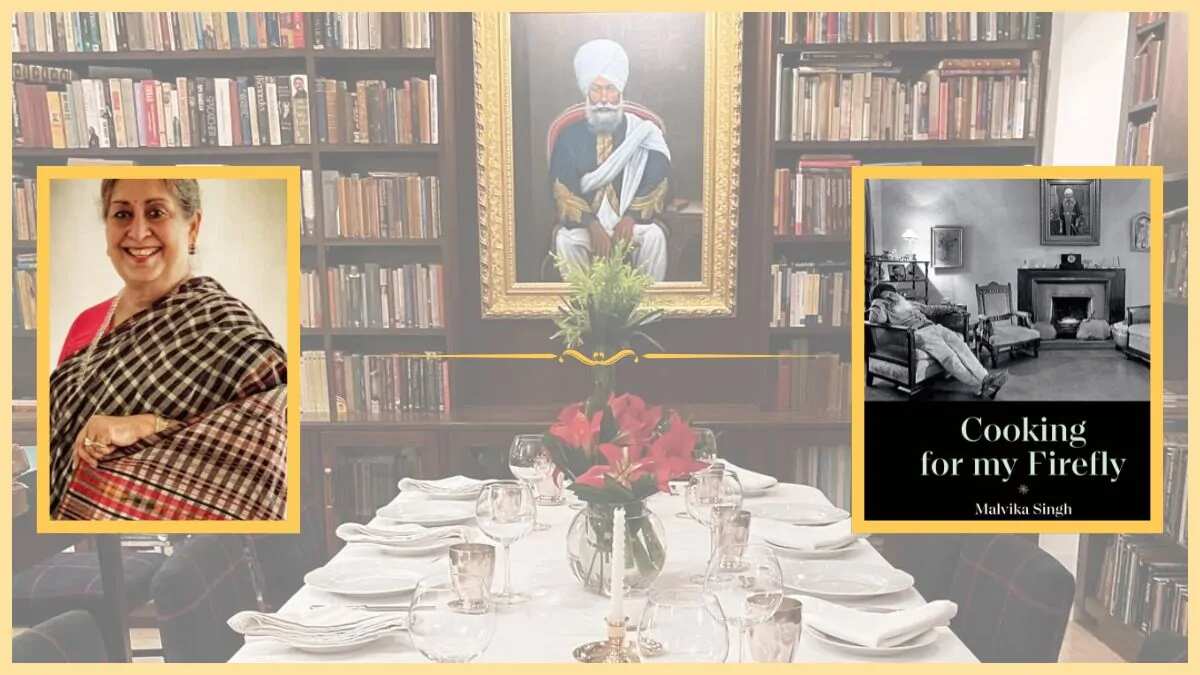
ONCE, WHILE IN DHAKA, cultural czarina Malvika Singh wandered down Elephant Road, a bustling, chaotic stretch lined with crockery boutiques selling everything from fine bone china to hand-painted pottery. Enchanted, she shopped with abandon, filling two large cartons with plates, bowls, and cups that promised new stories at her dining table.
Only at Delhi customs did she discover her treasure trove was contraband; ceramic ware from Bangladesh wasn’t allowed into India. As an officious officer approached, Singh — never one to back down — smiled mischievously and broke into song: 'Ruk ja o jaane wale, ruk ja.' The startled official burst out laughing and waved her through.
“I still have those plates and bowls,” she laughs. “And they’re still used. Every meal has a memory, every object a story.”
That same humour, grace and tactile joy of the table runs through her newest memoir, Cooking for my Firefly — a book less about recipes and more about life, love, and the alchemy of friendship, seasoned generously with food.
A LIFE IN THEMED VOLUMES
Singh explains, “My memoir is written in themed volumes. Each one follows another in fairly quick succession, patterned around the markers of my life.”
The first, Saris of Memory, used her wardrobe as an allegory to trace India’s post-Independence journey through the loom. “I used my saris as a metaphor; they carried the story of India’s artisan legacies, of revival, of our age-old oral traditions passed down word of mouth.”
The second, Cooking for my Firefly, shifts from warp and weft to warmth and spice. “This one salutes family, friendship and food; it uses food as a metaphor to tell the story of a life well lived.” Another volume, she hints with a laugh, is already simmering. “The next one’s in the pipeline. I’m not done telling my story yet!”
THE FIREFLY YEARS
At the heart of this book is a radiant presence — her husband Tejbir Singh, affectionately called Jugnu, meaning firefly. “I have shared my life with Tejbir, my Firefly, and this book is our journey together. It’s dedicated to him, and to all the light he brought into our home.”
Through themed chapters — The Open House, The Garden Party, The Large Party — the author reconstructs a world where homes, not hotels, were the heart of Delhi’s social life. “We lived and entertained at home, never in restaurants. That was how real friendships were forged.”
Their dinner table was a democratic space: eclectic, effervescent, and endlessly curious. “Everyone was a VIP; everyone had a story, a skill, a passion. We learned from one another, broadened our horizons, inhaled the untested unknown.” Those guests included Indira Gandhi, Romila Thapar (a relative), Vasundhara Raje, and Raghu Rai — luminaries from all spectrums of life.
But it wasn’t about status or spectacle, she insists. “Some guests were at the top of their professions; others were just starting out, struggling to cross hurdles. That was the exciting mix. Friends were equals, but individuals.”
THE ANDAAZA PHILOSOPHY
If Saris of Memory honoured craft, Cooking for my Firefly celebrates andaaza — that instinctive, unmeasured way of cooking passed from mother to daughter, generation to generation.
“This isn’t a cookbook,” she says. “It’s a memoir where food is the catalyst — a reason for family and friends to gather.”
In her kitchen, recipes aren’t rigid. “Andaaza makes them tactile. It allows you to add or dilute flavours according to your taste — that’s what gives cooking its excitement, its creativity.” She recalls how, in her family, everyone cooked. “We all love to cook and to share what we cook. But it’s never for me to say who should cook what. That choice rests in the gut of the cook!”
Cooking, she believes, is not about perfection but participation: about joy shared over flame and table.
FOOD, FRIENDS, AND THE JOY OF TOGETHERNESS
Singh’s home was not just a dining room; it was a salon — a meeting ground for thinkers, politicians, painters, and poets. “Professionals from multiple fields added their experience to the city’s social life. Everyone brought something of themselves; that was their credential.”
But while others might recall names, she remembers laughter. “Food is secondary to friends and family,” she says. “I enjoy all food, and all my guests. The joy lies in togetherness, not in what’s on the plate.”
In those days, she says, hospitality was simple and instinctive. “No one asked if guests were vegan or gluten-free! If someone was vegetarian, they simply didn’t eat meat. There was no fuss. The idea was to meet, to enjoy conversation, laughter, happiness — not merely to eat.”
Ask her about parties, and her eyes light up. “New Year’s Eve was an open house — no invitations, no RSVP. Friends just came. All ages, all backgrounds. The young danced, the old reminisced.”
A FEAST OF MEMORY
The book’s recipes, Singh explains, come from memory rather than measurement, each dish tethered to a moment, a guest, a story. “I chose foods from my memory and then wrote out how to cook them,” she says. “I then separated them into sections, following the general structure of a cookbook — but really, each recipe is a recollection.”
The recipes range from soufflés to seafood, from mutton dishes to yoghurt combinations, forming a menu that mirrors a life of travel and curiosity.
What emerges is not just a menu but a map of relationships: meals marking milestones, friends remembered through flavour, evenings bottled in aroma. “Every table was a tapestry,” she smiles, “woven with stories, laughter, the occasional argument — and always, love. We met to think, to argue, to laugh: not to pose.”
FROM SARIS TO SUPPERS
For Singh, writing Saris of Memory and Cooking for my Firefly has been an act of preservation. Each volume captures a facet of a vanishing India: the handloom and the home, the artisan and the amateur host.
“In one, I celebrated India’s legacy industries and artisan sector,” she reflects. “In the other, I salute family, friendship, and food — the simple pleasures that anchor us.”
Her work is as much social history as it is autobiography, a living archive of a generation that built community around curiosity and culture around conversation.
In Cooking for my Firefly, Singh shares a philosophy: of warmth over formality, curiosity over caution, and the belief that every plate, like every friendship, is best seasoned with laughter.
The plates from Dhaka may have crossed a border that day, but they’ve since crossed time...carrying with them the flavours of a home where joy was always the main course.