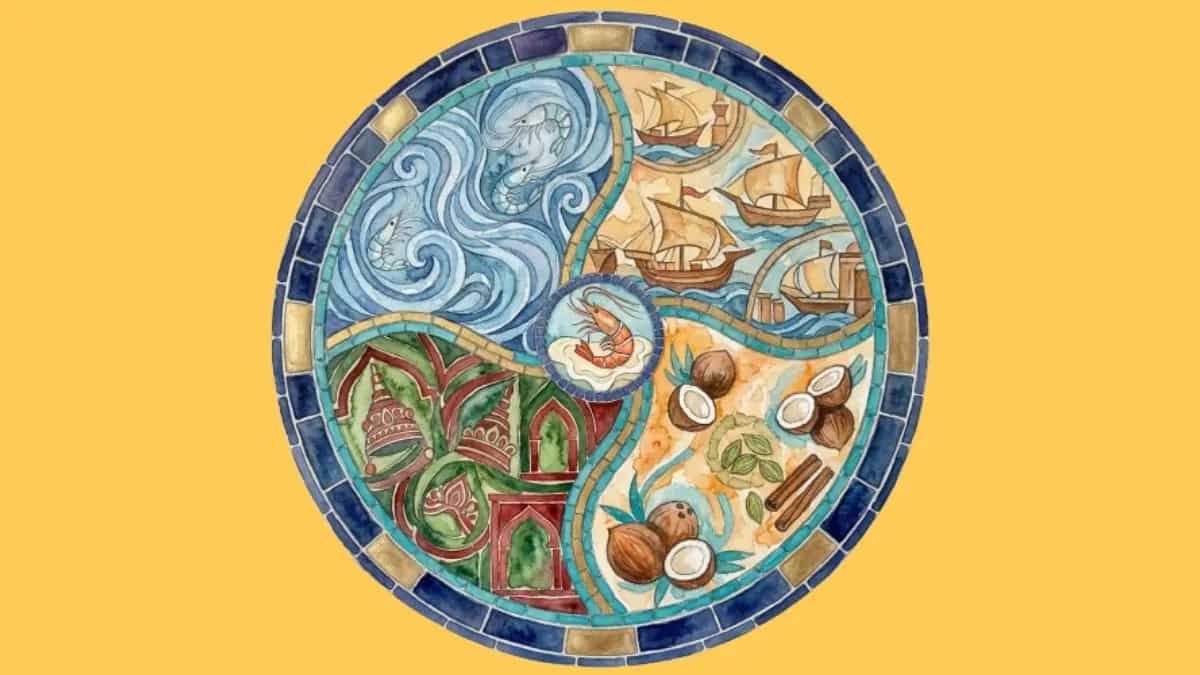
WHEN international food guide TasteAtlas recently ranked West Bengal's Chingri Malai Curry among the world's best shrimp dishes, it was easy to view the accolade as another feather in Indian cuisine's increasingly crowded cap. After all, global rankings come and go. Lists are made, updated, debated, and forgotten.
But Chingri Malai Curry is one of those rare dishes that deserves a closer look — not because it appeared on a list, but because it tells a story.
A story of rivers and trade routes. Of colonial encounters and culinary adaptation. Of weddings and Sunday lunches. Of a region so intimately tied to water that some of its greatest culinary achievements emerged not from land, but from what swam beneath its surface.
And perhaps most intriguingly, it is a story wrapped inside a name whose origins remain surprisingly contested.
The curious mystery of the "malai"
Ask most Indians where the 'malai' in Chingri Malai Curry comes from and you'll likely receive the same answer: cream.
It's an understandable assumption. After all, malai in Hindi and several North Indian languages refers to the rich layer of cream that rises to the top of milk.
Yet many food historians have questioned whether cream has anything to do with the dish at all.
One popular theory suggests that the word may actually derive from the Malay word associated with coconut preparations, reflecting centuries of maritime contact between Bengal and Southeast Asia. Culinary historian KT Achaya explored how trade routes across the Bay of Bengal facilitated the movement of ingredients, techniques, and food traditions long before the arrival of European colonial powers. Coconut milk-based seafood dishes were already common across parts of Southeast Asia, making the linguistic connection difficult to dismiss.
Whether the theory is entirely accurate remains debated. What is clear, however, is that the defining richness of Chingri Malai Curry comes not from dairy cream but from coconut milk.
And that coconut milk changes everything.
Unlike many Bengali curries built around mustard, poppy seeds, or light vegetable broths, Chingri Malai Curry belongs to a different family altogether — one where sweetness, fragrance, and silkiness take centre stage.
A curry born of water
To understand Chingri Malai Curry, one must first understand Bengal itself.
The Bengal delta is among the largest river systems on Earth. The Ganges, Brahmaputra, and Meghna rivers create a vast network of waterways, estuaries, ponds, creeks, and wetlands that have shaped local diets for centuries.
While much of India celebrates lamb, chicken, or beef as culinary centrepieces, Bengal developed a cuisine where fish and shellfish often occupied pride of place.
The Bengali saying "mache-bhate bangali" — a Bengali is made of fish and rice — is less a cliché than a geographic reality.
Prawns, particularly the prized galda chingri (giant freshwater prawns) and bagda chingri (tiger prawns), became symbols of abundance and prosperity. Their size, sweetness, and relative expense elevated them beyond everyday meals and into the realm of celebration.
Few dishes showcase that elevation better than Chingri Malai Curry.
From zamindar tables to wedding feasts
Many iconic dishes begin as peasant food before ascending to restaurant menus. Chingri Malai Curry largely followed the opposite trajectory.
The dish became closely associated with affluent Bengali households, zamindar estates, and festive occasions where premium ingredients could be showcased without restraint.
Large prawns were expensive. Coconut milk required labour. Whole spices such as cardamom, cinnamon, and cloves were historically luxury items.
This was not a curry designed for thrift; it was a curry designed to impress.
Even today, across Kolkata and beyond, Chingri Malai Curry remains a fixture at weddings, anniversary celebrations, Poila Boishakh feasts, Durga Puja gatherings, and special family lunches.
For many Bengalis, it belongs to a category of dishes reserved for days when ordinary rules no longer apply.
The great Bengali prawn debate
Mention Chingri Malai Curry in a room full of Bengalis and the discussion quickly becomes complicated.
Should it be made with galda or bagda prawns?
Should the gravy lean sweet or savoury?
How much coconut milk is too much coconut milk?
Can onions be included?
Should ghee make an appearance?
Like all beloved dishes, Chingri Malai Curry exists in countless versions.
Some recipes rely heavily on coconut milk, creating a rich, almost luxurious sauce. Others introduce yoghurt for tang. Some households emphasise ginger, while others allow cardamom and cinnamon to dominate. Certain cooks finish the dish with a touch of sugar, while others reject sweetness altogether.
The arguments can become surprisingly passionate, which is often how one identifies a truly great dish.
Coconut, prawns, & a global culinary family
What makes Chingri Malai Curry especially fascinating is that it belongs to a much larger global tradition.
Across tropical coastlines separated by thousands of kilometres, cooks have repeatedly arrived at the same conclusion: shellfish and coconut are natural companions.
In Brazil, Bobó de Camarão combines shrimp with coconut milk and cassava into a rich seafood stew.
Along India's western coast, Goan prawn curries balance coconut with chilli and tamarind.
Sri Lankan prawn curries often use coconut milk alongside curry leaves and roasted spices.
Across Thailand, shrimp frequently appears in fragrant coconut-based curries infused with lemongrass and galangal.
These dishes differ dramatically in flavour. Yet they share a common culinary instinct.
Coconut softens the briny sweetness of shellfish while providing body, fragrance, and richness without overwhelming the seafood itself.
Chingri Malai Curry may be distinctly Bengali, but it is also part of a much older conversation taking place across tropical kitchens around the world.
Why we keep returning to it
The appeal of Chingri Malai Curry extends beyond technique or history. Part of its power lies in what it represents.
For many Bengalis, the dish exists in memory as much as on the plate.
It is the aroma drifting from the kitchen before guests arrive; the oversized prawn placed carefully on top of steaming white rice; the special meal prepared when relatives visit from abroad; the wedding buffet queue moving slowly because everyone wants an extra serving.
The curry embodies hospitality. And hospitality, perhaps more than any individual ingredient, lies at the heart of Bengali food culture.
More than a ranking
TasteAtlas may have placed Chingri Malai Curry among the world's finest shrimp dishes, but rankings can only capture so much.
They measure popularity. They measure reputation. Occasionally, they measure technical excellence. What they, however, cannot measure is nostalgia.
They cannot quantify the comfort of coconut-scented gravy mingling with hot rice. They cannot capture family arguments over whether galda is superior to bagda. They cannot explain why generations of Bengalis continue to reserve this dish for life's happiest occasions.
Chingri Malai Curry is not merely a prawn curry; it is a map of Bengal's rivers, trade routes, celebrations, and culinary imagination.