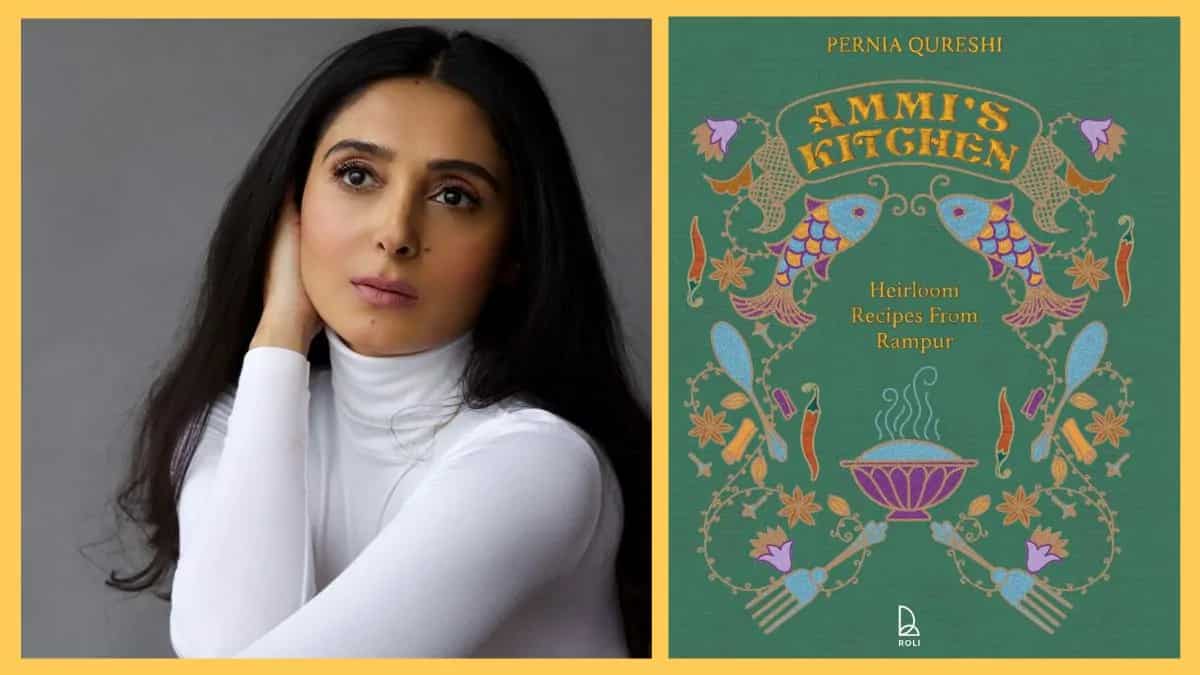
THE FIRST THING Pernia Qureshi tells me is that she still hasn’t fully processed her grandmother’s death. It’s been nearly six years, but the grief lingers. In smells, in tastes, in the instinctive pull of certain dishes. “Even now,” she says, “when I read the introduction of the book, I cry.”
The book she’s referring to is Ammi’s Kitchen, a deeply personal cookbook that is less about recipes and more about remembrance. For someone best known as a fashion entrepreneur — her name synonymous with Pernia’s Pop-Up Shop — the decision to document food might seem like a pivot. But Qureshi is quick to correct that assumption. “This book isn’t about food,” she says simply. “It’s about my grandmother. Her food just happens to be the way I remember her best.”
Her grandmother, Musharraf Begum, universally known as Ammi, was the axis around which family, food and hospitality revolved. “She was everyone’s Ammi,” Qureshi recalls. “Not just ours. The whole town of Rampur called her that.”
Ammi’s Kitchen pays homage to the author’s grandmother as well as the lip-smacking Rampuri cuisine: from mutton kacchi tikka (minced lamb patties marinated with spices) to lahori seekh kebab (spicy minced mutton kebabs) and chawlai saag (a spicy dry dish of red amaranth) and nimish (a light, airy dessert made of whipped milk and cream foam), it brings dishes belonging to different eras and kitchens right in front of your eyes.
A KITCHEN THAT FED A TOWN
Musharraf Begum’s beginnings were modest. She came from Chandausi, a small town in Uttar Pradesh, and was married young to Abdul Majeed Qureshi, a wealthy nobleman from Rampur — his fourth and only surviving wife.
When Ammi arrived in Rampur in the mid-1940s, she entered a world far larger and more complex than anything she had known. Rampur, a princely state steeped in Mughlai, Awadhi and Afghani influences, had a rich culinary culture. And in that kitchen, Ammi found her footing. “Food became her language,” Qureshi says. “It’s how she asserted herself, how she loved, how she led.”
As was common for women of her generation, Ammi ran the kitchen. But this was no ordinary domestic role. With eight children, several grandchildren, staff, townspeople, and frequent daawats hosted on behalf of her husband for visiting dignitaries and the Nawab, the kitchen was always feeding. “Cooking and eating were the centre of her world,” Qureshi says. “There was always someone to feed.”
Her closest ally was Israil Bhai, a young boy employed in the kitchen when she first arrived. Over time, he became her confidant and collaborator. “They created magic together,” Qureshi smiles. “I can still hear them bickering — Ammi calling him "tokri ke", basket case, which was the worst insult she could manage because she loved him too much to be truly angry.”
Despite having a large kitchen, they often cooked outside, setting up a choolah with bricks and wood to slow-cook dishes. The food that emerged was robust, deeply flavourful, and unmistakably Rampuri — mutton-heavy, rich, unapologetic.
“When people think of Rampur, they think of kebabs,” says Qureshi. “Seekh, chapli. But for me, the most Rampuri dish is taar gosht.”
Cooked in a masala gravy with so much ghee that a visible taar — a line — should connect your roti to the plate, taar gosht was Ammi’s answer to every occasion. Weddings, funerals, celebrations — it didn’t matter. “It was rich enough that no one could say she hadn’t done enough,” Qureshi explains, “and filling enough to feed everyone.”
FOOD AS LOVE, FOOD AS MEMORY
What made Ammi exceptional, beyond her command of traditional cuisine, was her adaptability. In her later years, when Qureshi’s grandfather fell ill and was advised to eat lighter food, Ammi adjusted. During frequent travels to Calcutta, she picked up British-style lighter dishes, tailoring her cooking to his needs.“She knew exactly who needed what,” says Qureshi. “Food was her love language.”
By the time Ammi moved to Delhi in 2010 to live with Qureshi’s family, this instinct remained intact. “Every time I came back from a trip,” Qureshi recalls, “my favourite gobi gosht with bina happa — black dal khichdi — would be waiting for me. Like magic.”
She was also a master of combinations. Kaddu bharta paired with pyaaz ki sabzi and besan roti. Dishes chosen not just for flavour, but for balance. Qureshi says, “Even today, we don’t dare change her combinations.”
It’s this intuitive knowledge — never written down, never measured — that made putting together Ammi’s Kitchen such a painstaking process. Qureshi herself doesn’t cook. “Honestly, it would have been easier if I did,” she admits. The book took three years to complete, involving constant coordination between her father, aunts, the family chef (whose father had once worked for Ammi), and countless rounds of testing. “Traditional cooks don’t think about measurements,” she says. “They just know. Writing it down meant becoming almost scientific.”
The result is a collection of over 100 recipes, most of them still in currency in the author’s household. “These are dishes we cook every day,” Qureshi says. “Three of them would be made in my house today.”
CARRYING RAMPUR FORWARD
In 1997, the family opened Rampur Kitchen in Delhi’s Khan Market, bringing Ammi’s food to a wider audience. Ammi and Israil Bhai personally trained the chefs. The response was immediate and overwhelming. “There were lines around the block,” Qureshi remembers. “Especially for the kali mirch chicken. Everyone ordered it.”
Though she laughs now, the memory underscores something important: how deeply people connect to food that feels honest.
When I ask Pernia what it is about food that opens such powerful floodgates of nostalgia, she answers without pause. “It’s our grandmothers. It’s our memories of home,” she says. For her generation, food was a love language, usually spoken by a mother or grandmother at the stove.
“Millennials grew up receiving love through food,” she reflects, noting how different that is from the way children are raised today. That’s why our happiest memories are almost always edible ones. Ask anyone in their late thirties or forties about childhood, she smiles, and the answer will inevitably begin with meri nani/dadi yeh banati thi. “We are a food generation,” Pernia says. “And I love that about us.”
When asked what advice she has for those wanting to stay connected to their culinary roots, her answer is direct. “There are no shortcuts,” she says. “You have to invest time. And utensils. Traditional cooking demands both.”
It’s a fitting conclusion for a conversation that circles back, again and again, to patience, care and intention. Deeply personal, emotive and filled with luscious imagery of food, this book is a tribute that is as unique as the cuisine it details.