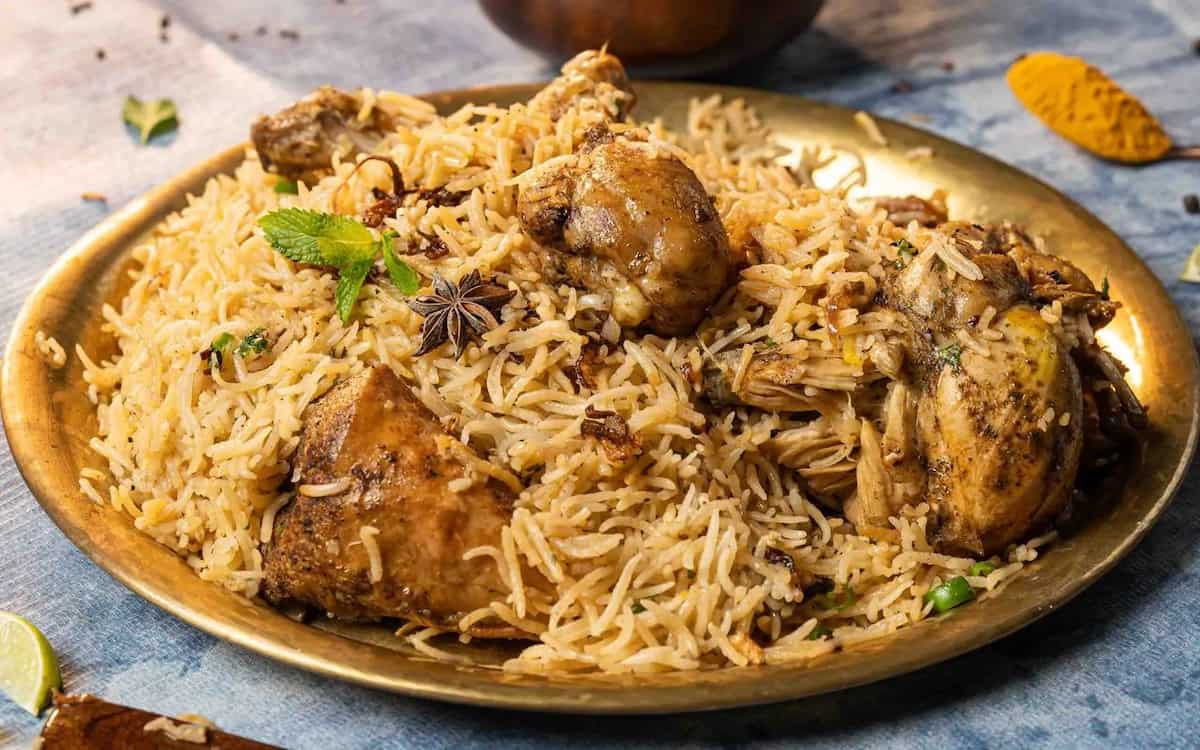
For a dish that appears so often on our tables, biryani remains surprisingly difficult to define. Every region seems to have its own version, every cook their own rules and every enthusiast their own fiercely defended opinions. In A Quest For The Perfect Rice, food writer Zubin D'Souza follows those many threads through history, tracing the stories, ingredients and traditions that have shaped one of the subcontinent's most iconic rice dishes.
The book's narrator finds himself in the company of an unlikely guide: the spirit of Nawab Wajid Ali Shah, the last ruler of Awadh and one of history's great patrons of food and culture. In this excerpt, the nawab reflects on the remarkable diversity of biryanis, pulaos and teharis, while making a spirited case for why rice deserves just as much attention as the ingredients layered around it.
***
'MAKING A BIRYANI tends to get a tad bit repetitive, doesn't it? I mean, you cook the meat or vegetables and the rice and then you layer it and ta-da! You have a biryani. All we have to do is to change the meat or protein or the primary ingredient and you have a new biryani right there.'
'I really would love to carry my naivety with the same confidence as you,' said the nawab in a voice that dripped with sarcasm. 'Do you know that India has roughly about 380 different varieties of traditional biryanis? And I have tried and tested recipes for each and every one of them! I can share them with you if you would like, but I don't know if this is going to be worth the effort. I mean, just from our initial conversations and your grasp on the concept of biryani, I find you as clear on the concept as a cataract-laden eye is in seeing what's right in front of it.
'Anyway, one mustn't be rude to honoured guests and, as time flies by, it ensures that I get so very few of them. And no, not everything with meat, rice and spices was to be considered a biryani. A pulao was something that was more commonly eaten. It was light and flavourful and just perfect for the warm weather that we battle through most of the year. It may come as a surprise to you, but despite all the stories of gluttony that you may have heard, most of us, including several scions of the Mughal empire, actually preferred vegetarian food over meat. A pulao could have the rice simmered in a spice-scented meat broth. The broth was created with the scraps and bones after a butcher was done with stripping the animal for other dishes. A pulao was a great substitute for a biryani and could be eaten more regularly. A biryani needed a celebration for it to be doled out. But a pulao was readily available, required a shorter preparation time and also had the right amounts of protein that one needs, sans the uneasy bloating that always accompanies an indulgence in meats.
'A tehari, on the other hand, is a dish that traces its roots to antiquity and has even found mention in ancient Ayurvedic treatises, where it was referred to as tapahari. A tehari is also a one-pot rice dish that was almost always vegetarian. It is mildly spiced and uses the liquid to cook the rice and extract the flavour from the vegetables simultaneously. The result is an aromatic, flavoured rice dish that is lighter on the stomach. Although you may hear people wax eloquently as to how certain meats add an absolutely unique twist and flavour, I think one of the unsung heroes has to be the rice. Although most gravitate automatically towards Basmati as an automatic choice, there are so many other rice varieties that elevate the game in so many ways. The nutty-flavoured Seeraga Samba rice from South India is amazing in a biryani despite the fact that it is rather diminutive in size when compared to its longer-grained cousin. The Jeerakasala rice from Kerala is another stellar example of a fluffy, earthy-flavoured grain that lends itself beautifully to biryanis. Purists may raise an eyebrow, but the lilliputian Gobindobhog rice from Bengal is not meant to be restricted to only creating the famed payesh, which is a rice and milk pudding. With its natural tendency to retain its shape and emanate an extremely aromatic and unique fragrance, I have used it in quite a few biryanis at my home as well. It is not meant to be confused with another aromatic and short-grained rice grown further east into Bengal called the Kalijeera rice. For a short period of time, I experimented with the black-grained and dense rice called Kalanamak. Legend traces the origins of this rice variety to being a gift from Lord Buddha to the residents of these particular villages who had imbibed his teachings. Although it may be used in a biryani, it is rather gimmicky as it doesn't really absorb flavours well and doesn't allow the dish to be as harmonious as it should be.
Towards the west, they love to use the Sella variety of rice. It sports beautiful long grains and reduced starch levels, so the grains do not stick to each other amorously and muck up the biryani. The golden brown Sona Masuri or the pale-shaded Patna rice have also been incredible in adding to the delight each time a biryani is prepared.
'Basmati rice, of course, tends to rule the roost when being tasked with making a biryani. The long grains and the very unique, earthy flavour go a long way in creating the most amazing experience. But a biryani needs more than protein and rice. It needs a perfect blend of spices to create those unmistakable memories. Each biryani also brings with it a unique blend of spices. Stronger-flavoured meats may require spices that complement their robustness, like black cardamom, cloves and black caraway seeds. Lighter-flavoured ingredients, which vie to be the centre of attention in a biryani, need to have their characteristics accentuated by aromatic and yet lighter spices, like fennel seeds, green cardamom, cinnamon and nutmeg. Sometimes regional sentimentalities may be given a nod, like the use of the dried lichen known as kalpasi or dagad phool, the expensive and peppery pipla or long pepper or the spice called cobra's saffron or nagkesar. Beyond adding flavours, a spice mix is also about adding balance. It is never meant to overpower a dish but to complement it. Getting the right spice mix is akin to a game of chess. When you have a great partner to play with, it is interesting and riveting — you couldn't ask for anything better. Spices are far too important to be mishandled or used inappropriately.
'Garam masala mixes were composed of different spices in varying quantities, dependent upon the ingredient that they were meant to be accentuating and the dish that they were going to be a part of. Far too often have I come across people who use a single spice mix for everything that they are cooking. It is passable, but it will never be perfection. In my estimation, as far as food and the arts are concerned, perfection is everything. Culture is far too important to allow it to slide into a state of mediocrity. You only have to look towards the Philistines to understand how important culture is for a community to thrive!
'Apologies,' spoke my cordial host as he raised his arms with his open palms facing me and dropped his head in a sign of submission. 'Apologies! I think that sometimes I tend to forget where the artist ends and the nawab begins! I have been accused of being overly sentimental in the past, but I think that the labels have always come from people who will never understand true passion. I will always be remembered by history and you, my fine sir, are also proof of the same. I worked really hard to position my kingdom as a watering hole for the cerebral and artistic elite. I created great governance and greater prosperity for my people. I created opportunities, and identity and beauty!
***
The above excerpt from Zubin D'Souza's latest book, 'A Quest For The Perfect Rice' (Paperback | 344 pp | Rs 599), is published by Vintage, an imprint of Penguin Random House, and is reproduced here with due permission of the publisher.