


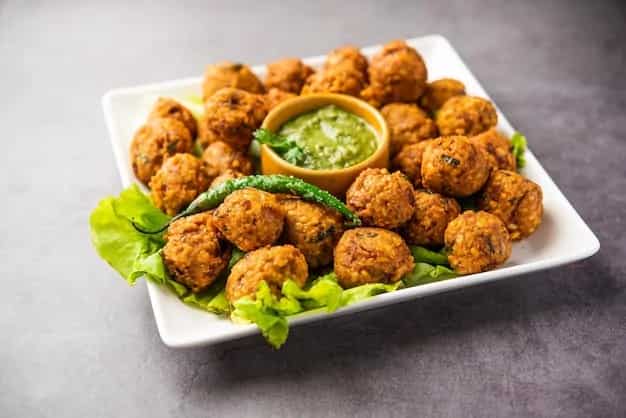
Pakoda
Nutritional Value
233
Calories
per serving
- Fat1 g
- Protein6 g
- Carbs49 g
- Fiber3 g
- Sodium0 g
- Others0 g
- Place of OriginINDIA
- CuisineAsian
- Common Ingredients
- CourseStarter & Appetizer
If there is one Indian street snack that has taken the world by storm in the last decade, it has to be Pakoras. Sinfully scrumptious and highly addictive, Pakoras are Indian fritters that can be made with almost any vegetable. All one needs to do is select a vegetable of choice, dunk it in Besan (gram flour) batter, and deep fry it until the batter becomes sonorously crunchy.
Their ubiquitous presence makes a curious mind wonder about the first time a cook decided to chop vegetables up and deep fry them. Turns out, pakoras have been around for centuries. But when was the first version of Pakora made?
The earlier written evidence of Pakoras can be found in ancient Sanskrit and Tamil texts, but the description is vague and the recipe, unavailable. The first recipe of Pakora is documented in Chalukya King Someshvara III’s 12th Century text Manasollasa and is called Parika.
Not only in the subcontinent, but the influence of pakoras was also evident in other global cuisines as well. Legend has it that in the 16th Century, Spanish and Portuguese travellers travelling to Japan would halt at India. These Indian cooks would whip up a wide variety of dishes to feed the travellers, of which one was Pakoras. On reaching Japan, many Indian cooks would eventually take up work in the country, thus inspiring Japanese kitchens to come up with their version of Pakora, the Tempura. Since deep-frying is not a culinary technique practised by the Japanese, it can be concluded that Pakora was the true precursor of this Japanese delicacy.
The reason for switching the Besan batter with a lighter wheat flour batter is the lack of availability of chickpea flour in the island nation. Chickpeas are a non-negotiable part of desi kitchens. While smaller chickpeas are ground to make flour, mature chickpeas are made into curries and boiled for salads and soups. Not just in India, curries made of chickpeas are also widely popular in Pakistan, Bangladesh and the UK.
In the eastern belt of India, in Odisha, Bengal and Assam, chickpea is replaced with rice flour batter owing to its easy availability and popularity in these states. The content of the Pakora also changes according to their geographical location. So Bengal makes Beguni, a flat, batter-fried pakora with a thin sliver of cooked brinjal inside, but Rajasthan is popular for its spicy Mirch Pakora.
Nutritional Value
233
Calories
per serving
- Fat1 g
- Protein6 g
- Carbs49 g
- Fiber3 g
- Sodium0 g
- Others0 g