


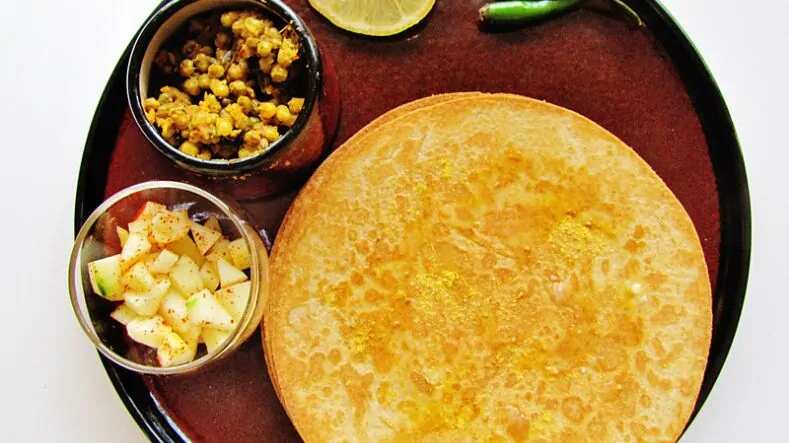
Khakra
Nutritional Value
1536
Calories
per serving
- Fat51 g
- Protein37 g
- Carbs227 g
- Fiber16 g
- Sodium0 g
- Others0 g
- Place of OriginGUJARAT
- CuisineAsian,Indian,Gujarati
- Common Ingredients
- CourseStarter & Appetizer
The sheer enormity and variety of the Indian culinary landscape is a true testament to the rich and diverse culinary history of the country. Yet, there is little documented evidence around the genesis of many of these preparations, which could be attributed to the country's tradition of aural documentation.
Khakras, the airy-light Gujarati wafers that have been having a bit of a global domination moment in the past decade, have an ambiguous story of origin. Some experts have conjectured that Khakra was born in Jain kitchens. Since Jains avoid eating leftover food, the households decided to dehydrate the chapatis so that there was no bacterial growth on them. The moisture in the food accelerates the rotting process, and therefore, to preserve them for longer, the chapatis were dry roasted on a tawa (hot pan) under high pressure. Thus was conceived the first-ever Khakra.
There is another theory that suggests Gujarati traders were behind the creation of wheat crisps. Gujaratis were known to travel enormous distances on roads and ships for trade. The journeys were long and perilous, and the food supply was unpredictable. So, devising ways to carry and preserve food became a priority.
Now, most of these Gujarati merchants were vegetarians, and some of them followed the strict dietary mandates of Jainism. Furthermore, the food item had to be easily portable, fuss-free and something that wouldn't get spoiled even in a hot and humid climate.
Thus, roti seemed to be the best possible food item that could be carried in bulk on their journeys. Dehydrating is one of the two major ways Indians have preserved their food, the other way being pickling. With the rotis dehydrated in a hot oven, they would remain fresh for weeks, even months. It was also an economical choice because this way, no food would go to waste.
Today, there is an assortment of flavoured Khakras on offer in the market. From simple garlic, pudina, methi (fenugreek), to jeera (cumin) and cheese ones, Khakras can now also be made in Pani Puri, Pav Bhaji, pizza and other such complex flavour combinations. There is even a sweet rendition of Khakra called Mungdi, which derives its flavour from date palm jaggery.
Nutritional Value
1536
Calories
per serving
- Fat51 g
- Protein37 g
- Carbs227 g
- Fiber16 g
- Sodium0 g
- Others0 g