


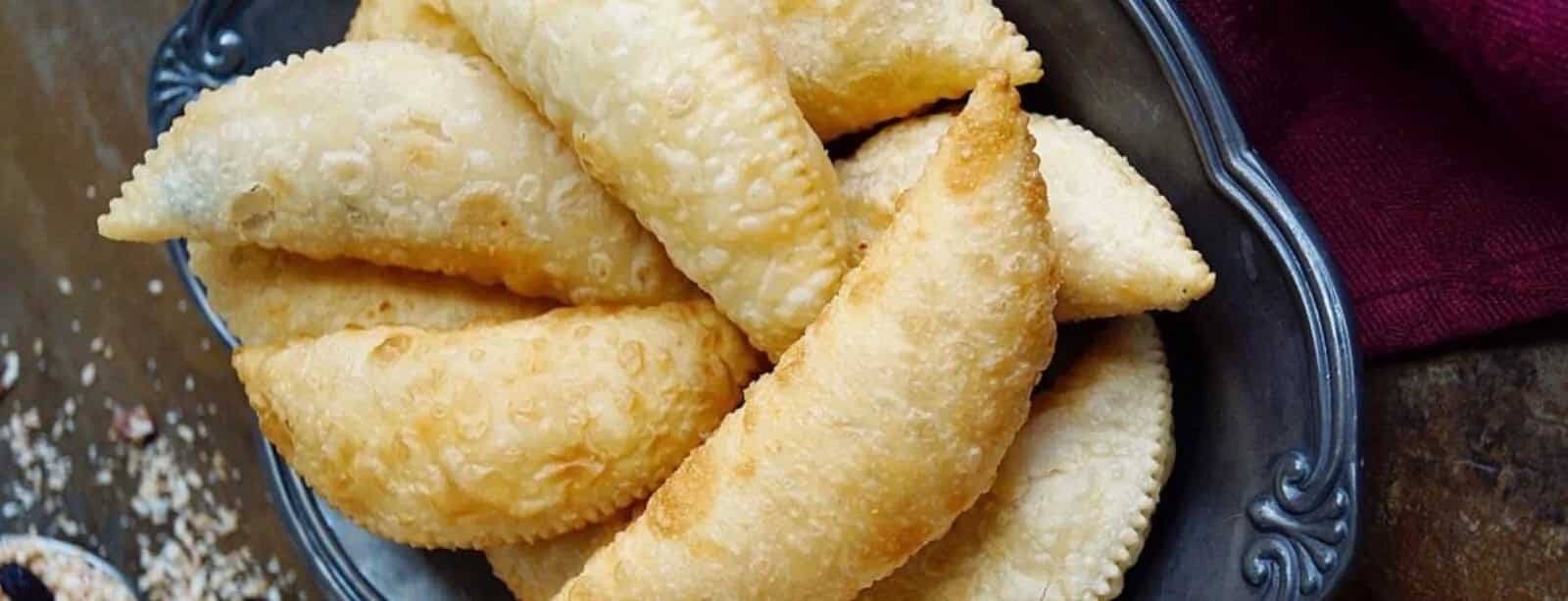
Karanji
Nutritional Value
295
Calories
per serving
- Fat18 g
- Protein10 g
- Carbs24 g
- Fiber1 g
- Sodium0 g
- Others0 g
- Place of OriginMAHARASHTRA
- CuisineAsian,Indian,Maharashtrian
- Common Ingredients
- CourseDessert
In her handbook to Indian cuisine titled The Indian Grocery Store Demystified (2016), writer Linda Bladholm elaborately breaks down the many Indian staples—from rice grains like Gobindabhog and Basmati, breads like Rumali Roti and Khakhra Roti, to sweets and vegetable curries.
While decoding the rich mosaic of Indian sweets, Bladholm points out how the popularity of the moreish, decadent Karanji in Maharashtra is only bested by the other Maharashtrian staple, Modak.
In fact, Karanji is a crescent-shaped Modak. Both the sweets are Ganesh Chaturthi favourites and have a succulent and scrumptious filling of jaggery and coconut. Beyond the demonstrable difference in the shapes of these sweets, the only other difference between the two is the outer coating. While Modaks are steamed, Karanji has a flaky, crumbly pastry covering.
Much like Modaks, Karanjis started out as exclusively being made in household kitchens, since anything store-bought would be considered unfit for a religious offering. The ingredients used in this dish are found in every Indian kitchen. Yet, making Karanjis at home from scratch can prove to be challenging, as mastering the skill of making the perfectly crumbly pastry can take years to perfect.
To make the filling, grated coconut and rava (semolina) are roasted separately until they lose all moisture. Then in boiling sugar syrup, the dry ingredients—coconut, cardamom powder, rawa and sesame seeds—are folded in. The pastry dough is made with maida (refined flour) and ghee and kneaded until it becomes easily pliable. It’s then separated into smaller dough balls and rolled out to resemble Puris. The filling is carefully spooned in on one side of the pastry, and the other side is folded on itself and sealed with a bit of milk or water. After this, the Karanjis are deep fried in a kadhai with ghee until the coating crispens up and becomes golden brown.
The trick to getting crispy Karanjis is to let them rest for a while before starting to fry them. If it’s too soggy, the chances are, the Karanjis are going to turn out chewy. Some cooks even add a portion of rice flour to the dough to make the sweets even crispier.
Nutritional Value
295
Calories
per serving
- Fat18 g
- Protein10 g
- Carbs24 g
- Fiber1 g
- Sodium0 g
- Others0 g