


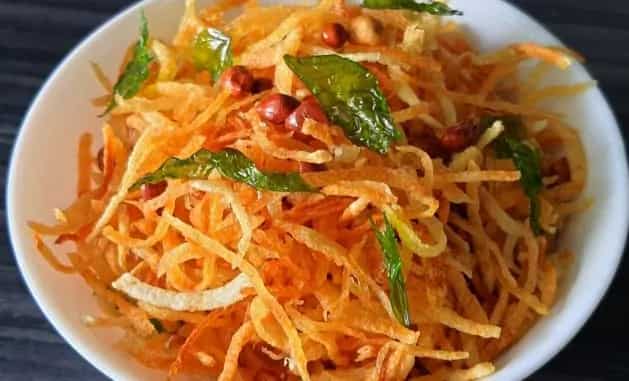
Jhuri Aloo Bhaja
Nutritional Value
4795
Calories
per serving
- Fat511 g
- Protein11 g
- Carbs56 g
- Fiber9 g
- Sodium0 g
- Others0 g
- Place of OriginEASTERN,INDIA
- CuisineAsian
- Common Ingredients
- CourseStarter & Appetizer
Every year, on 23 January, Lakshmi Narayan Shaw & Sons in North Kolkata distributes free fries and fritters to everyone to mark the birth anniversary of the most reputed customer to have ever set foot in their store—Netaji Subhash Chandra Bose. It is believed that Netaji, then a student at Scottish Church College, frequented their store for a cup of hot tea and crispy fries.
Much like Bengal’s fascination with the legends of the man, the Bengali obsession with fries and fritters has transcended middle-class lunch platters to become a hallmark of Bengali culinary identity. Out of all the bhajas (fries) that Bengalis love, Jhuri Aloo Bhaja is probably the most common. Owing to its crispy texture and rich golden colour, the dish, prepared by frying grated potato in simmering mustard oil, is a fantastic accompaniment to Dal Bhaat (rice with lentil soup) or the more rural counterpart Panta Bhaat (cooked rice soaked and fermented in water).
Interestingly, Jhuri Aloo Bhaja is only a type of the many forms of fried potato popularly consumed in Bengal. Besides the grated form, potatoes can be cut into round slices, thin cylinders, or small cubes dotted with poppy seeds; there is no end to the experiments that can be done with Aloo Bhaja and its shapes. But contrary to its internationally famous counterpart, the Bengali Aloo Bhaja demands a much thinner cut compared to the more robust French Fries.
The origin of the Bengali Bhaja dates back to the medieval period and possibly earlier. Traditionally, Bhaja is served in Bengali households as a starter and can be made from ingredients like besan (Bengal gram flour), fish, brinjal, bitter gourd, spinach, and onion, only to name a few. In fact, Bhaja is listed as an essential item of the common Bengali diet in both Narayandeva’s Padmapuran and Manik Gangopadhyay’s Dharmamangal, narrative poems of medieval Bengal.
However, Aloo Bhaja is essentially a colonial construct since potatoes were brought to India by the Portuguese in the 17th century and introduced in Bengal by the British East India Company in the 18th century. But potatoes have a rather unpleasant history in the Indian subcontinent and may be considered to be at the root of British imperialism in the country. Historical records indicate that the East India Company popularised potatoes by handing over considerable quantities of free seeds to the peasants to cultivate. Soon, overwhelming batches of produce found potato a place in most Indian cuisines and a favourite with the locals. For the British, however, the potato was a superfood laden with starch and therefore a tool to create an ever-increasing number of able colonial labourers. It was also used as a means to justify British imperialism, saying that the potato was an embodiment of happiness and food security that the British had gifted the country.
Despite controversial beginnings, Jhuri Aloo Bhaja continues to satiate millions of Bengalis. Breaking into the hot flaky golden strands of potato, despite its contested history.
Nutritional Value
4795
Calories
per serving
- Fat511 g
- Protein11 g
- Carbs56 g
- Fiber9 g
- Sodium0 g
- Others0 g