


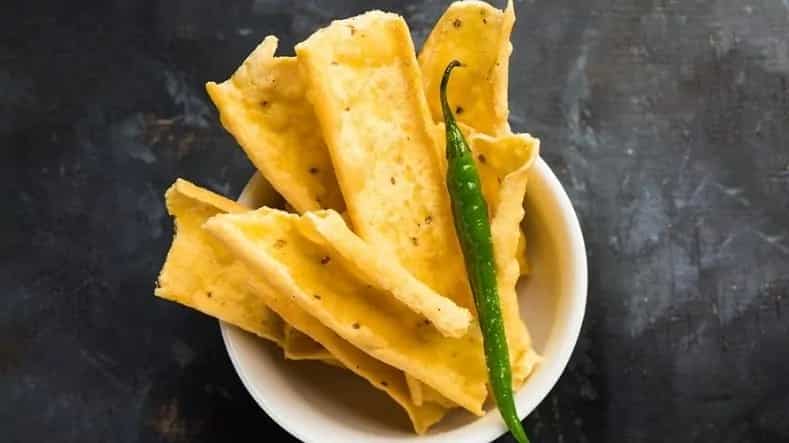
Fafda
Nutritional Value
1410
Calories
per serving
- Fat48 g
- Protein68 g
- Carbs175 g
- Fiber33 g
- Sodium0 g
- Others0 g
- Place of OriginGUJARAT
- CuisineGujarati
- Common Ingredients
- CourseStarter & Appetizer
A cursory glance at Gujarat’s culinary history reveals that many of its food items were tailored to be travel friendly. From Khakras, Khandvis, and Dhoklas to Theplas, there is a category of dry Gujarati food that was once geared towards convenience and now has evolved to become dependable snacks.
A savoury, salty fried snack, paired with a hot Jalebi or only crispy, fried chillies, is a common breakfast dish in the western belt of India. It is a type of Gathiya, a deep-fried snack made with besan and an assortment of spices, in various shapes.
Fafda doesn’t fret around with too many ingredients, yet the challenge of making Fafda is to achieve the perfect consistency for the dough so that they have a sonorous crackle. To make Fafdas, the dry ingredients are stirred together with little water until it becomes moderately malleable. Then the dough is separated into balls and each ball is stretched out with oil to form thin sticks. The sticks are deep-fried in oil till they become hard and crispy.
Historian KT Achaya states in his Dictionary of Indian food that this deep-fried snack can be eaten on its own or served as an accompaniment to another meal. It’s also a staple sight during the Dussehra festival. The reason for that is as per Hindu traditions, gram flour is auspicious and is believed to be a favourite of Lord Hanuman. This is why Hanuman temples all over the country serve gram flour snacks like Besan ke Laddoo as religious offerings. Therefore, Gujaratis celebrate Rama’s defeat of Ravana by consuming Fafda and Jalebi for Dussehra breakfast.
Today, its global popularity has led to the mass production of Fafdas. But Gujaratis still prefer to make their Fafdas at home for an authentic taste.
Nutritional Value
1410
Calories
per serving
- Fat48 g
- Protein68 g
- Carbs175 g
- Fiber33 g
- Sodium0 g
- Others0 g