


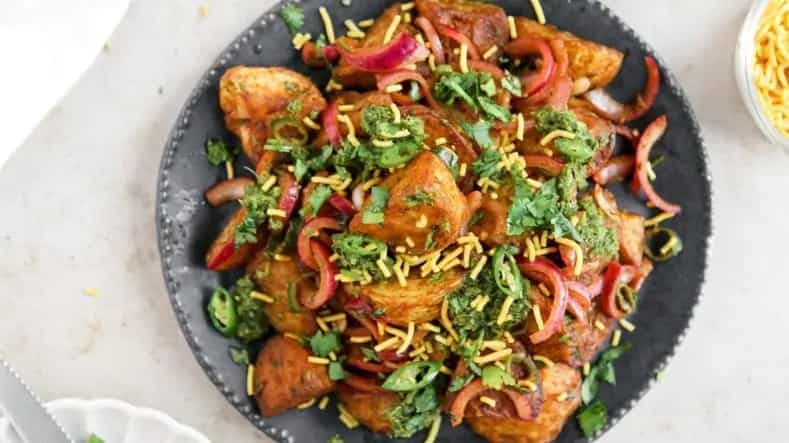
Aloo Chaat
Nutritional Value
998
Calories
per serving
- Fat50 g
- Protein32 g
- Carbs102 g
- Fiber31 g
- Sodium0 g
- Others0 g
- Place of OriginDELHI
- CuisineAsian,Indian,North Indian
- Common Ingredients
- CourseStarter & Appetizer
Aloo Chaat is unanimously hailed as the indisputable emperor of street food in India. And why wouldn’t it be? It combines the two things Indians can’t get enough of—aloo (potatoes) and chaat (a dry, savoury snack mixture).
While it’s difficult to determine when and where Aloo Chat has its origins, historians claim that a fried potato snack topped with different types of salt may have been around before it assumed the identity of Chaat. Over the years, this infinitely versatile dish has been co-opted by different regions as per their produce and food habits.
So, the Aloo Chat sold on the streets of South Kolkata leans more towards sweet and sour than spicy. One salient feature of this Bengali appetiser is that it misses one of the key ingredients of every chaat—yoghurt. Instead, the sourness is derived from the addition of tamarind sauce. This special type of Aloo Chaat is known as Aloo Kabli, and uses boiled potato cubes instead of fried ones. The boiled potato and chickpeas are injected with a heady mix of spices that include aamchur (dried mango powder), rock salt and ajwain, among other everyday spices like cumin and coriander powder.
Delhi's version of Aloo Chaat is far more full-bodied and richer in spice. The potato cubes are first boiled, then deep fried in a wok of ghee, followed by them being tossed in a mix of dry spices like red chilli powder, dried mango powder, garam masala, tamarind chutney and green chutney, made with coriander, mint and green chillies. It is served with a sprinkling of lime juice, freshly chopped coriander and pickled ginger shards and anardana (dried pomegranate) powder.
When the same recipe is recreated with potato patties, it is called Aloo Tikki Chaat.
Chaat itself has been around for over a whopping four centuries. History has it that Shah Jahan was fairly worried about the unpalatable water of Yamuna, which led to a cholera outbreak. The physicians of the time suggested food be made spicier in order to tackle the health scare. Hence, cooks started making food with exorbitant portions of spices and oil. Where the meat-eating Mughal court experimented with kebabs, the Hindu masses conceived the idea of making Chaat. No wonder the name of the dish comes from the Hindi word "chaat", which means to lick.
Nutritional Value
998
Calories
per serving
- Fat50 g
- Protein32 g
- Carbs102 g
- Fiber31 g
- Sodium0 g
- Others0 g