


- Home
- Slurrp360
- Most searched
- Mishti Doi
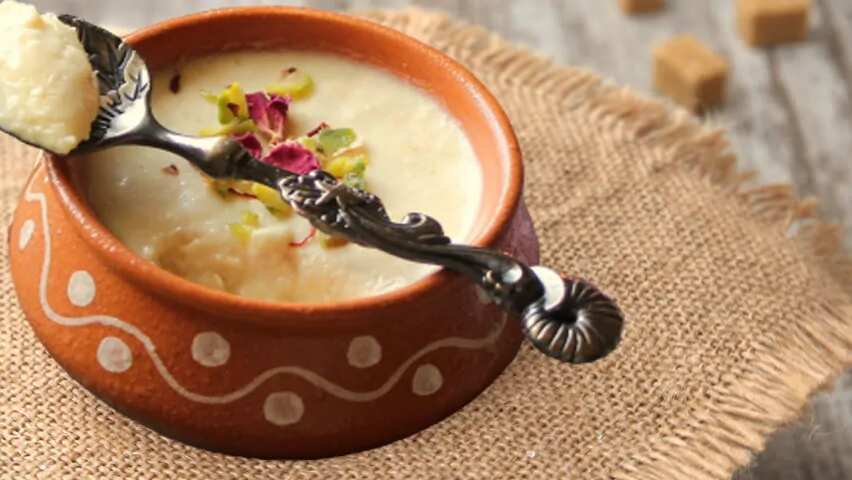
Mishti Doi
Nutritional Value
1467
Calories
per serving
- Fat81 g
- Protein43 g
- Carbs142 g
- Fiber1 g
- Sodium0 g
- Others0 g
- Place of OriginKOLKATA
- CuisineBengali
- Common Ingredients
- CourseDessert
In Bengal’s famous culture of sweets, Roshogolla, Sandesh and Mishti Doi are often hailed as the holy trinity, each providing a unique texture and flavour profile, and each with a distinctive history of its own. The creamy sumptuous Mishti Doi or sweetened curd, is prepared by boiling milk until slightly thickened, adding the sweeteners, and allowing the milk to ferment overnight. The traditional choice of cauldron for the microbial witchcraft is the ubiquitous Indian earthen pot, and as a homage to its meticulous process of preparation, the dish is best served and eaten from earthen cups that allow gradual evaporation of the fluids and leaves a thicker creamier curd for a sweet connoisseur’s delight.
Delving into the history of this sinful indulgence, we discover the rather interesting fact that, contrary to popular belief, the origin of this Bengali icon is actually Bulgarian. Evidence suggests that a dish similar to Bengal’s Mishti Doi was introduced by Bulgaria’s nomadic tribes almost 4000 years ago by fermenting milk in bags made of animal skin. This makes Bulgaria the first nation to introduce curd in Europe—a possible forerunner of Calcutta’s culinary pride.
While some contest that the recipe for the curd is laid down in the Vedas, others believe that much like the Chenna (cottage cheese) that revolutionised the confectionery culture of erstwhile Bengal, Mishti Doi, too, was a European, essentially a British, import to Bengal’s zamindar households. Ever since then, the Mishti Doi has become a symbol of celebration for the Bengalis, especially on Jamai Shashti (annual feast for the son-in-law) and Poila Boishakh (Bengali new year). In fact, depending on the method of preparation, the Mishti Doi has, over time, developed two distinct variants—the ubiquitous white curd and the red-hued Nabadwip’s Laal Doi made from jaggery.
Legend has it that the conversion of British-brought yoghurt to Bengal’s classic sweetened curd took place in the Bogra district of modern Bangladesh. Almost 200 years back, when the British had just started turning their interests from mercantilism to colonialism, a certain Bose family from Sherpur pioneered the process of making the Mishti Doi. But the family was subsequently belittled by Altaf Ali Chowdhury, the contemporary Nawab of Bogra, who failed to identify the revolutionary nature of the Bose sweet and only allowed a nominal stretch of land from his vast possessions to set up a family sweet shop. However, the Nawab’s misjudgement could not hold back the charisma of the dish, which spread like wildfire to Assam, Bihar, and Orissa, and became a household name in the east.
Nutritional Value
1467
Calories
per serving
- Fat81 g
- Protein43 g
- Carbs142 g
- Fiber1 g
- Sodium0 g
- Others0 g