


- Home
- Slurrp360
- Most searched
- Gulab Jamun
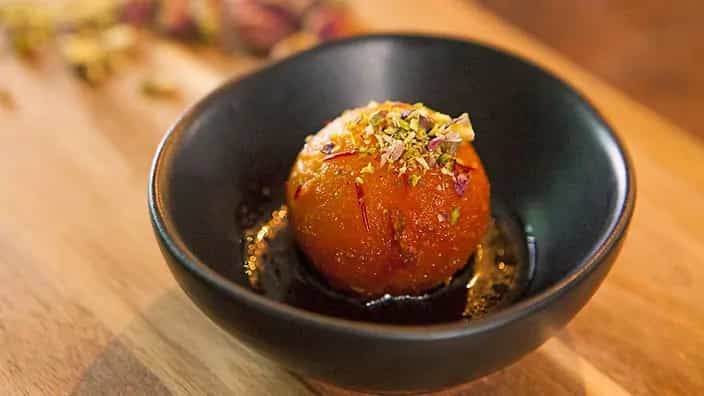
Gulab Jamun
Nutritional Value
2708
Calories
per serving
- Fat111 g
- Protein38 g
- Carbs388 g
- Fiber12 g
- Sodium0 g
- Others0 g
- Place of OriginPERSIAN
- CuisinePersian
- Common Ingredients
- CourseDessert
With flour, milk, and ghee, and various other ingredients to cook it including baking soda, pistachio, sugar, water and rosewater for the syrup, Gulab Jamun is a time honoured tradition at special events in several Indian households. It takes some meticulousness and practice to get right, but this fried dessert that melts in the mouth at the slightest pressure is a proud feather in the cap of several Indian cooks.
There are a few options that fit the predecessor tag. There’s the story that it was created by accident by Shah Jahan’s royal chef who was trying to create another dish. The Persian Bamieh and Turkish Tulumba can both be considered inspiration for the Gulab Jamun, being fried dough dipped in sugar syrup, but served cold. There’s also the Arabic Luqmat-al-Qadi, which are fried dough balls dipped in honey.
Michael Krondl’s book The Donut: History, Recipes, and Lore from Boston to Berlin talks about how the Persian invaders brought a “round fritter” that eventually became the Gulab Jamun. He adds: “The [Indian] recipe is more complex than in the Middle East, requiring a mixture of dried and fresh milk thickened with flour. But as in Iran, the mixture is fried and soaked in rosewater syrup.”
Whatever its origin, the Gulab Jamun soon became a favourite among Indians and different regions have adapted it to suit their tastes. There’s Kolkata’s Ledikeni which comes with a popular story. In the 1850s, confectioner Bhim Chandra Nag was asked to make a special dessert for Lady Canning who was coming to India. He created the dessert, which the Lady loved, and the locals soon started calling it Ledikeni, a mispronunciation of her name.
Fun fact: Along the Maigalganj-Shahjahanpur-Lucknow National Highway 24, there’s a half kilometre stretch called ‘Gulab Jamun Highway’ with over a 100 shops selling the famed dessert.
Nutritional Value
2708
Calories
per serving
- Fat111 g
- Protein38 g
- Carbs388 g
- Fiber12 g
- Sodium0 g
- Others0 g