


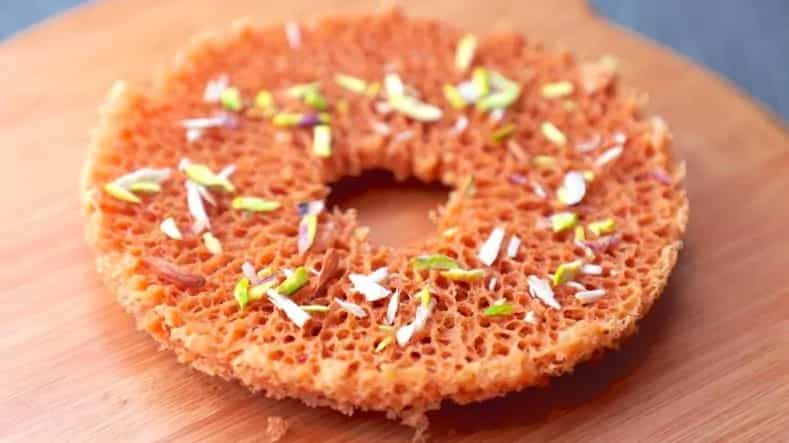
Ghevar
Nutritional Value
1070
Calories
per serving
- Fat48 g
- Protein10 g
- Carbs149 g
- Fiber5 g
- Sodium0 g
- Others0 g
- Place of OriginRAJASTHAN
- CuisineRajasthani
- Common Ingredients
- CourseDessert
Popularly also called the ‘honeycomb’ dessert, Ghevar is a Rajasthani dessert that is essentially made of wheat flour, saffron, sugar syrup, and dry fruits. Owing to its circular shape and the combination of sugar and pistachio in Ghevar, many believe that the sweet may have originated in Iran (also known for dousing their sweetmeats in a pool of sugar syrup, and then layering the treats with ground pistachios, almonds and cashews). This theory, however, is completely rubbished by any self-respecting sweet shop owner in Western India, who staunchly support the theory of its genesis being in Rajasthan.
Ghevar is traditionally a sweet meant for auspicious occasions in Rajasthani culture. The Marwar region (present day Jodhpur) of Rajasthan was supposed to have been home to the royal descendants meant to protect the legacy of this prized dish. Hence, you’d often find Marwaris serving the Ghevar during festivals like Teejh and Raksha Bandhan. In fact, newly engaged girls are presented with Ghevar as gifts, as it is believed to usher in nuptial bliss. The sweet is handed to the bride-to-be after various rituals, where the family’s elders anoint the sweet dish with their blessings.
A plethora of recipes for the original dish have now sprung up, like Paneer Ghevar (that uses cottage cheese), Kesariya Ghevar (using saffron) and Malai Ghevar (with an addition of thickened milk layer).
However, the dessert is not without its share of controversies. In the recent past, with awareness spikes among health conscious citizens, Ghevar came under the scanner for its oddly high calorie count. A rich, sinful dessert to its core, it was certainly not earning those brownie points for being a healthy mouthful. Despite the slight negative press, the dessert has had its share of loyalists who would prefer it over any other light version, not only in Rajasthan, but across the nation.
The sweetmeat, considered to be Jaipur’s pride, is also sold extensively in Lucknow. Its introduction into the largely Awadhi cuisine of the erstwhile princely state was owing to emperor Wajid Ali Shah, whose acute fondness for the dessert made it a permanent fixture in Lucknowi cuisine.
The dessert is typically made to celebrate the advent of Saawan (monsoons). It is said that after the Ghevvar is prepared, it is kept in room temperature so the sweet can absorb the moisture in the monsoon air, making it more porous and fluffy.
Nutritional Value
1070
Calories
per serving
- Fat48 g
- Protein10 g
- Carbs149 g
- Fiber5 g
- Sodium0 g
- Others0 g