


- Home
- Slurrp360
- Main Course
- Murgh Musallam
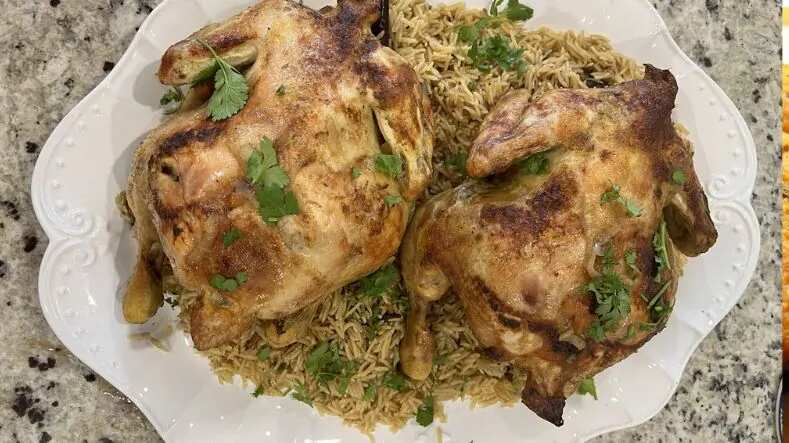
Murgh Musallam
Nutritional Value
6251
Calories
per serving
- Fat526 g
- Protein45 g
- Carbs350 g
- Fiber28 g
- Sodium0 g
- Others0 g
- Place of OriginDELHI
- CuisineAsian,Middle Eastern,Persian
- Common Ingredients
- CourseMain Course
Contemporary food historians and enthusiasts owe much to Ain-E-Akbari, the comprehensive final chapter to Akbarnama that lends us a glimpse into the lavish, fascinating Matbakhs or royal kitchens of the Mughal Empire under Akbar's reign. Penned by Abul Fazal, one of the nine revered courtiers or Navratans, the book features Murgh Mussalam among its 30 other dishes.
As per historical accounts, the Mughal emperor was an ardent food connoisseur and was served not less than a hundred food items every day over forty different courses. A dish that abounds in the sumptuous imperial meal was the gourmet preparation Murgh Mussalam, touted to lend the Dastarkhwan (tablecloth) an august presence.
As is evident from its name, Murgh Mussalam is a whole chicken with a stuffing of boiled egg. The preparation of the whole bird is indicative of Mughal eating traits like sharing meals from a single serving dish and gifting dishes to hosts as a sign of hospitality.
Ain-E-Akbari describes the process of preparing the chicken in detail—the bones are plucked out through the bird’s neck, keeping it whole. The chicken is then marinated with ginger, garlic and chillies and seasoned with a host of spices, including saffron, cardamom, black pepper, cloves and cinnamon.
This way of serving the whole chicken has striking parallels with the European roast fowl, accounts of which can be found in Tractatus, a 14th-century Latin manuscript. In her book Curry: A tale of Cooks and Conquerors, writer Lizzie Collingham unspools the intertwined history of these two dishes. She notes that the recipe for roast chicken featured similar ways of stuffing the chicken with a boiled egg and minced meat. Both recipes used cinnamon to season the meat, which could indicate that the influx of European techniques was a result of countless invasions of the subcontinent.
Collingham also suggests that since the spice trade through land routes was a time-consuming and financially draining enterprise, only the wealthy could afford to use such spices in their dishes. Hence, it could be said that both Murgh Mussalam and its European counterpart were specifically gourmet dishes.
Nutritional Value
6251
Calories
per serving
- Fat526 g
- Protein45 g
- Carbs350 g
- Fiber28 g
- Sodium0 g
- Others0 g