


- Home
- Slurrp360
- Main Course
- Kuzhambu
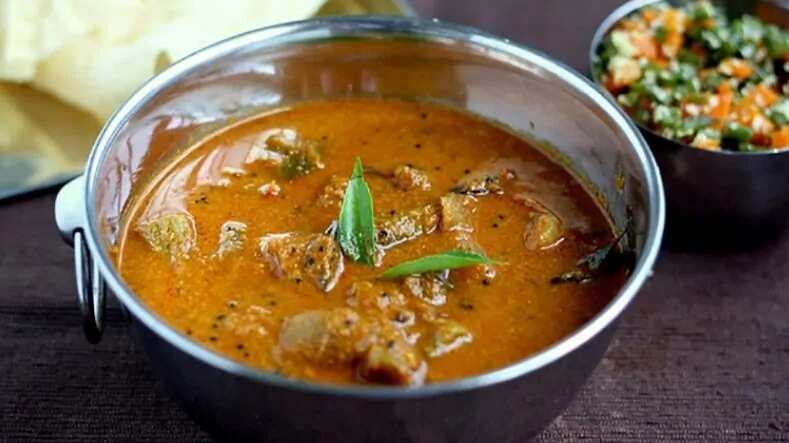
Kuzhambu
Nutritional Value
991
Calories
per serving
- Fat70 g
- Protein20 g
- Carbs71 g
- Fiber34 g
- Sodium0 g
- Others0 g
- Place of OriginTAMIL,NADU
- CuisineAsian,Indian,South Indian,Tamil
- Common Ingredients
- CourseMain Course
Kuzhambu, or Kuḻambu (as it is popularly known) is a sour broth of sorts. Traditionally a Tamil dish, this may be vegetarian or non-vegetarian, depending on its contents. Made with a generous amount of tamarind water, Kuzhambu is primarily cooked with a mix of spices like methi (fenugreek) and ground coriander seeds. The toor dal is a preferred choice of lentil, along with vegetables like okra, eggplant and plantains, which are diced and fried along with the spices. Chopped shallots and garlic are added to the mix as a first step, and diced tomatoes go in at the end. The dish can also be prepared with meat (mostly chicken), egg or fish.
The broth is a healthy mix of spices, lentils and proteins. Traditionally, toor and urad are used, along with curry leaves, salt and chopped chillies. More than 100 variants of Kuzhambu are recorded in Tamil cuisine. Of the main ones, Kara Kuḻambu (consisting tomatoes, onions and dried chillies), Vathal Kuḻambu (with shallots and turkey berries), Milagu Kuḻambu (with black peppers), Mor Kuḻambu (containing pumpkin, ash gourd, chana dal and a thick buttermilk mix), and Kathirikkai Kuḻambu (a variant that uses eggplants) top the list. The Vathal Kuḻambu is arguably most popular in Tamil Nadu, owing to the medicinal benefits of turkey berries that is known for its digestive properties and its ability to enhance bone health.
Similarly, when chicken is added, it is called Kozhi Kuḻambu, Muttai Kuḻambu when egg forms the main ingredient, and Meen Kuḻambu, when fish is the primary protein.
Many claim that the Kuzhambu is a distant cousin of the South Indian staple Sambar, a vegetable and lentil sour, watery blend that accompanies every plate of Dosa, Idli or Vada. One of the main differences between these two preparations is probably the fact that Kuzhambu depends heavily on the use of shallots and tamarind water, and is thus much more sour as compared to the more grounded Sambar.
Nutritional Value
991
Calories
per serving
- Fat70 g
- Protein20 g
- Carbs71 g
- Fiber34 g
- Sodium0 g
- Others0 g