


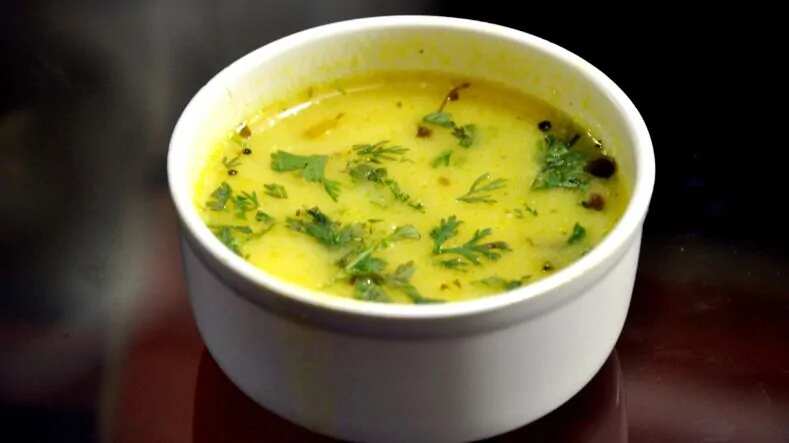
Kadhi
Nutritional Value
182
Calories
per serving
- Fat4 g
- Protein7 g
- Carbs29 g
- Fiber7 g
- Sodium0 g
- Others0 g
- Place of OriginPUNJAB,,GUJARAT,,MAHARASHTRA
- CuisineIndian,Maharashtrian,Rajasthani
- Common Ingredients
- CourseMain Course
This vegetarian delight has long been one of the most savoured dishes in the northern hemisphere of the Indian subcontinent. Places like Punjab, Gujarat, Rajasthan and even Maharashtra, have adopted the Kadhi and infused their local aesthetics to the dish. Kadhi, which is essentially a spicy chickpea and buttermilk fry, is generally made in North Indian homes.
A humble medley of homegrown, local wonders, Kadhi has multiple recipes. The Punjabis prepare with generous amounts of ghee and cream, making the gravy rich and dense. For the vegetarian balls that go into the curry, Punjabis use Pyaaz ke Pakode (onion fritters). Rajasthanis have a much lighter take on the dish; their yellow gravy is much paler and watery in consistency, and uses the chickpea batter fries instead of introducing onion to the mix. On the other hand, Gujaratis prepare it with a much sweeter undertone, almost bordering on a vegetarian dessert of sorts.
These myriad avatars of Kadhi are only fair, considering the dish’s ancient presence within Indian provinces. The roots of the dish go back multiple centuries to 1200 AD. In his book titled Indian Food: A Historical Companion, KT Achaya notes that the dish was made using milk, which then yielded thakra (buttermilk). It ultimately formed kshiraprakara (chhena, sweet milk-cheese), which was used to make Kadhi.
Another account links the dish’s origin to Rajasthan, where the concept of dairy-inclined, rich foods were prevalent, owing to the water scarcity around them. Heavy users of chickpea, the Rajasthanis are known to have a largely vegetarian cuisine that also consists of gravies and curries conjured from local resources. The use of digestives in the form of spices like asafoetida and fenugreek in Kadhi, may actually be to undercut the otherwise dairy-rich dish.
Yet another possible genesis of the dish is in its Ayurvedic roots. Kadhi, was supposedly a favoured dish, prescribed by followers of this ancient science in India. Owing to the dish's laxative and digestive ingredients, Kadhi was considered light on the stomach and also a metabolism accelerator. In Ayurveda, cooking of buttermilk (a crucial preparation in Kadhi), releases elements that pacify its vata-inducing properties.
Nutritional Value
182
Calories
per serving
- Fat4 g
- Protein7 g
- Carbs29 g
- Fiber7 g
- Sodium0 g
- Others0 g