


- Home
- Slurrp360
- Main course
- Chicken Jalfrezi
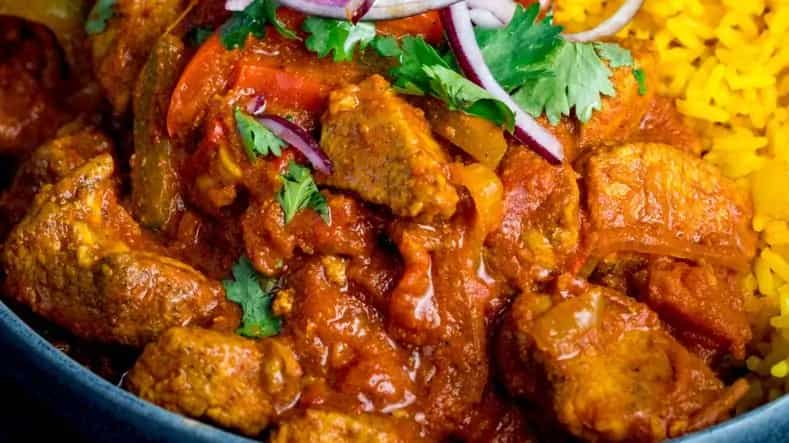
Chicken Jalfrezi
Nutritional Value
1125
Calories
per serving
- Fat74 g
- Protein98 g
- Carbs15 g
- Fiber16 g
- Sodium0 g
- Others0 g
- Place of OriginWEST,BENGAL
- CuisineAsian,Indian,Bengali
- Common Ingredients
- CourseMain Course
Chicken Jalfrezi is quickly becoming a forerunner to nab the best curry crown in the world. Interestingly though, this lip-smacking bowl of creamy, indulgent curry was born out of the need to finish off leftovers.
Food historian Lizzie Collingham writes in her book Curry: A Tale of Cookbooks and Conquerors that the birth of this dish can be traced back to the kitchens of high-ranking British officials stationed in Bengal during the 1850s. The British would host lavish dinners, which would inevitably lead to a large amount of leftover meat and fish. So that the food would not be wasted, they were distributed among the Indian cooks serving at the British mansions. At home, the “virtuous wife” was tasked to transform thrift—leftover meat—into a prestige dish by stir-frying it in heaps of chilli and onion to infuse the meat with intense, pungent flavours.
Born out of the humble Bengali kitchen, this dish derives its name from two Bengali words; Jhaal (spicy) and Porhezi (edible). An interesting thing to observe here is that the leftover food was considered to be impure in Hinduism, and the dish was most likely created by a Muslim cook. Not just poultry, but all kinds of meat, including beef and lamb, were used to make Jalfrezi.
Another fascinating aspect of Jalfrezi is its unique method of preparation. Traditionally, in Indian non-vegetarian dishes, the vegetables are cooked out first, and then the meat is added, to adjust for the difference in their cooking time. Stir-fry is a characteristically Chinese way of preparing food where vegetables, spices, meats, eggs or noodles are all fried and tossed together in high heat inside a wok. Unlike other meat preparations, Chicken Jalfrezi takes less than an hour to be made because of the high heat in which it is cooked.
Chinese immigrants moved to Bengal around the latter part of the 18th century, and settled in and around the port city then governed by the British. It is likely that this foreign technique of cooking was adopted by Bengali cooks around the same time.
Since the dish was invented sometime in the 1850s, its advent is credited to the then-Governor General of Bengal, Lord Marcus Sandys. Anglo-Indian cookbooks of the time heavily feature this Indian recipe, which is a testament to the dish’s popularity even in Britain. In fact, the dish was bestowed with the British Indian Curry Award as recently as 2015.
Nutritional Value
1125
Calories
per serving
- Fat74 g
- Protein98 g
- Carbs15 g
- Fiber16 g
- Sodium0 g
- Others0 g