


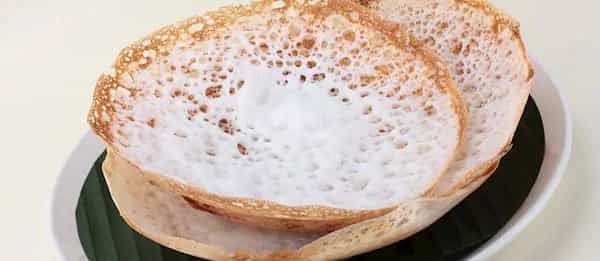
Appam
Nutritional Value
1784
Calories
per serving
- Fat9 g
- Protein43 g
- Carbs373 g
- Fiber17 g
- Sodium0 g
- Others0 g
- Place of OriginKARNATAKA,,TAMIL,NADU
- CuisineAsian
- Common Ingredients
- CourseStarter & Appetizer,Main Course
In her detailed account of the history of Indian food titled Whose Samosa Is It Anyway, writer Sonal Ved infers that some of the most commonplace household food items, like barley and milk, date back roughly to the Age of the Vedas. In fact, the rudimentary forms of Shrikhand and Malpua are even mentioned in Rig Vedas.
Appam, a savoury pancake made with rice flour and coconut milk, finds its origins in Apoopam, a dish made by frying the batter of barley flour water in ghee and then adding honey to it. The Aryan civilization has enough and more references to Apoopam in their religious texts. As per the Vedas, Apoopams were offered to deities during grand religious ceremonies and yajnas.
The popularity of Appam has, through the centuries, spread across the Indian subcontinent and reached other parts of the world, like Sri Lanka and Singapore. You can even find inscriptions about Appam offerings on the temple grounds of Tirupati that are estimated to date back to the 16th century. According to these records, Appams would be offered to the deities in nine instalments or padis during grand religious festivals.
This version of Appam was supposedly flavoured with the strong, pungent kick of ground pepper and cumin seeds. Research scholars mention that pepper and sugar were a commonly-found flavour combination in naivedyas or food offerings to Hindu deities.
In modern-day Udipi in Karnataka, the Krishna temple sees Appam being offered all year round. From July to December, you may even get to experience the special version of Appam, which has jackfruit added to it.
While the basis remains the same, this dish assumes a different form in Chettinad in Tamil Nadu, where it is known by the name of Kandarappam. Here, the dish is not made with barley or rice, but with a mixture of rice and urad dal along with jaggery. It is the denser, oilier and deep-fried sister of the pillowy white appams.
There are countless variants of Appam, be it Idiyappam, made from rice noodles and eaten with a side of chicken or rice, or Achappam, a type of cookie shaped like roses, made primarily with wheat or rice flour and coconut milk.
Apon, a common street food item in Myanmar, also finds its roots in Appam. In Indonesian streets, one can find stalls lined with Kue Apam, a form of traditional rice and coconut milk cake sweetened with palm sugar and coconut.
Nutritional Value
1784
Calories
per serving
- Fat9 g
- Protein43 g
- Carbs373 g
- Fiber17 g
- Sodium0 g
- Others0 g