


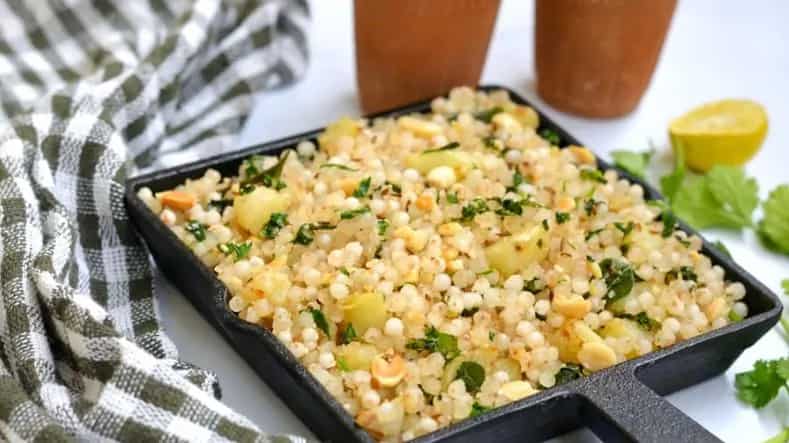
Sabudana Khichdi
Nutritional Value
842
Calories
per serving
- Fat16 g
- Protein12 g
- Carbs160 g
- Fiber12 g
- Sodium0 g
- Others0 g
- Place of OriginTAMIL,NADU
- CuisineAsian,Indian,South Indian,Tamil
- Common Ingredients
- CourseStarter & Appetizer
Milky white tapioca beads mixed with crunchy peanuts and specks of green chilli, Sabudana Khichdi is a humble, yet incredibly tasty meal typically prepared during the Hindu festivals of Navratri and Shivratri. A bowl of sweet curd plays the perfect carrier for this savoury snack.
A rich source of carbohydrates, Sabudana Khichdis are meant to keep you feeling full throughout the day when observing fasts. It is the quintessential comfort food that can be stirred up within minutes.
Indeed, the only preparation needed to make Sabudana Khichdi is to soak the tapioca beads overnight in a bowl of water so that they swell up and turn gelatinous. Once the pearls are soft, they are tossed in a pan with ghee, roasted cumin seeds and boiled potatoes for a few minutes before it’s ready to serve with a sprinkling of ground black pepper and a few sprigs of coriander leaves.
While Sabudana (sago) is almost inextricably linked to Indian cuisine—evident in its ubiquitous presence across the country, from Uttar Pradesh and Gujarat to Madhya Pradesh and Karnataka—it was only 80 years ago that the chewy white beads were introduced to the subcontinent. The first time sago was imported into the country from China was in 1943, in Tamil Nadu. It led to a few rudimentary factories being set up in the city of Salem.
Soon the popularity of tapioca pearls skyrocketed to be used in all forms of dishes, from Vada to Papad.
But legend has it that the first time the country tasted tapioca was back in the early 19th century when Travancore was hit by a famine. At the time, King Ayilyam Thirunal Rama Varma discovered that the high starch content of the tapioca root could be helpful in eliminating malnutrition. Thus, the king facilitated the production of tapioca in his kingdom, and so was born the dish Kappa. Similarly, during World War II, tapioca acted as a substitute for rice when the war disrupted trade and caused an acute shortage of rice.
Be that as it may, the high-calorie content of Sabudana Khichdi, with almost no other nutrients present in it other than carbohydrates, does have its share of naysayers.
Nutritional Value
842
Calories
per serving
- Fat16 g
- Protein12 g
- Carbs160 g
- Fiber12 g
- Sodium0 g
- Others0 g